Full Article
about Baides
Where the Henares and Salado meet; once a key rail junction
Hide article Read full article
A Village That Moves at Its Own Pace
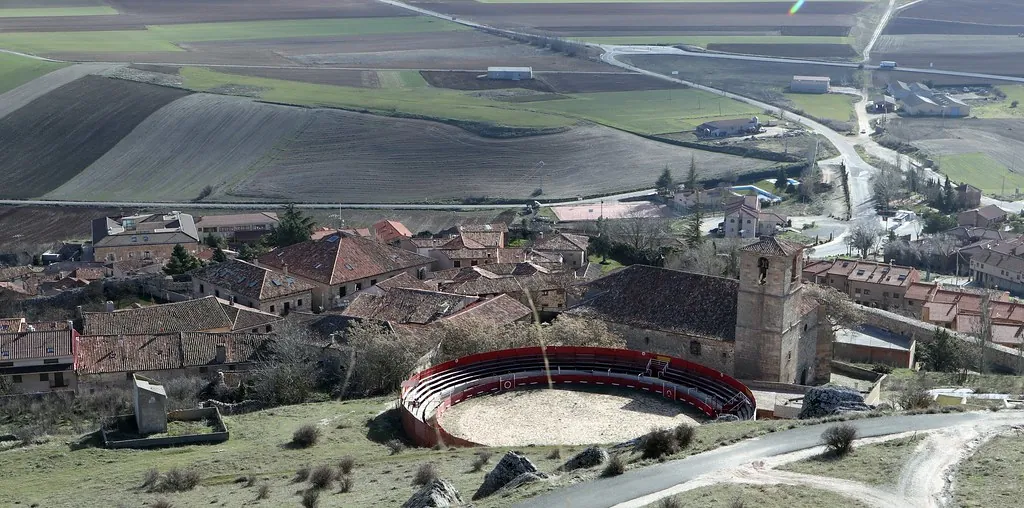
Early in the morning, Baides barely makes a sound. A door opens somewhere, a car briefly passes along the nearby road, and then the quiet settles back in. Stone houses keep their shadows pressed against the façades for much of the day. The main street, with its uneven stretches of ground, links wooden gates, masonry walls and the occasional courtyard where an old vine spills into view.
Tourism in Baides has little to do with ticking sights off a list. It is about stopping for a while and taking in what is around you. The village is small, very small, home to only a few dozen residents, and everything unfolds slowly. A conversation leans out of a window. A tractor hums in the distance. Dogs wander through the streets without urgency.
The cluster of houses gathers around the church of Santa María Magdalena. Built in stone and plain in style, it has a simple tower that can be seen from various points in the village. There are no grand architectural gestures. Instead, there is a sense of continuity, a building that has accompanied daily life here for generations.
Baides does not try to impress. Its appeal lies in its scale and in the way daily routines are still visible. The rhythm of the place remains steady through most of the year, shaped more by seasons than by visitors.
Walking Beyond the Last House
It takes only a few minutes to leave the village centre and reach dirt tracks that open out between fields and gentle hills. These are not marked hiking routes or long-distance trails. They are agricultural paths, still edged in places by dry-stone walls and scattered old animal pens.
From some of the nearby rises, the landscape of this part of Guadalajara comes into view. Patches of holm oak and scrubland sit alongside cultivated plots and meadows where sheep or cattle graze. The wind moves freely between the slopes. On clear days, the air carries the dry scent of thyme and sun-warmed earth, typical of inland Spain.
In autumn, when the first rains arrive, it is common to see people searching for mushrooms in the surrounding hills. Permits are usually arranged locally during the season, and it is sensible to check the current rules before heading out. Going with someone who knows the terrain also helps.
If you come to walk, it makes sense to do so without a fixed destination in mind. These paths are better understood as gentle strolls rather than routes with a clear end point. The interest lies in the changing light, the sound of the wind and the way the village gradually disappears behind a fold in the land.
Details in the Landscape
The surroundings are not dramatic in an obvious way, yet small details emerge if you pause for a moment. Partridges dart between bushes. A bird of prey glides overhead as the air begins to warm. On windy days, the dry crack of branches carries across the fields.
Spring brings wildflowers and small insects to the edges of the paths, adding colour to the otherwise muted tones of earth and scrub. In winter the landscape becomes barer. The silence feels heavier then, and the outlines of hills and stone walls stand out more clearly.
There is a simplicity to the setting that rewards attention. The terrain rolls rather than rises sharply. The vegetation alternates between cultivated and untamed. Nothing demands a photograph, yet much invites a second look.
When Baides Feels Livelier
For much of the year, Baides keeps to its calm routine. With such a small population, there are days when you might walk through the streets without passing anyone.
That changes in summer. In August, residents who live elsewhere often return, and the village regains some movement. Conversations stretch out into the evening. Activities are organised by the neighbours themselves. Celebrations linked to the church bring people together again around Santa María Magdalena.
Outside those weeks, visitors will mostly encounter quiet. It is worth bearing that in mind when planning a trip. Baides does not offer a packed calendar of events or a constant flow of activity. Its character is defined by stillness for much of the year.
Reaching Baides
Baides lies in the northern part of the province of Guadalajara, within Castilla La Mancha. It is reached via secondary roads after leaving the main routes behind. From the provincial capital, the drive takes a little over an hour, depending on the road chosen.
Public transport is limited, so travelling by car is the most practical option. The village is small enough to cross on foot in just a few minutes, and parking is usually straightforward near the entrances.
Services are also limited and not always open continuously. If you are planning to spend the day in the area, it is generally wise to bring water and something to eat, or to check in advance what might be available in nearby villages.
Baides is not a destination for grand monuments or major attractions. It is one of those places where the interest lies in the details: late light settling on rooftops, the smell of wood smoke in winter, the quiet that returns once a car has passed and everything falls back into place.