Full Article
about Bañuelos
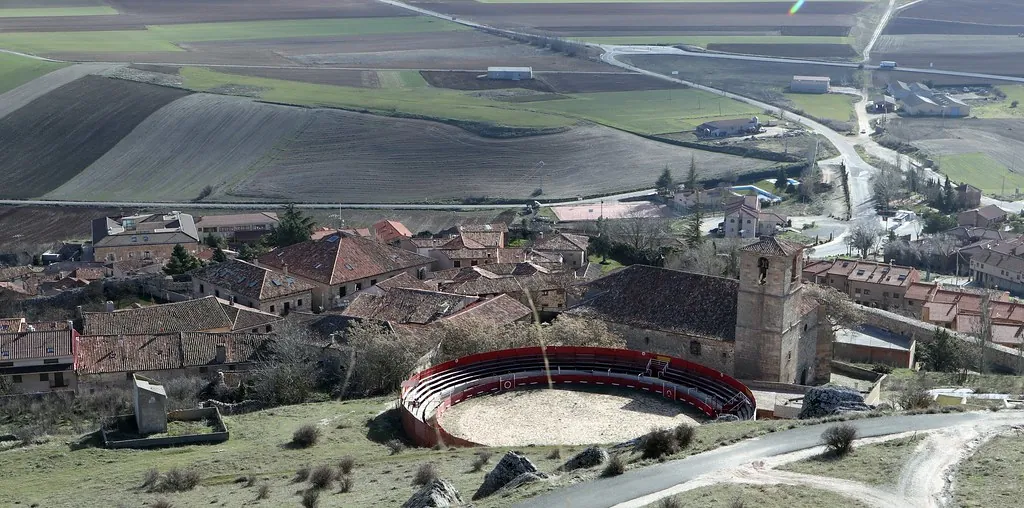
Mountain village with traditional architecture; surrounded by pastures and livestock.
Hide article Read full article
A village where sound carries
By mid-afternoon, the quiet in Bañuelos breaks in small ways: a blackbird shifting through branches, the dry crack of a pine cone hitting the ground, wind moving down from the pine forest. Light filters through the trunks and settles on stone walls in a pale grey, almost silvery tone. The air often smells of resin and damp earth, especially after a cloudy day.
Bañuelos sits at over a thousand metres above sea level, tucked into a remote corner of the Sierra del Ducado in the north of Guadalajara province. Only around a dozen people live here throughout the year. Streets are short and sloped, and the houses, built from limestone and wood, follow the shape of the land rather than trying to impose on it. Some still have dark beams and curved roof tiles where snow lingers for several days in winter. Others show cracks and recent repairs, signs that the village continues at its own slow pace.
The road in: forest and narrow bends
The approach already hints at what lies ahead. The road narrows between Scots pines and scattered oaks, with bends that force a slower speed. It makes sense to arrive without rushing and with enough fuel, as there are no services or shops in the village itself.
As the road climbs, the landscape closes in. On windy days, the sound of treetops brushing against each other becomes constant. By late afternoon, temperatures drop quickly, even in summer.
Stone streets and San Juan Bautista
The centre is small and can be walked in a matter of minutes. Streets connect courtyards, old animal enclosures and a few threshing floors where marks are still visible in the stone. In some stretches, grass has begun to push through the gaps.
The parish church, dedicated to San Juan Bautista, has a simple bell gable and thick walls. Inside, the space is plain, much like many churches in mountain villages. An inscription on the façade places its origin in the 16th century, although the building has seen later repairs. It remains the main point of gathering when something brings people together.
Paths into the surrounding hills
The real space of Bañuelos begins beyond the houses. Dirt tracks leave from the edge of the village and lead into the hills. Some climb towards rocky areas where wide views open across the surrounding valleys. Others run into pine woods, where the ground is covered with dry needles.
Signposting is not always clear, so a map or GPS helps if the plan is to go further afield. Even so, short walks are easy to manage by following the forestry tracks.
Wildlife leaves its traces here. Roe deer cross at dawn, wild boar tracks appear near clearings, and birds of prey circle above ravines when the air begins to warm.
Autumn colours and long quiet winters
Autumn brings a noticeable shift. Yellow and reddish tones appear between the trunks, and the ground fills with dry leaves that crunch underfoot. In wet years, mushrooms grow in the clearings among the pines, drawing people from nearby areas. Anyone collecting them needs to know what they are doing and respect the land, as checks are not unusual in the region during mushroom season.
Winter can leave the village very still for days at a time. When snow falls, sound becomes muted and the only constant is the wind moving through the trees.
Festivities that still gather people
Celebrations follow the traditional calendar of the village. San Juan Bautista, the patron saint, marks one of the key moments when people come together. Neighbours arrive from nearby places, and others return for a few days to where their families once lived.
Summer also brings simple gatherings among former residents and those who still keep a house here. There is not always a fixed programme. Sometimes it comes down to a shared meal, a mass, or a long conversation as night falls.
When to go and what to expect
Spring and autumn tend to be the most comfortable times for walking in the surrounding countryside. Summer is quiet, although the sun is strong in the middle of the day and some paths offer little shade. Winter brings serious cold, and roads in the area can start the day with ice.
It helps to bring water and some food, and to accept that Bañuelos has almost no tourist infrastructure. Very few places to stay remain open all year, and the village functions more as a small residential settlement than as a destination set up for visitors.
Anyone who arrives understands the appeal quickly. The interest lies in the quiet, in the nearby hills, and in the sense of being at a far edge of the map of Guadalajara. It is a place that has not changed much, largely because there has never been much urgency to change it.