Full Article
about Bustares
Mountain town at the foot of Alto Rey; golden and black architecture
Hide article Read full article
Arriving on Purpose
There are places you end up in by accident, passing through on the way somewhere else. Bustares works the other way round. If you get here, it is because you meant to. The road narrows as you go, the hills close in slightly, and when the cluster of houses finally appears, it feels as though everything is moving at a different pace.
Tourism in Bustares is tied to that feeling. You come knowing there is not much going on, and that is precisely the reason for the detour.
The village sits in the Sierra Norte of Guadalajara, at a fairly high altitude. For much of the year it has only a few dozen residents. In winter, chimney smoke is visible from a distance. Summer brings a bit more activity, but it remains a small place, the kind where two short streets are enough to get a sense of how everything works.
Slate, Slopes and the Centre of the Village
The first thing that stands out in Bustares is the so-called black architecture typical of this part of Spain. Houses are built with dark slate, with sloping roofs and chimneys designed to cope with the cold.
It is not a perfectly preserved set piece. Some buildings have been renovated using newer materials. Even so, the overall look still holds together. The impression is of a village that has changed gradually, without completely losing what was already there.
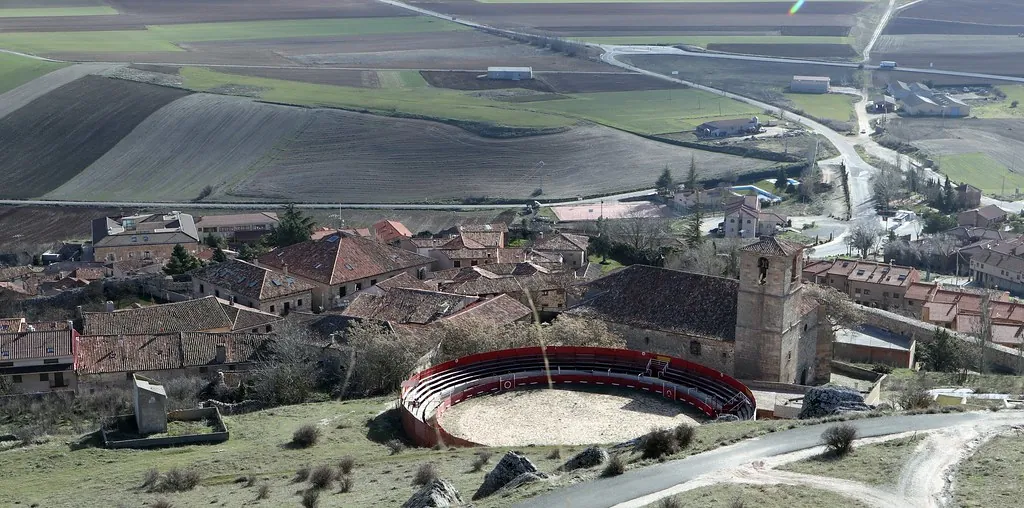
At the centre stands the church of San Lorenzo. It is not monumental, but it plays a familiar role found in many small Spanish villages. It gives you a clear point of reference and becomes the place where things happen when there is a celebration or a gathering.
Walking the Sierra de Pela
Beyond the houses, the landscape takes over. Around Bustares you find pine woods, oak groves and long-established paths, many of them neither signposted nor turned into formal walking routes.
For those who enjoy walking without too much guidance, there is plenty of ground to cover. Traditional paths that once linked vegetable plots, animal enclosures or livestock routes are still visible in places. Sometimes the trees open up to reveal views across the valleys. At other times the route slips into denser stretches where there is barely any sound at all.
The river Pelagallinas runs through the area. It is not a large river, but it shapes the landscape clearly. In spring it usually carries more water, fed by rain and melting snow. Nearby, scattered walnut trees appear, along with some maples that shift the colour of the valley noticeably in autumn.
When Winter Changes Everything
Snow alters Bustares completely. Roofs turn white, footprints mark the streets, and the silence deepens. It is the kind of place where checking the forecast matters before setting off, as mountain roads are not always in the best condition.
There is a particular appeal to seeing it like this. Walking slowly, hearing the crunch of snow underfoot, and not much else. There is no urgency, because, honestly, there is very little to tick off a list.
That lack of pressure is part of the point. Time stretches differently here, especially in colder months, when daily life settles into a quieter rhythm.
Festivities, Food and Village Life
In August, Bustares usually celebrates its patron saint festival in honour of San Lorenzo. It is the moment when many people with family ties to the village return. For a few days, the atmosphere shifts from calm to lively.
Shared meals, music in the square and religious processions form part of the typical scene. It feels less like tourism and more like a large reunion of people coming back to a familiar place.
Food follows the traditions of the surrounding sierra. Dishes tend to be hearty, with stews and lamb playing a central role, as this has long been common in the area. Honey is also produced nearby, and beehives can still be found scattered across the hills.
The Road In
The journey from the city of Guadalajara is roughly a hundred kilometres along regional roads. At first, the route crosses open countryside. Gradually, the terrain becomes more mountainous.
It is a drive best done without rushing. A steady pace, a few bends in the road, and the sense that each kilometre takes you a little further from everyday noise.
Bustares is not a destination for filling a weekend with plans. It is the sort of place you go to walk for a while, look out over the hills and sit quietly for a bit. By the time you leave, it becomes clear that this was exactly what you came for.