Full Article
about Cendejas de Enmedio
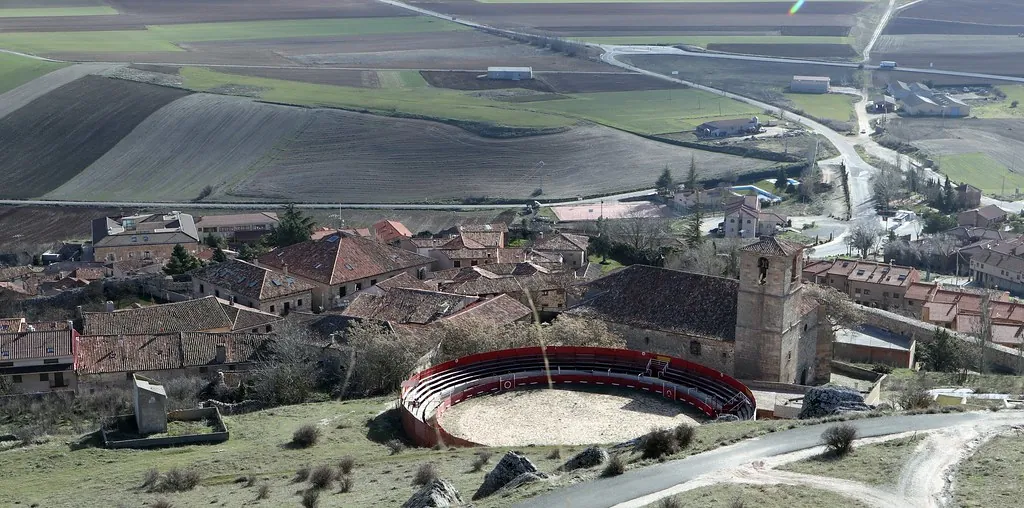
Part of the Salado River valley; simple rural architecture and a quiet setting.
Hide article Read full article
Between Three Villages in the Sierra Norte
Cendejas de Enmedio sits at the centre of a small triangle of villages in the Sierra Norte of Guadalajara, in Castilla La Mancha. Flanked by Cendejas de la Torre and Cendejas de Abajo, it shares with them the same landscape, the same network of paths and much of their history. Today, around 68 people live here.
The village remains compact. Its houses are built from masonry, with slate roofs typical of this part of the sierra. The overall impression is practical rather than decorative. Limestone, slate and wood come from the surrounding area, and their use reflects a long-standing tradition of building with what the land provides.
Cendejas de Enmedio owes its origins to the medieval organisation of territory around Atienza. After the Castilian frontier was consolidated in the 11th and 12th centuries, many settlements in this region were incorporated into the Comunidad de Villa y Tierra de Atienza. This system structured the shared use of pasture, woodland and farmland across a wide area. The three Cendejas formed part of that rural framework. For centuries they functioned as small farming and livestock villages, dependent on a larger administrative territory but maintaining their own local life.
Agriculture sustained the village for generations, and its imprint remains visible. Around the built-up core are cereal fields, patches of pasture and hillsides where holm oaks and junipers still grow. There is no attempt at ornament in the architecture. Every element answers a practical need.
San Pedro and the Shape of the Village
At the centre of the village stands the parish church of San Pedro. The present building appears to date from the early modern period, probably built or remodelled between the 16th and 17th centuries, as happened in many small settlements in the sierra. Later interventions can be seen in additions and repairs.
It is not a large church, yet it occupies the traditional position: slightly elevated, acting as a reference point from which the small network of streets unfolds. From here, the houses cluster closely together. Many retain wide gateways, once used for carts and livestock, along with former stables and enclosed yards.
In some walls, traditional solutions for storing or protecting grain and firewood are still visible. These details speak of a self-sufficient rural economy shaped by climate and terrain. The layout of the village does not follow a preconceived plan. It developed gradually, adapting to the gentle slope of the land.
Walking through the streets takes little time. The interest lies less in individual monuments and more in observing how the buildings relate to each other and to the ground beneath them.
An Open Landscape of Moorland and Streams
The surrounding landscape is one of mid-altitude hills, open plateaus and shallow valleys where seasonal streams flow after rain. From nearby rises, the village’s position within the wider comarca becomes clear. The three Cendejas appear as small clusters of stone set within a broad rural expanse.
There are no large, continuous forests. Instead, fields alternate with scrubland and scattered stands of juniper and holm oak. The agricultural character of the area is evident in the cereal plots that extend beyond the village edge.
These open spaces are well suited to birds of prey that ride the air currents. Griffon vultures are commonly seen in the Sierra Norte. On clear days, other species associated with cereal-growing landscapes and low scrub can also be observed, though the scene remains quiet and largely unchanged by modern development.
The sense of openness is one of the defining features of Cendejas de Enmedio. The terrain shifts gently rather than dramatically. As a result, the village is always in dialogue with its surroundings, neither hidden nor dominant.
Paths Linking the Three Cendejas
The routes connecting Cendejas de Enmedio with Cendejas de la Torre and Cendejas de Abajo largely follow old agricultural tracks. They were not conceived as signposted walking trails. Instead, they developed through everyday use over decades, serving those moving between villages or heading out to work their fields.
These tracks and paths make it easy to understand the historical relationship between the three settlements. Distances are short, and the terrain presents no great difficulty. The landscape changes little along the way, yet perspectives shift subtly. As one advances, the outline of each village and the arrangement of its fields come into view from new angles.
This close proximity reinforces the idea of a shared space. Although administratively separate, the three Cendejas form a small rural network shaped by common resources and longstanding ties.
Local Traditions and the Rural Calendar
As in many small villages in the Sierra Norte, community life in Cendejas de Enmedio concentrates around particular moments of the year. Patron saint festivities usually take place in August, when former residents who have moved away return, sometimes after decades, to spend time in the village.
In addition, some religious celebrations linked to the traditional calendar are still observed, though on a more modest scale than in the past. The reduced population inevitably affects the size of these gatherings. Even so, they continue to mark the rhythm of the year and maintain connections between those who remain and those who return periodically.
Practical Orientation
Cendejas de Enmedio lies in a little-travelled part of the province of Guadalajara, within the Sierra Norte. Access is via local roads, narrow in places. A slow approach suits both the route and the setting.
There are no shops or services in the village, so it is wise to arrive prepared. The built-up area can be covered quickly on foot. The real interest lies in observing how the village relates to its landscape: how stone houses, cereal fields and open hillsides form a single, coherent environment shaped over centuries.
Cendejas de Enmedio does not rely on major monuments or organised attractions. Its character emerges from continuity. Medieval systems of land management, early modern religious architecture and a farming economy have all left their mark, not as isolated features but as part of an everyday rural fabric. In this corner of Castilla La Mancha, the scale is small, the horizons wide, and the connection between settlement and land remains clear.