Full Article
about Cogolludo
Ducal town with Spain’s first Renaissance palace; rich in history.
Ocultar artículo Leer artículo completo
The Renaissance palace rises from the plateau like a Florentine banker’s villa that took a wrong turn leaving Tuscany. Its honey-coloured stone catches the high-altitude light differently from the surrounding ochre cottages, announcing Cogolludo’s former importance before you even reach the plaza. At 884 metres above sea level, the air is thinner, the nights cooler, and the silence more pronounced than in the baking lowlands of La Mancha an hour south.
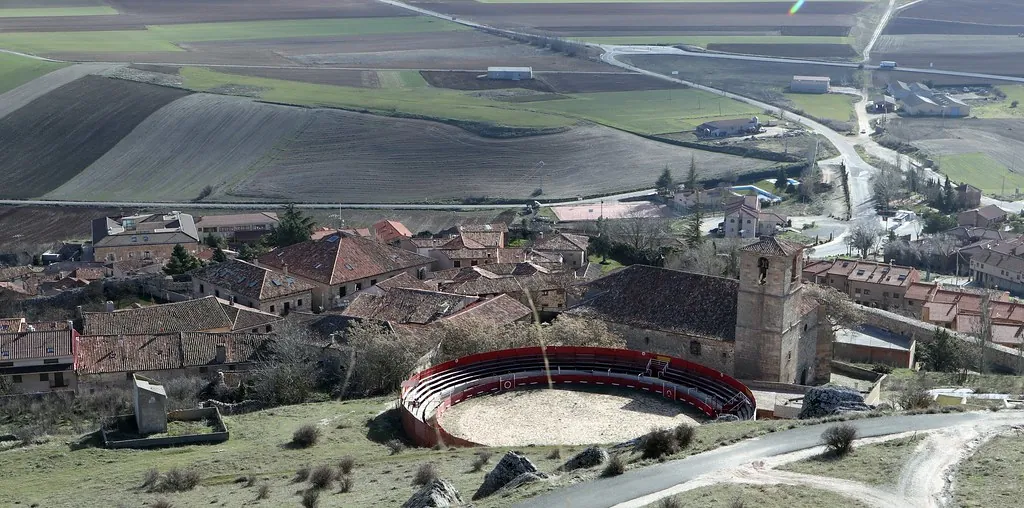
Five hundred souls live behind these medieval walls, enough to keep two bars busy and the Saturday market alive, few enough that strangers are clocked within minutes. The village spreads across a ridge; every street tilts either towards the river gorge or up to the fortress-like church, calves soon reminding visitors that this is proper mountain terrain. Come January, when the surrounding sierra whitens, the road from Guadalajara can ice over; summer brings 25-degree relief after the 40-degree furnace of the provincial capital.
Stone chronicles of the Medinaceli dukes
Start in the Plaza Mayor, a rectangle of packed earth and granite slabs presided over by the Palacio de los Duques de Medinaceli. Built in the 1460s by Lorenzo Vázquez de Segovia, the façade is textbook early-Renaissance: symmetrical rows of twin windows, medallions of Roman emperors, and the family’s coat of arms repeated like a branding exercise. The towers at each end still fly the ducal standard on feast days; the central balcony is where sentences were once read to the townsfolk. Inside, the town hall has colonised most rooms, so only the ground-floor arcade is reliably open, its ceiling carved with fat cherubs and Moorish strapwork.
Opposite, the sixteenth-century Rol de Justicia – a carved stone column – marks the spot where public punishments were carried out. The message is unsubtle: palace and pillory share the square, power and its enforcement within shouting distance. Tilt your head back to see the church tower poking above the roofs; the climb to Santa María takes three minutes via Calle de las Cuevas, a lane narrow enough to touch both walls.
The church is late-Gothic finished with plateresque garnish. Inside, the main retablo glitters with gilt pine cones and painted life-size saints; a thirteenth-century wooden Virgin surveys the nave from a side chapel. The tower can be climbed on request – ask the sacristan whose house backs onto the churchyard – but the key comes with a warning: 127 steps, no handrail, and a bell that still marks the quarters. From the top the view stretches across wheat fields and holm-oak dehesas to the saw-toothed Sierra de Pela, 40 km away.
Wander downhill and you’ll pass stone houses whose doorways still carry the owners’ initials and medieval masons’ marks. One lintel shows a sword and castle, another a boar and barrel, carved during the reign of the Catholic Monarchs. The occasional modern intrusion – a satellite dish, a lurid PVC window frame – only emphasises how little has changed since the village’s 1492 population charter.
Walking country for spring and autumn legs
Cogolludo sits on the southern lip of the Serranía de Guadalajara, a maze of limestone escarpments and oak valleys threaded by old mule paths. The terrain rewards walkers who don’t mind 300-metre climbs starting literally from the church door. A signpost beside the cemetery points to the PR-GU 122, a 12-km circuit that drops to the Arroyo de Valdehornos, passes a ruined water mill, then climbs back through rosemary and lavender scrub. Allow four hours and carry more water than you think; shade is scarce until the canyon narrows.
Harder-going hikers can link with the GR-113 long-distance trail that traverses the entire province. Heading north-east, it reaches the ghost village of Valdeprados – roofless houses, a church without a congregation – in two hours. The return can be made via the Cerro de San Cristóbal (1,320 m), where griffon vultures ride the thermals and the views take in four provinces.
Winter walking is feasible most years, though night frosts harden the paths and the odd snowfall shuts the higher tracks. Summer, despite the altitude, is best avoided after 11 a.m.; Iberian sun at 900 m still burns. April–June and September–mid-October offer 20-degree days and night-time coolness that justifies a jacket.
Calories and coffee
Bars open at seven for farmers and close when the last dice game ends. On the plaza, La Tahona does a fixed-price menu for €12: garlic soup, roast suckling lamb, house wine and coffee. Their migas – fried breadcrumbs studded with chorizo and grapes – arrive sizzling in the pan; order a half portion unless you’ve just walked the PR-GU. Around the corner, Café Bar Palacio pours decent cortados and displays sepia photos of the 1930s threshing crews, when 2,000 people still worked these fields.
Shopping is limited to basics. A tiny Ultramarinos sells tinned beans, tinned tuna, and not much else. The Saturday-morning market consists of two vans: one for fish, one for underwear. Serious provisions mean the 18-km drive to Marchamalo or a picnic assembled in Guadalajara before you leave the A2.
Getting there, staying over
From Madrid, the fastest route is the A2 to Guadalajara (55 min), then the CM-101 north. The final 28 km switchbacks through pine plantations; allow 45 minutes and expect oncoming timber lorries. Buses run twice daily except Sunday, timed for school and hospital runs rather than tourism – check Alsa’s site, then double-check the village noticeboard where drivers occasionally announce strikes.
Accommodation is thin on the ground. The only hotel, La Casa del Infanzón, has six rooms inside a sixteenth-century manor house; doubles cost €60–€70 with breakfast. Otherwise, weekend cottages advertise on Spanish letting sites; most sleep four and start at €90 per night. Wild camping is tolerated in the pine woods 3 km north, but fires are banned and the Guardia Civil patrol during dry months.
Quiet nights, honest assessment
After dark, Cogolludo folds in on itself. Streetlights dim at midnight, shutters clatter down, and the only sound is the church clock striking the half. For visitors seeking tapas trails and flamenco tablaos, this is the wrong postcode. The village suits history buffs happy to read facades instead of interpretation panels, or walkers whose ideal evening involves a bottle of local tempranillo and the Milky Way unobstructed by light pollution.
Crowds arrive in late June for the fiestas of San Pedro: temporary bars, brass bands, and a fairground squeezed into the football pitch. August repeats the dose with added bull-running through the narrow streets – thrilling for some, terrifying for others, impossible to sleep through. Outside those weeks you’ll share the plaza with the mayor’s dog and two old men arguing over cards.
Leave expecting modest scale rather than blockbuster spectacle and Cogolludo delivers: a slice of Castilian high country where stone remembers rank, and the night sky still feels medieval.