Full Article
about Condemios de Arriba
Rural tourism hub in the mountains; base for exploring the area
Hide article Read full article
A village at the edge of the Sierra Norte
Condemios de Arriba sits at the far north of the province of Guadalajara, in the Sierra Norte, at over 1,300 metres above sea level and close to the boundary with Castilla y León. Its position defines much of what the place is. This is open, demanding mountain country, historically tied to livestock grazing and a subsistence economy that shaped daily life for generations.
Today, just over a hundred people live here. The pace remains closely linked to the rural calendar, as well as to the seasonal return of families who maintain roots in the village. That rhythm becomes especially noticeable at certain times of year, when the population briefly grows and familiar patterns shift.
The surrounding landscape belongs to the high sierras of northern Guadalajara. Broad plateaus stretch out across the higher ground, while valleys drop away towards seasonal streams. Patches of juniper and pine appear along the slopes, breaking up the open terrain. It is a setting where exposure to the elements is constant, and the built environment reflects that reality with clarity.
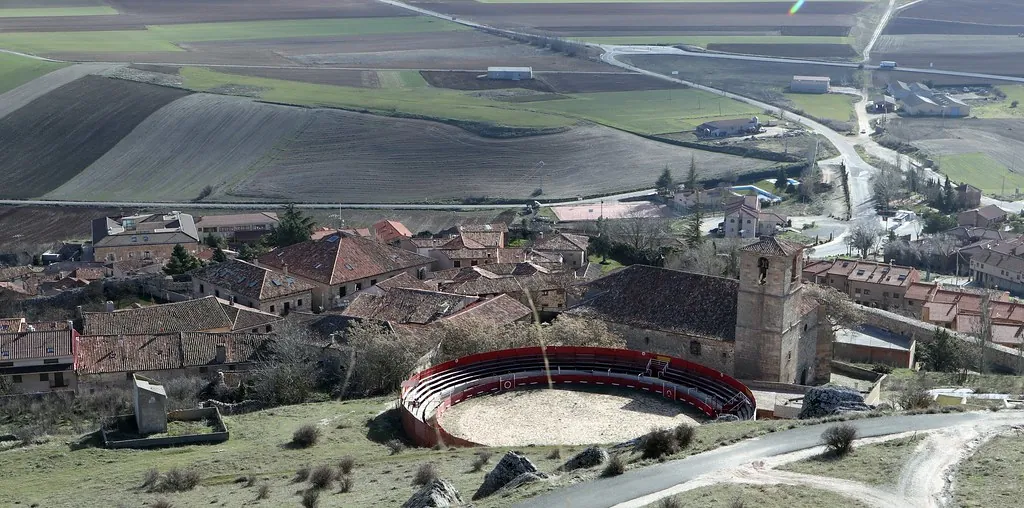
Traditional houses were constructed using local limestone, with thick walls and tiled roofs designed to withstand long winters. Many buildings still retain features linked to agricultural and pastoral work, such as corrals, haylofts and small auxiliary spaces once essential for managing livestock. The result is a village where architecture and landscape are tightly connected.
Walking through the village
The main interest of Condemios de Arriba lies in the overall ensemble rather than in a single landmark. A walk through its streets reveals the logic of mountain architecture in this part of Spain. Houses tend to be compact, with exposed stone walls and a practical layout shaped by both climate and work.
Alongside the main dwellings, smaller constructions speak of a way of life that depended on farming and livestock until relatively recently. These structures, modest in scale, help to explain how the village functioned as a self-sufficient community for much of its history.
At the centre stands the parish church, dedicated to San Vicente. Its appearance is sober, with solid walls and simple lines typical of rural churches in the Sierra Norte. Inside, a popular-style altarpiece has been preserved. It offers insight into how religious art reached villages like this one, often created with fewer resources than in urban centres but still carrying local meaning.
A short distance from the built-up area, the landscape opens quickly. The surrounding plateaus make it easier to understand the geography of this part of the Sierra Norte: high, wind-swept surfaces above, and lower down, valleys where pasture and scattered woodland begin to appear.
Paths and the wider landscape
The traditional paths that once connected Condemios de Arriba with neighbouring villages remain the most direct way to explore the area. These routes were used to move livestock between grazing areas or to maintain contact between settlements across the sierra.
As the ground rises towards the plateaus, the views widen across the surrounding mountains. The sense of space becomes more pronounced, with long sightlines over the high terrain. In contrast, descending into the valleys brings a different atmosphere. These areas are more sheltered, with meadows and streams that only carry water at certain times of year.
This is also a place where wildlife can still be observed with relative ease, provided there is patience. Vultures are often visible riding the air currents that form above the slopes. Other birds of prey native to these sierras may also appear, though less predictably.
Orientation requires some care. Not all paths are signposted, and the higher ground can become disorienting when the weather changes. A map or a pre-downloaded track is advisable for those planning to walk beyond the immediate surroundings of the village.
Traditions and everyday life
Local traditions continue to shape life in Condemios de Arriba, even with its small population. The patron saint festivities usually take place in summer, when many people with family ties to the village return from elsewhere. During these days, the population increases noticeably and the main square fills again with activity and familiar connections.
In winter, another long-standing practice continues, mainly within the domestic sphere: the matanza del cerdo, or pig slaughter. Rather than a public event, it is a family tradition that allows households to prepare cured meats and preserves for the months ahead. This process forms part of a broader body of knowledge passed down through generations in the villages of the Sierra Norte.
Such customs reflect a way of life closely tied to the seasons and to self-sufficiency. Even as circumstances change, these practices maintain a link with the past and help define the identity of the place.
Getting there and moving around
Condemios de Arriba lies a little over 90 kilometres from the city of Guadalajara. The final approach follows regional mountain roads that cross much of the Sierra Norte. These roads do not present particular difficulty for a standard car, although winter conditions such as ice or snow can complicate some sections.
The village itself can be covered in a short amount of time. What tends to matter more are the paths leading out into the surrounding hills and the opportunity to observe how the houses and agricultural spaces are arranged around the settlement. The relationship between built space and landscape is one of the defining features of Condemios de Arriba, and it becomes clearer the more time is spent moving between the two.