Full Article
about Galve de Sorbe
Dominated by the castle of the Zúñiga; high-mountain setting of pine forests
Ocultar artículo Leer artículo completo
At 1,364 metres above sea level, Galve de Sorbe sits high enough for your ears to pop on the final approach. The thermometer drops five degrees between the baking plain of Guadalajara and the village’s single traffic-calmed street, and the air carries the sharp scent of pine resin instead of diesel. Stone houses shoulder straight onto the tarmac; there’s no pavement, so you step straight from car door into someone’s porch. A tractor parked outside the bar has sheep droppings on the mudguard and a licence plate older than most British hatchbacks.
This is Spain’s Meseta tilted upwards: Castilla-La Mancha tipping into the Sierra Norte. The village headcount—ninety-six on the last census—fits comfortably into a double-decker bus, yet the surrounding municipality spreads across 62 square kilometres of forest and pasture. Weekenders from Madrid call it “el último balcón” before the land folds into the Alto Tajo. They come for cool nights in July, for mushrooms in October, and for the simple shock of finding mobile reception patchy on every UK network.
Stone, Slate and Snow Gates
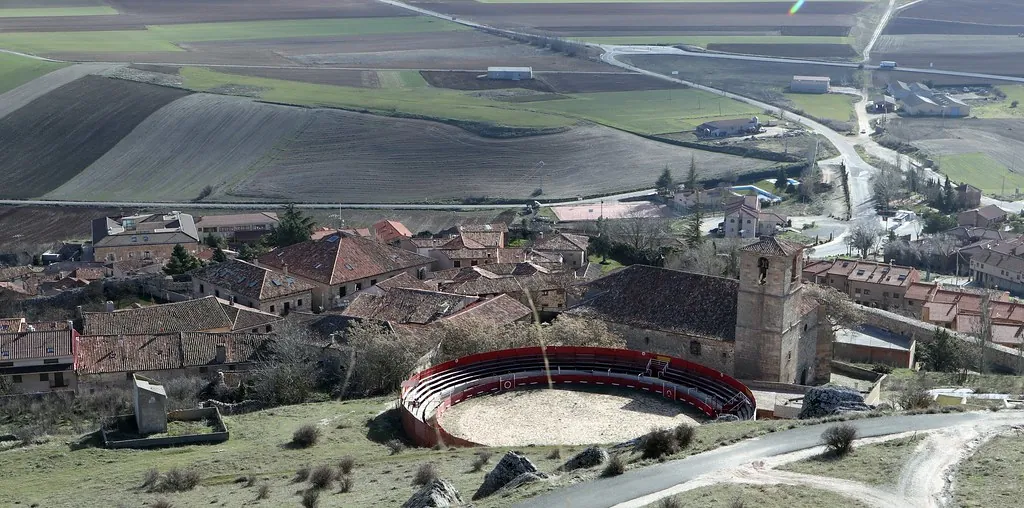
Local builders worked with what the hill gave them: grey limestone, splintery slate, and beams of Scots pine that creak all winter. Roof pitches are steep enough to shrug off the snow that still arrives most Januarys—sometimes enough to block the CM-101 for half a day. The older houses have wooden balconies the width of a single plant pot; modern second-homes have plate-glass terraces but keep the colour palette out of respect (or planning law). Look closely and you’ll spot stone lintels carved with the year—1894, 1907, 1931—each marking a wedding, an inheritance, or a boom in the wool trade.
The church of San Pedro Apóstol squats at the top of the only gradient steep enough to call a hill. It’s locked most days, but the key hangs behind the bar; ask and the owner will rinse a coffee cup, wipe her hands, and lead you across the plaza. Inside, the nave is the width of a London bus and twice as cold. A 16th-century font sits next to a radiator installed in 1982 and never turned on since. The bell tower doubles as a stork nursery; if you hear clattering, look up—huge nests overhang the parapet like avant-garde hairpieces.
Walking Tracks That Start at the Doorstep
Forget day-ticket coaches and audio guides. The only interpretation board is a hand-painted map in the square, faded to the colour of weak tea. From it, three footpaths fan out: one to the ruined snow wells, one to the Despanalagua waterfall, one to the abandoned hamlet of Arbeteta. All are way-marked in the Spanish fashion—occasional paint splash, occasional missing splash—so take the free leaflet from the hostal or download the GPX before you set off.
The waterfall walk is the crowd-pleaser, though crowds here mean two other couples and a dog. Twenty-five minutes of gentle descent through holm oak brings you to a limestone choke-stone where water drops eight metres into a pool the size of a badminton court. Kids can paddle; adults can sit on the flat rocks and remember what cold water feels like. After prolonged rain the path turns into a clay skid-pan—walking poles save British knees.
Fit walkers can stitch together a 12-km loop that climbs to the Puerto de la Hiruela (1,550 m) and returns along the cattle track used until the 1960s. The reward is a picnic spot overlooking the Sorbe gorge where griffon vultures circle at eye level. June to August you need to start early; by 11 a.m. the sun is high enough to fry English complexions at this altitude. In winter the same route is perfect on snow-shoes—rent them in Sigüenza for €15 a day—provided the road up was clear that morning.
What Passes for Nightlife
Evenings centre on the hostal bar, which opens at seven for the men who still tend sheep and closes when the last customer stops buying rounds. There’s no written menu: ask what’s cooking. If the answer is chuletón, say yes. A T-bone the weight of a small laptop arrives sizzling on a terracotta tile, flanked by hand-cut chips and a quarter lemon. The house red is young Valdepeñas served in a glass tumbler; at €2.50 it costs less than the bottled water you’ll find in a city hotel. Vegetarians get migas—fried breadcrumbs with garlic and grapes—filling enough to fuel tomorrow’s hike.
Saturday night might feature a domino tournament judged by the mayor (who also pours the gin). Visitors are welcome, though expect to partner with someone’s grandfather and to lose spectacularly. Music is whatever the owner’s grandson has loaded onto his phone; if you request Oasis he’ll play Wonderwall twice and expect a tip.
Practical Notes You’ll Wish You Knew Earlier
Cash: the nearest cash machine is 22 km away in Sigüenza. The hostal takes cards, but the bakery doesn’t, and neither does the lady who sells honey from her kitchen window. Fill your wallet before the final climb.
Shops: there isn’t a supermarket. The tiny ultramarinos opens 9–1, stocks UHT milk, tinned tuna and tinto de verano, then shuts for the day. Bring fresh milk, decent tea, and anything gluten-free if that matters.
Fuel: the village pump closed in 2003. The last petrol on the CM-101 is in Tortuera; after that the gauge stays empty until the descent to Somolinos. Diesel drivers can reach Madrid and back on a tank; petrol hatchbacks should top up obsessively.
Weather: at this height seasons mean something. May brings wildflowers and 22 °C days; nights still drop to 7 °C. October is mushroom month, idyllic until the first storm when roads wash out. Snow can fall any time between December and March; if the forecast says “nevada débil” take it seriously and carry blankets. British winter tyres are useless here—chains or 4×4 are the local currency.
The Honest Verdict
Galve de Sorbe will never tick the box for Moorish castles or Michelin stars. The mobile signal wobbles, the coffee is either perfect or burnt, and you will be woken by either church bells or a tractor. That, oddly, is the point. Come if you want to measure time by sunrise over pine ridges, to walk without meeting anyone who speaks your language, and to remember that Spain still has corners where the loudest noise at 10 p.m. is a dog barking at a shooting star. Don’t come if you need room service, taxis, or a choice of restaurants. Book the hostal, pack cash, and check the snow forecast—everything else sorts itself out once you’re up there breathing air the temperature of a proper British spring.