Full Article
about Gascueña de Bornova
Small village in the Bornova valley; quiet and nature
Hide article Read full article
A Village Apart in the Sierra Norte
Tourism in Gascueña de Bornova has little in common with the usual destinations of the Sierra Norte. This tiny settlement in the mountains of Guadalajara, sitting at just over 1,000 metres above sea level and home to barely twenty residents, belongs to that group of villages that never adapted to rural tourism. For that very reason, it has kept a way of life and a landscape that remain largely unchanged.
This is one of the most sparsely populated areas in the north of Guadalajara province, in Castilla La Mancha. The setting follows the logic of the paramera serrana, a high, open plateau typical of inland Spain. Expect wide ground, gentle rises and scattered patches of sabina albar, the Spanish juniper that thrives in dry, poor soils. It is not dramatic scenery in an obvious sense, but it is highly characteristic of this part of the province.
Wind shapes the atmosphere for much of the year. Even now, it is common to see flocks making use of seasonal pastures, a reminder that livestock farming has long been central here. The built fabric of the village reflects that traditional economy tied to herding and the land. Houses are mainly constructed in irregular masonry, sometimes reinforced with timber framing, and topped with simple pitched roofs. These are buildings designed to endure and to withstand harsh winters, rather than to attract attention.
The Village as a Whole
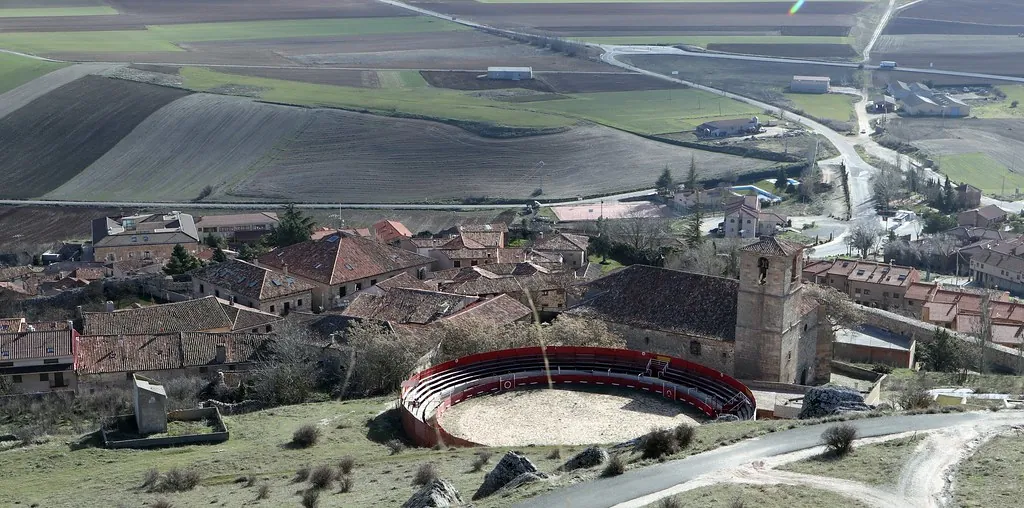
In Gascueña de Bornova, there are no headline monuments that draw attention on their own. What matters is the village as a whole. The streets follow a straightforward layout shaped by the topography and by the traditional organisation of pens, yards and work spaces. The arrangement speaks of a practical rural life, where domestic and agricultural functions were closely connected.
Some homes still preserve older features such as stone doorways, exposed beams and small internal courtyards. These elements offer a glimpse into how daily life was structured in mountain hamlets like this, where families and animals shared close quarters and seasonal rhythms governed the year.
At the centre of the settlement stands the parish church. The present building dates from the 16th century and was later altered, probably in the 18th. It is a sober stone structure, in keeping with the scale of the village. Its importance lies less in interior decoration and more in the role it has played as a gathering point. In places with so few inhabitants, the church has traditionally been the main space for meeting and marking key moments in community life.
Beyond the last houses, open fields begin almost immediately. The juniper stands on nearby slopes form part of one of the most representative ecosystems in the area. These are not dense forests but widely spaced trees adapted to a dry climate and nutrient-poor soils. Their presence defines the horizon and reinforces the sense of exposure that characterises the paramera.
Birdlife is part of that landscape. Raptors are often seen taking advantage of air currents, especially over slopes and small ravines. The griffon vulture appears with some regularity in this stretch of the sierra, particularly on clear days when thermals are strong.
Walking the Paramera
Gascueña functions above all as a gateway to its surroundings. From the edges of the village, agricultural tracks and footpaths lead out towards other small settlements in the comarca and across expanses of plateau where houses may not appear for kilometres.
There is no systematic network of waymarked routes, so anyone planning a longer walk should rely on a map or GPS. In return, the terrain allows for covering considerable distances with hardly any traffic or infrastructure to interrupt the experience. The openness of the land is one of its defining features.
For those interested in birdwatching, the wide spaces of the paramera provide favourable conditions. Birds of prey frequently use the thermals that form above slopes and gullies, circling high before gliding across the plateau. The absence of urban noise and development makes observation easier, though patience is part of the experience.
The village itself has no tourist services or shops. If supplies are needed or a place to eat is required, the usual solution is to head to larger towns elsewhere in the comarca. Gascueña de Bornova remains focused on everyday rural life rather than on visitors.
Traditions in a Small Community
As in many very small villages, much of the social activity in Gascueña centres on its fiestas. The patronal celebration normally takes place in summer, when those who maintain a family home in the village return, even if they live elsewhere for most of the year.
During these days, the number of people increases noticeably. Streets that are quiet for much of the year regain, at least temporarily, something of the atmosphere they once had when the population was higher. For a short period, the village’s social fabric becomes more visible, and shared spaces such as the church and surrounding streets take on renewed importance.
Getting There and When to Go
Reaching Gascueña de Bornova involves leaving the province’s main roads and continuing along local routes. The final stretch passes through open countryside and scattered hamlets, reinforcing the sense of distance from larger urban centres.
Given the absence of shops or other services in the village, it is wise to arrive with enough fuel in the car and to bring water or food if planning to spend several hours in the area. Facilities are not part of what this place offers.
Spring and autumn are generally the most pleasant times to explore the surrounding tracks. In winter, the climate can be severe, and fog or episodes of snow are not uncommon at this altitude. Summer brings very dry days, and the landscape takes on the pale tones typical of the paramera.
Gascueña de Bornova is not a destination built around attractions or amenities. Its interest lies in continuity: a high plain shaped by wind, livestock and sparse settlement, and a village that has changed little because it never needed to change. For those seeking to understand the quieter side of the Sierra Norte, it offers a clear, unembellished view of life on the plateau.