Full Article
about Huérmeces del Cerro
Set in the Salado river valley; noted for the Santuy gorge.
Hide article Read full article
A village that wakes slowly
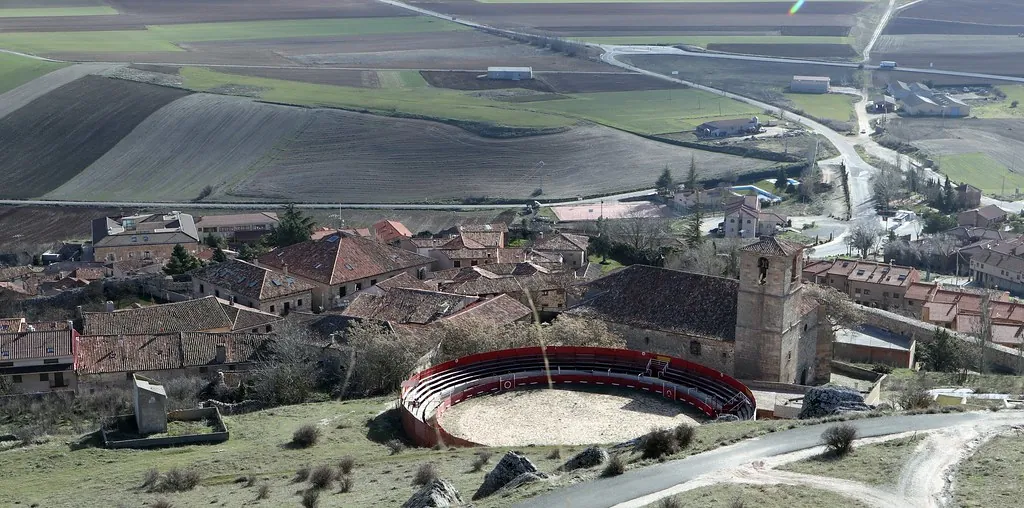
In midwinter, morning arrives late in Huérmeces del Cerro. Light settles first on the high plateau before it drops down to the stone façades, which still hold the night’s cold at that hour. Sound is scarce. A door opens somewhere, a dog barks in the distance, wind moves along the walls. With just over forty residents, the village runs at a pace that needs little explanation.
The surrounding landscape feels dry and open. Holm oaks stand apart across tough fields, patches of scrub spread over the slopes, and the horizon line seems to recede the further one walks. Wind is a constant presence. It cuts across the face in winter and lifts fine dust from the tracks in summer. Vegetation does not grow lush here; it clings low to the ground with the resilience of plants used to drought and altitude.
A compact village centre
Huérmeces del Cerro can be crossed in a matter of minutes. Masonry houses line the streets, with enclosed yards behind wooden gates. Some small kitchen gardens are still kept, while others have been left untended for years. Everything sits close together: the fountain, the small square, the parish church.
The church stands in a modest position, with thick walls and a look that leans more towards function than decoration. It often remains closed for much of the day, which is common in villages of this size, so the exterior tends to be the main point of interest.
Small details hint at daily life. Firewood is stacked neatly against walls. Tools rest beside doorways. At times, the metallic rattle of a trailer breaks the quiet as a tractor passes along the main street.
Tracks across the plateau
Several dirt paths leave directly from the village and stretch out between holm oaks and cereal fields. Some follow old mule tracks once used for transport; others are agricultural routes still in use. Not all are signposted, though it is easy enough to find the way with a downloaded track or a simple GPS.
The experience of walking here has an older feel to it. Long straight lines cut through the land. When the sun warms the ground, the scent of thyme rises. Birds of prey take advantage of the air currents above the valley. Kites are a common sight, and buzzards can often be seen circling in wide arcs.
Summer requires an early start. Shade is scarce, and the heat builds quickly towards midday. Winter brings the opposite challenge. Wind can be particularly harsh across the higher parts of the plateau, so warm clothing and something to cover the face make a clear difference.
Light through the seasons
The landscape shifts noticeably at sunrise and sunset. Low, horizontal light defines each holm oak against the ground and stretches shadows towards the edges of the fields. It becomes a good time to walk slowly or stop with a camera without needing to go far from the village.
Autumn brings changes if rainfall has been kind. The scrub takes on ochre and reddish tones across the slopes. It is also mushroom season in parts of the wider area, though gathering tends to be done quietly and with knowledge of the terrain.
Food and moments that gather people
The cooking that remains in the area follows a straightforward, substantial style, especially in colder months. Slow stews appear often, along with small game when the season allows, and potatoes that absorb thick broths well. These are dishes shaped by long days outdoors and winter conditions rather than presentation.
Village festivities usually take place in summer, when those who have family homes here return. For a few days, the streets become busier than usual. The usual quiet gives way to long conversations in doorways and small groups that linger late into the evening.
Huérmeces del Cerro does not try to draw attention. It is one of the villages in the Sierra Norte where what stands out most is what is absent: traffic, noise, urgency. What remains is wind, stone, horizon, and a rhythm that has changed little over the decades. A visit works best without rushing and without expecting much beyond that. At times, that is enough.