Full Article
about Jadraque
Town dominated by the Castillo del Cid; famous for its roast kid.
Hide article Read full article
A Hill That Explains Everything
Jadraque is a village in the Sierra Norte of Guadalajara, Castilla-La Mancha, that makes sense only when you see it from above. The castle occupies the entire summit of a solitary hill, a long, sober walled platform overlooking the valley of the River Henares. The village clusters tightly at its base. The geography is the history: this isolated height controlled a natural corridor. For centuries, holding this point allowed oversight of movement and trade through the valley.
What you see today are largely the late medieval reforms promoted by the Mendoza family. It is not a palace-fortress but a defensive enclosure. Its scale is its main feature, best understood by walking the perimeter of the walls. From there, the purpose is clear. You look out over land, not in at ornament.
The climb is steady. You can walk up from the village, following the slope that leads directly upwards, or drive to where the track widens near the entrance. Either way, the ascent is part of it. The view opens gradually: first the terracotta roofs below, then the patchwork of fields along the Henares, finally the first rises of the northern sierras framing the valley.
Streets on the Slope
Jadraque’s streets adapt to the incline, many seeming to orient themselves towards the hill. The layout suggests medieval origins, though the buildings tell several centuries’ story. Among simpler houses, you’ll find façades with large stone gateways and weathered coats of arms. These speak of a time when the village held more economic weight, of local hidalgos and families involved in regional administration or trade.
The architecture doesn’t form a single monumental set. It offers scattered clues. Most remain private homes, so your reading is limited to what the street reveals.
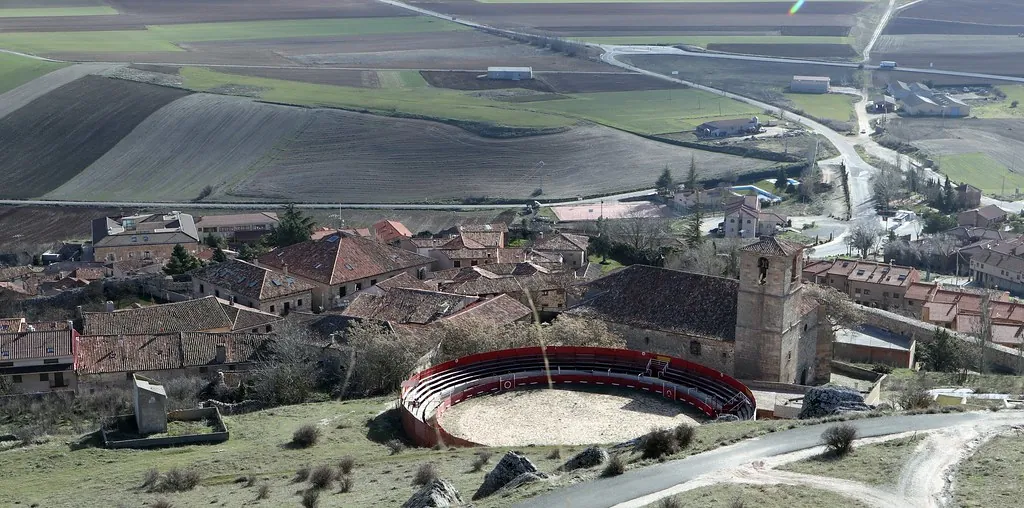
The church of San Juan Bautista stands at the centre. Its origins are Romanesque, but what you see is the result of later alterations. The tower, with a Renaissance air, defines Jadraque’s profile from the valley. Inside, altarpieces and pieces of sacred art reflect the continuity of religious life here.
A short walk from the main streets brings you to the hermitage of Santo Domingo. It’s a simple building, associated with local devotions that are still observed on certain dates. Its modesty fits the rural surroundings, part of the network of small religious sites common in this part of Castilla-La Mancha.
Between Campiña and Sierra
The landscape here is a transition. To one side lies the campiña of the Henares, a gently rolling agricultural plain. To the other, the first sierras of northern Guadalajara begin to rise.
Low scrub and scattered holm oaks cover many slopes. Cereal fields spread across flatter ground, especially closer to the river. From the castle, the contrast is straightforward: drier hillsides and, beside the Henares, greener vegas where cultivation has long taken advantage of better soil.
Paths leave from around the base of the hill, used now for walking. Some circle the castle; others head towards neighbouring villages. These are not mountain routes. They follow the agricultural landscape, linking fields, low woodland and open slopes.
The valley’s escarpments and open inclines often attract birds of prey. It’s common to see raptors riding thermals above the cuttings, adding a slow arc of movement to a scene shaped by farming.
Flavours of Inland Guadalajara
The cooking follows the traditions of inland Guadalajara. Lamb dishes are common, reflecting the livestock farming in the surrounding countryside. Migas, a preparation of fried breadcrumbs, appears regularly, as do stews suited to cooler months.
In autumn, given sufficient rainfall, mushrooms gathered from nearby hills find their way into kitchens. Their presence is seasonal and depends on the weather.
Beekeeping has left its mark. There is a tradition of colmenares, or apiaries, in the area, and honey from local pantries often comes from those same fields and scrublands visible from the castle walls.
Getting Your Bearings
You can walk Jadraque’s compact centre without hurry. The main sights are close together. The climb to the castle is best taken steadily due to the gradient.
To understand the place, start at the top. From the fortress walls, the layout of the village clarifies, along with the lines of the Henares valley and the old routes that defined its purpose. Looking down, the connection between geography and history is direct. The hill explains why the settlement is here and why it still turns its gaze upwards.