Full Article
about Jirueque
Small town near Jadraque; church with a gilded altarpiece
Hide article Read full article
A village that explains itself in minutes
Some places take time to figure out. Jirueque does not. You arrive, park, walk a couple of streets and quickly understand what kind of village this is. It is small, very small, set in the Sierra Norte of Guadalajara, a mountainous area in northern Castilla La Mancha where silence can feel heavier than any landmark.
With around 44 registered residents, Jirueque is not about ticking off sights. It is about getting a sense of what these settlements were like when the sierra was far more populated than it is today.
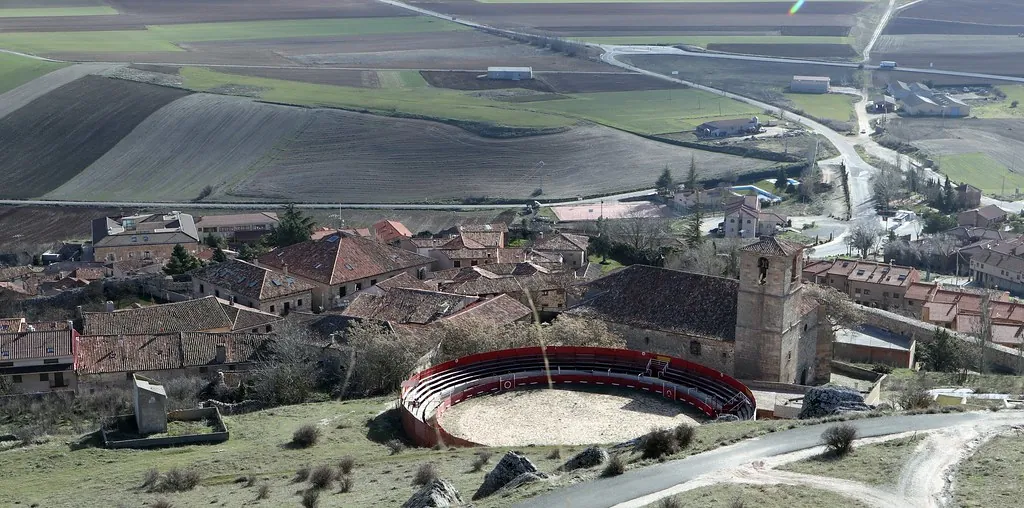
The village stands on rugged ground at just over 800 metres above sea level. Here, architecture is practical rather than decorative. Stone houses, slate roofs and narrow streets are built to endure long winters. Walking around, everything seems to have been constructed from whatever was at hand, in the way someone might repair something at home using what is already in the shed, except done properly and made to last for decades.
A snapshot of mountain architecture
The houses are the first thing you notice. Thick walls, steeply pitched roofs covered in dark slate, small windows. There are no grand façades or eye-catching renovations. Instead, there is a consistent look that matches what you see in other villages across the Sierra Norte.
At the centre stands the parish church of San Bartolomé. It is simple and without grand gestures, yet it shapes the rhythm of village life, as churches traditionally do in many rural parts of Spain. Nearby, a small square opens up, more an informal widening between houses than a formal plaza. When the weather is kind, this is where neighbours gather.
Jirueque can be walked end to end in about half an hour without effort. The short stroll gives you time to focus on details: worn wooden gates, stone animal pens, small auxiliary buildings that hint at busier days when daily life here was more intense and the population larger.
There is no sense of spectacle. What you see is what has always been here, shaped by climate, livestock and the practical needs of mountain living.
Paths that lead into the sierra
If there is one thing that makes sense in Jirueque, it is walking beyond the last house. The village is surrounded by scrubland, holm oaks and oaks that withstand harsh winters and dry summers. The landscape feels open and unmanicured.
Do not expect clearly signposted routes or visitor infrastructure. The paths are the old ones, agricultural tracks and footpaths that once linked fields and neighbouring villages. With a map or a digital track, it is easy to extend your walk into the surrounding countryside.
From slightly higher or clearer points, views open across the valleys of the sierra. These are not formal viewpoints with railings and panels, simply natural breaks in the terrain where the horizon stretches further than expected. Sometimes it is enough to pause for a moment and look.
It is also a place where birds of prey can still be seen circling overhead. For anyone who enjoys noticing small details in the landscape, walking slowly here has its rewards.
Come prepared
It is worth being direct about this: there are no bars or restaurants operating all year round in Jirueque. This is the kind of village where you arrive having already eaten or carrying something in your rucksack. If the plan is to spend the morning walking in the area, it makes practical sense to head afterwards to a larger town in the region.
The upside is an unusual level of quiet. There is no through traffic, no souvenir shops and no organised visitor groups. What you encounter instead is the everyday calm of a place that has never adapted itself to tourism.
That calm is part of the experience. Jirueque does not try to entertain or impress. It simply continues at its own pace.
Days when the village fills again
For much of the year, life moves slowly. In summer there is usually a little more activity, as people who have family homes here return for the warmer months.
The patron saint festivities of San Bartolomé, held in August, tend to bring more people together in the square for a few days. Like many village fiestas in Spain, they are rooted in religious tradition but function just as much as a social reunion for residents and relatives.
In winter, the tradition of San Antón is still observed, including the blessing of domestic animals. This custom is closely linked to the livestock-raising heritage of villages in the sierra, where animals were once central to survival.
These celebrations are small in scale, shaped by and for the local community rather than outside visitors.
Is Jirueque worth a stop?
That depends entirely on what you are looking for. If the expectation is a monumental village filled with standout sights, Jirueque will feel understated. There are no headline attractions or major landmarks to structure a day around.
If the interest lies in understanding how many settlements in the Sierra Norte were before the large rural exodus of the twentieth century, then Jirueque works almost like a still photograph. Its scale, its buildings and its quiet streets offer a clear impression of a way of life that has largely receded elsewhere.
It works best as a short stop while exploring the wider area. Park, take an unhurried walk through the streets, then follow one of the tracks out into the surrounding countryside. In a brief visit, it is possible to grasp how this corner of the sierra moves and breathes. In a village of this size, that is already quite a lot.