Full Article
about La Huerce
Mountain village on the Sorbe slope; green landscapes and water
Hide article Read full article
The road to La Huerce
Getting to La Huerce takes a bit of patience. From the city of Guadalajara it is just over two hours by car. The first stretch follows faster roads, but the final part climbs into the hills on increasingly narrow mountain routes. The last few kilometres bring tight bends and little margin for error. In winter, ice or snow can appear, so it is worth checking conditions before setting off.
The journey itself sets the tone. This is not a place you arrive at by chance. It sits at a distance from busy routes, and the effort to reach it is part of the experience.
Once there, the scale is immediately clear. The village is very small, with barely fifty residents and a compact centre that can be walked in ten minutes at an easy pace. There is no real issue with parking as traffic is minimal, though it tends to be simplest to leave the car at the entrance and continue on foot.
A village that has changed little
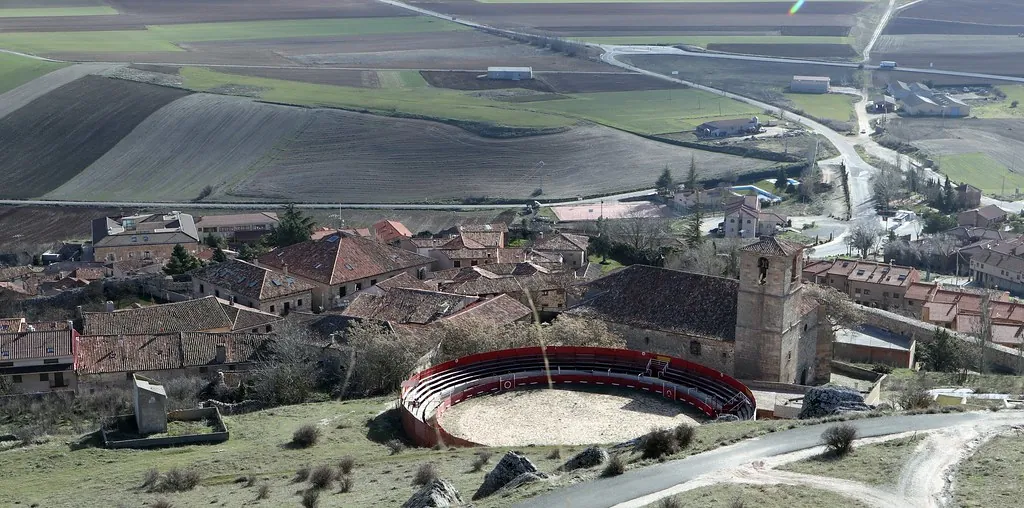
La Huerce stands at over 1,200 metres above sea level, in the Sierra Norte of Guadalajara. The setting shapes everything. Houses cluster closely together, built in stone with tiled roofs and the occasional wooden balcony. Nothing here aims to impress. There are no grand monuments or striking landmarks, just a straightforward mountain village that has remained largely as it was.
At the centre sits the church of Nuestra Señora de la Asunción. It is small and rather plain. Its role is more practical than touristic, a point of reference within the village rather than a destination in its own right.
Daily life moves quietly. Shops are not part of the scene, and there is no steady flow of visitors. What you notice instead is the absence of noise and the occasional conversation between neighbours in the street. The pace is slow without trying to be.
The landscape beyond the houses
The surroundings are where La Huerce becomes more interesting. The village is encircled by oak woodland, pine forest and open slopes typical of this part of the Sierra Norte. A short walk out of the centre leads to small passes and higher ground. On clear days, these spots offer views stretching towards the peaks of the Ocejón.
There are no formal viewpoints or information panels. The area does not present itself in a curated way. Good views come from walking the paths and stopping where the landscape opens up.
Wildlife is present but rarely visible. Roe deer and wild boar live in these hills, along with other life among the trees. What most people notice are signs rather than sightings: tracks, movement in the undergrowth, the sense that the forest is inhabited even if it remains out of view.
Walking routes and seasonal changes
Several paths leave the village, many of them traditional routes that have been used for years. Not all are marked, so it is sensible to carry a map or use a route app. The terrain itself is not especially difficult, yet the size of the surrounding sierra means it is easy to lose your bearings if you wander too far without preparation.
Autumn brings a noticeable shift in the landscape. The oak trees turn shades of yellow and red, and the hills take on a different character. This is also the time when people come to search for mushrooms. As in many rural areas, it is best to check local rules before collecting anything.
The appeal of walking here lies in its simplicity. Paths are not designed as attractions. They exist because people have used them, and they continue to offer a way to explore the terrain at your own pace.
Limited services, quiet nights
Services in La Huerce are limited. In villages of this size in the Sierra Norte, availability often depends on the day or the time of year. Anyone planning to eat or stay nearby should check in advance what is open.
This lack of infrastructure is part of what defines the place. It is not set up for convenience, and expectations need to match that reality.
At night, the sky becomes one of its strongest features. Light pollution is minimal, and there is little nearby to interfere with the view. On clear evenings, the stars stand out sharply. Temperatures drop quickly after sunset, even outside the winter months, so warmer clothing is often necessary.
Local celebrations
Festivities in La Huerce tend to take place in summer. At that time of year, people with family ties to the village return, and the population briefly grows. Celebrations are simple: processions, shared meals and a very local atmosphere. These are not large events aimed at visitors but gatherings rooted in the community itself.
What to expect
La Huerce is not a place for variety or constant activity. The village can be seen quickly, and there are no major sights competing for attention. The reason to come lies elsewhere.
It suits those who enjoy quiet mountain landscapes and unhurried walks. The surrounding hills, the absence of noise and the sense of distance from busier areas all define the experience. Anyone looking for more services or a livelier setting will likely find better options elsewhere in the region.
With modest expectations and time to explore on foot, the visit makes sense. Without that mindset, it may feel too limited.