Full Article
about Majaelrayo
One of the most beautiful villages of the Black Architecture; at the foot of Ocejón
Hide article Read full article
A mountain village shaped by slate
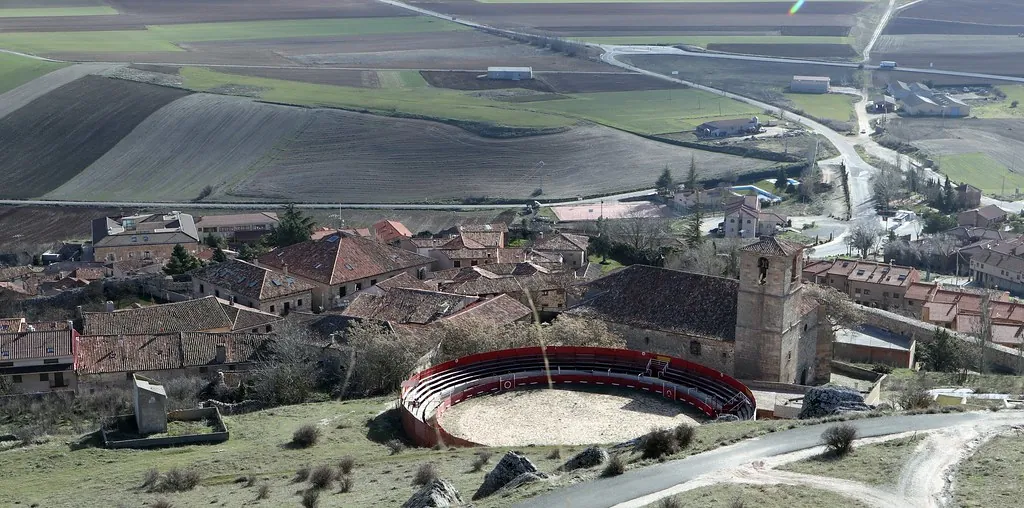
Majaelrayo sits on the northern slopes of the Sierra de Ayllón, in the most mountainous corner of Guadalajara province. It belongs to the group of settlements known as arquitectura negra, or black architecture, where slate defines both the landscape and the way people build. Here, it is not a stylistic choice. It is simply the stone underfoot, used out of necessity.
With around sixty registered residents and an altitude above 1,000 metres, daily life has always been tied to the terrain. Long winters, steep ground and historically difficult access have shaped how the village developed and how it still feels today. Even now, there is a sense that the surroundings set the pace rather than the other way round.
Streets built to endure
The layout of Majaelrayo remains close to its original mountain logic. Houses cluster along short, sloping streets, following the contours of the land rather than imposing order on it. Walls are built from dark masonry and roofs are layered with thick slabs of slate, creating a compact, weighty appearance. This is architecture designed to cope with snow, wind and persistent cold.
Some buildings still show traces of their former uses. Wooden balconies appear here and there, along with large entrance doors that hint at a time when homes doubled as spaces for livestock, firewood or tools. These were not purely domestic interiors but working structures tied to a rural economy.
At the centre of the village is a small square that gathers much of its social life. The church of Santa María stands here, likely dating back to around the 16th century, although it has been altered over time. It is a restrained building, in keeping with the rest of Majaelrayo, with a stone tower and very little decoration. Its importance lies less in architectural detail than in its role as a point of reference. For generations, it has anchored the settlement and served as a place where people come together.
Under the presence of the Ocejón
From several streets, the outline of the Ocejón peak is clearly visible. Rising above 2,000 metres, it dominates much of this stretch of the Sierra de Ayllón. Its presence goes beyond the visual. It influences the local climate, shapes how the surrounding land is used, and determines the routes that begin in the village.
The landscape around Majaelrayo shifts between open grazing meadows, oak woodland, and, further away, the beech forests of the Tejera Negra Natural Park. This gradual change can be seen along the paths that start directly from the village. Each stretch reveals a slightly different environment, without any sharp boundary between them.
Paths through the sierra
Majaelrayo has become one of the usual starting points for climbing the Ocejón. The route heads upwards across open slopes and stony sections before reaching the summit. It is not a technical climb, but it is long and involves a significant change in height. Proper footwear is important, and time should be planned with care, particularly in winter.
There are quieter options for those who prefer a less demanding walk. Paths circle the village, many of them running between dry stone walls, across pastureland and alongside small seasonal streams. The surroundings shift with the seasons. Spring brings meadows filled with flowers, while autumn turns the tones towards ochre and red.
Clear nights reveal another side of the area. Light pollution is very low, and when there is no moon, the sky becomes sharply defined. Stars are easy to see, stretching across a darkness that feels uninterrupted.
A landscape still tied to livestock
Although rural tourism has grown in recent years, livestock farming continues to shape everyday life. Cows and sheep are a common sight in nearby fields during the milder months. The presence of animals is part of the working landscape rather than a staged scene.
Anyone walking in the area is expected to respect fences, gates and traditional paths. These elements are part of how the land is organised and used, and they remain essential to those who live and work here.
Traditions that bring people back
The main local celebrations are the patronal festivities dedicated to Santa María, usually held in August. At that time, many people with ties to the village return for a few days. The atmosphere changes noticeably compared to the rest of the year. Streets that are often quiet fill with activity, and events are organised by the residents themselves.
A procession forms part of the celebrations, alongside other gatherings that revolve around shared participation rather than spectacle. The festival reflects the rhythm of a place where community ties remain strong, even among those who no longer live there permanently.
Before setting off
Majaelrayo is small and services are limited. It is sensible to take care of anything specific, such as fuel, larger purchases or administrative errands, in bigger towns elsewhere in the area before arriving.
Access is via mountain roads from Tamajón, which serves as the main gateway to this part of the Sierra Norte. The final stretch passes through increasingly enclosed scenery, with slate, oak trees and dark slopes setting the tone well before reaching the village itself. Once there, everything can be explored on foot in a short time. The streets are easy to follow, and the surrounding sierra naturally guides the pace of any visit.