Full Article
about Matillas
Industrial town thanks to its cement factory (now closed); distinctive landscape and the Henares river.
Hide article Read full article
A Small Village Between Plain and Hills
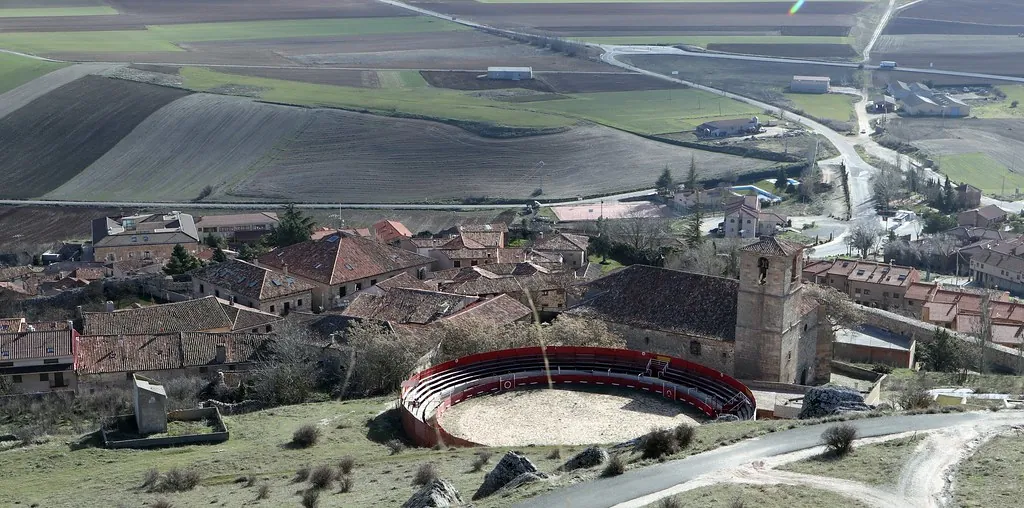
Matillas sits in the Sierra Norte of Guadalajara, in Castilla-La Mancha, and has just over a hundred inhabitants. At around 800 metres above sea level, it occupies a transitional strip of land between open cereal plains and the first gentle rises of the sierra. That position explains much of what you see on arrival: wide agricultural fields stretching outwards, broken here and there by patches of holm oak and juniper that interrupt the horizon.
The municipality still looks much as it has for generations, shaped by farming rather than by expansion or development. Wheat and barley dominate in summer, when the fields turn from green to ochre and the landscape takes on the dry tones typical of inland Spain. Between the plots are small areas of scrubland and a network of tracks. For centuries these paths have linked nearby villages and allowed livestock to move between grazing areas.
Night falls quietly in Matillas. With very little artificial light, the sky is clear on cloudless evenings, a common feature in many villages across this part of the province where daily activity winds down early and silence settles in quickly.
There are no grand monuments or headline attractions. The interest lies in the whole: a compact cluster of houses arranged around a central square and church, where the forms of rural architecture connected to agricultural life can still be recognised.
San Andrés and the Shape of the Village
At the centre of Matillas stands the parish church, dedicated to San Andrés. The present building appears largely to date from the early modern period, with later alterations, something frequently seen in rural churches across the province of Guadalajara. It is a sober structure, built with the materials traditionally used in the area.
Its tower rises above the surrounding rooftops and can be seen from the nearby fields. For generations it has served as a visual reference point for those working the land around the village, a fixed marker in an otherwise open landscape.
The houses follow the same constructive language found in other settlements of the Sierra Norte. Masonry walls, simple doorways, interior courtyards and wooden eaves define much of the built environment. Not everything has been preserved in the same way, but elements of traditional rural housing remain visible: broad chimneys, small animal pens and vegetable plots pressed up against the edge of the village.
Matillas is very compact. It can be walked in about half an hour at an unhurried pace, taking time to notice the details that often go unseen when simply driving through. The rhythm of the streets reflects a place designed for proximity, where the square and the church continue to structure daily life.
Tracks, Fields and Open Horizons
The surroundings of Matillas are better suited to a gentle stroll than to a demanding hike. Agricultural tracks and old paths connect it with neighbouring villages, crossing land that is generally even and without major gradients. The terrain invites slow exploration rather than physical challenge.
On clear days, birds of prey can often be seen circling above the open fields. This is typical of this part of the province, where cultivated land alternates with patches of low woodland. The combination creates a habitat that supports a range of wildlife, even if the landscape at first glance seems austere.
Autumn brings another change. With the first rains, certain areas around the village attract those who go out in search of wild mushrooms. In Castilla-La Mancha, mushroom picking is regulated in many woodland areas, so it is important to be aware of and respect the local rules that apply. The activity is seasonal and depends on rainfall, but it forms part of the rural calendar in many villages across the region.
Throughout the year, the landscape around Matillas retains its agricultural character. The colours shift with the seasons, from the greens of spring to the dry golds of summer and the muted tones that follow the harvest. The absence of major roads or industrial development reinforces the sense of continuity between the village and its fields.
Festive Days and a Quiet Routine
As in many small villages in inland Spain, the festive calendar marks the moments when Matillas briefly regains some of the population that lives elsewhere for much of the year. Patron saint festivities dedicated to San Andrés and the summer celebrations are the main occasions when the village sees more movement.
These are simple events, closely tied to residents and to families who return for a few days. The emphasis is on reunion rather than spectacle, on maintaining links with a place that many still consider home even if they now live in larger towns or cities.
For the rest of the year, life moves at a calm pace. The routine reflects the scale of a very small municipality, where daily activity is shaped by the agricultural environment and by a limited number of services. Matillas does not present itself as a destination packed with attractions. Instead, it offers a snapshot of rural life in the Sierra Norte of Guadalajara, with its particular balance of fields, scrubland and low hills.
Practical Notes for Visiting
Matillas lies around 50 kilometres from the city of Guadalajara. The usual access is via the N‑320 towards Cuenca, followed by regional roads that pass through several villages in the area.
Spring and autumn are generally the most pleasant seasons for exploring the comarca, the wider district to which Matillas belongs. Summer can be very hot in the middle of the day, while in winter frosts are not uncommon at this altitude. These are typical conditions for inland Castilla-La Mancha, where temperatures vary noticeably between seasons.
Within the village itself there are limited services, so it makes sense to plan a visit with the surrounding towns in mind. That practical consideration aside, Matillas rewards those who arrive without hurry: a place defined by its fields, its compact streets and the steady presence of San Andrés at its centre, set beneath a wide and often brilliantly clear sky.