Full Article
about Medranda
Small settlement in the Cañamares valley; riverside setting
Hide article Read full article
First Light in the Sierra Norte
Early in the morning, before the sun has properly climbed, the pale stone of Medranda’s church reflects a cool light into the narrow streets. Adobe walls hold the night’s damp, and the air carries the scent of turned earth and old firewood. There is little sound. A swift cuts quickly across the rooftops, a door creaks somewhere, wind moves through the holm oaks that ring the village.
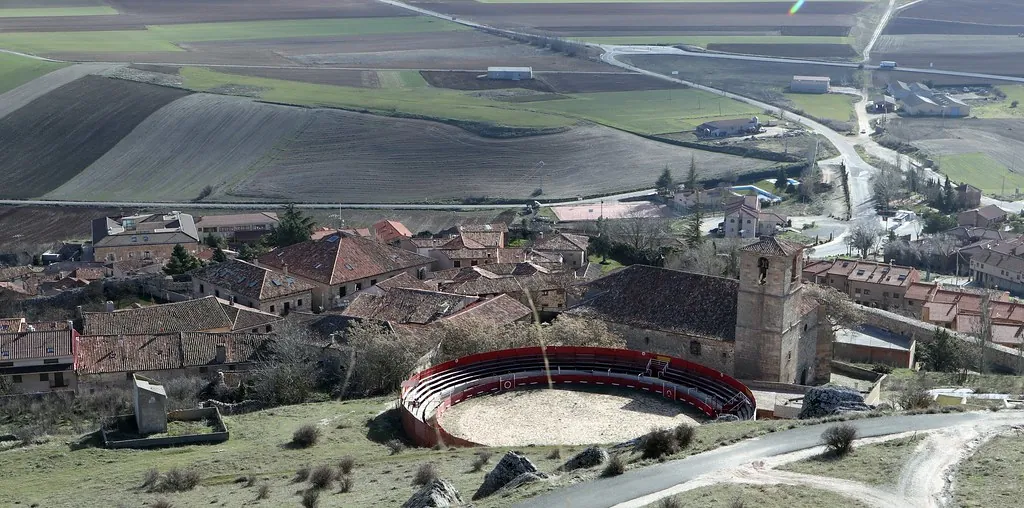
Medranda is one of the very small settlements scattered across the Sierra Norte de Guadalajara, in the north of Castilla La Mancha. According to the most recent municipal register, just over eighty people live here. The houses form a compact cluster that can be crossed in minutes. The village sits at around 800 metres above sea level, in a landscape of gentle hills where holm oak woodland alternates with scattered oaks and low scrub.
Getting here requires patience. Regional roads link small villages and open stretches of countryside, and a car is almost essential as public transport in this area is irregular. From Madrid, the journey usually takes around an hour and a half, depending on the route chosen.
A Small Settlement Between Care and Decline
Medranda’s layout is irregular, as is common in villages that developed gradually without formal planning. Stone and timber houses gather around the parish church, dedicated to the Natividad, the Nativity. Some homes are carefully maintained. Others stand with window frames empty of glass.
The church itself is simple. A square bell tower rises above thick walls, and inside there is a sober barrel vault. There are no elaborate decorations or striking altarpieces. Instead, the building feels shaped by what the local community could sustain at different moments in its history.
A slow walk reveals details that speak quietly of the past and present. A dry stone livestock pen partly collapsed. An old door, its wood bowed after many winters. A small fountain where a thin stream of water still runs when the rainy season has been generous. There are no explanatory panels, no marked viewpoints. The interest lies in observing what remains and what is still in use.
Paths Into the Hills
Several dirt tracks leave from the last houses and head out into the surrounding hills. They are not signposted as official walking routes. These are traditional paths, used for years by livestock farmers and neighbours moving between plots of land or towards nearby villages.
Anyone planning a longer walk should carry a map or GPS track. At some junctions there are no signs, and the paths can fade into pasture or oak woodland.
The vegetation is typical of this part of the Sierra Norte: holm oaks, scattered oaks and open meadows. In spring, small wildflowers cover the ground and insects provide a constant hum in the air. Autumn brings a more restrained landscape, with dry leaves gathering along the edges of the tracks and reddish patches of quejigo, a type of oak, on the slopes.
Griffon vultures are often visible high above once the day warms up, gliding on rising air currents. Goldfinches and other small birds can be heard near the edges of the village.
There are no visitor centres or marked nature trails. The experience here is informal and depends on personal judgement. The scale is intimate. The horizon is never far away.
Traces of Livestock Farming
Much of what surrounds Medranda is tied to extensive livestock farming, a system in which animals graze over large areas rather than being kept indoors. A short distance from the centre stand parideras, traditional lambing shelters, along with stone pens and small enclosures that for decades housed sheep or cattle.
Many of these structures remain upright through sheer solidity. Dry stone walls, low doorways and yards protected from the wind show a practical approach to building. Some are still used. Others stand as a kind of open-air record of how life was organised here not so long ago.
The village fountain, with its narrow spout and heavily worn stone basin, is another reminder of how essential water has always been in small rural communities like this one. In places where summers are dry and winters can be harsh, access to a steady water source shaped daily routines.
Medranda’s surroundings do not present dramatic landmarks. Instead, they offer continuity. Fields, walls and tracks connect past and present without drawing attention to themselves.
Eating, Sleeping and Choosing the Moment
There are no accommodation options or bars in Medranda that operate steadily throughout the year. Visitors who wish to eat or stay overnight usually head to nearby villages within the comarca.
Across the area, traditional dishes remain closely linked to the countryside. Roast lamb appears when ovens are fired up. In mushroom season, stews feature locally gathered varieties. Cured meats produced in the sierra are common. In colder months, some places prepare migas, a rustic dish based on fried breadcrumbs, or gachas, a thick, savoury preparation often made with flour. These are simple, filling foods shaped by the climate and by agricultural rhythms.
Spring and autumn are generally the most comfortable times to explore the paths around Medranda. In April and May, the countryside is green and the ground still holds moisture from recent rains. In autumn, the light drops lower and the hills take on ochre tones.
Winter makes its presence felt here. Frosts are frequent, and occasional snowfall can complicate access along secondary roads. Checking the weather forecast before setting out is advisable during the colder months.
Medranda can be crossed in less than an hour if walking without pause. The point, though, is not to count monuments or tick off sights. Attention shifts to smaller things: the silence between gusts of wind, houses still inhabited alongside others that are no longer lived in, the sense that the village continues at its own pace, largely detached from whatever unfolds beyond the hills that enclose it.