Full Article
about Monasterio
Small village with a Romanesque church; surrounded by oak groves
Hide article Read full article
A Handful of Houses at 900 Metres
Monasterio is a very small hamlet in the Sierra Norte of Castilla‑La Mancha, on the slopes of the Sierra de Pela at around 900 metres above sea level. Today it has little more than a dozen residents. Its cluster of houses, built in stone with low roofs and a few outbuildings, sits among woodland and open pasture.
Depopulation here is not an abstract idea. A short walk along the main street is enough to see houses closed up for much of the year. Some are lived in permanently, others come back to life at weekends or during the summer when families return.
The name Monasterio is usually linked to former religious settlements in the area. It is not entirely clear which community might have been established here, yet in this part of the sierra there were small hermitages and retreat houses from the Middle Ages onwards. The place name has remained as a trace of that past. Daily life, however, looks very different today.
There are no monuments to draw crowds and no organised activities to fill an itinerary. What defines Monasterio is the quiet of a minimal settlement surrounded by hills, in a landscape that has changed very little over generations.
The Church and the Tiny Settlement
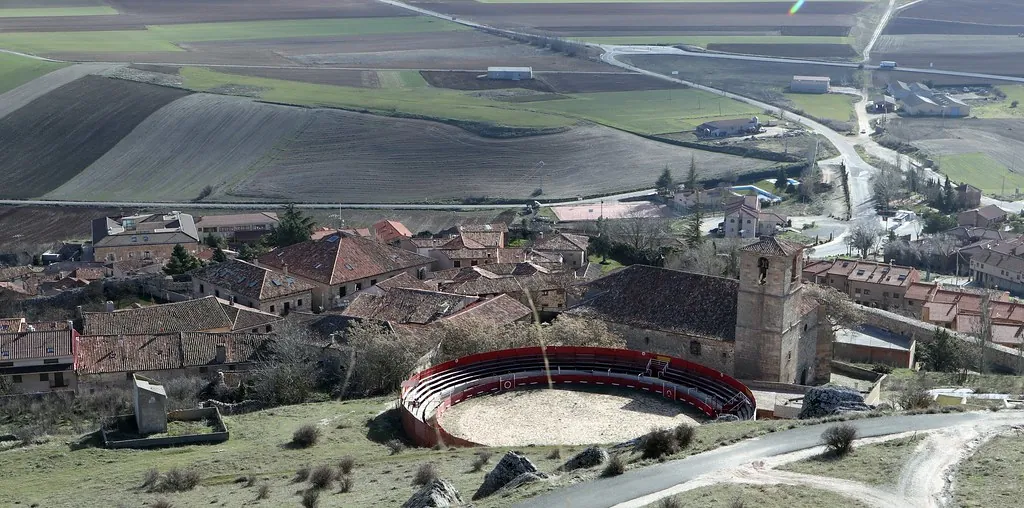
The village can be crossed in a matter of minutes. Houses are grouped around a small square where the parish church stands, dedicated to the Asunción, the Assumption of the Virgin.
The building is simple, constructed in stone and with little ornamentation. A square bell tower rises above the rest of the houses. There is no sign of major extensions, reinforcing the sense that the community was never large. The church’s interest lies less in its architecture than in its role as a meeting point. In places of this size, the square and the church porch function almost as an extension of the street, a shared space where everyday life gathers.
Around the edges of the settlement there are still livestock pens, dry stone walls and former vegetable plots that are now barely used. They are modest details, yet they help explain how rural life was organised in this part of the Sierra Norte. The layout speaks of self‑sufficiency, small herds and seasonal work tied to the land.
Nothing here feels staged. The scale is intimate, the buildings low and practical. Even the bell tower, the most visible element, seems proportionate to the handful of roofs beneath it.
Tracks into the Hills
From the last houses, several dirt tracks lead straight into the surrounding hills. Many follow old livestock routes, later adapted as forestry tracks. The terrain alternates between oak woods, areas of quejigo, a type of oak native to the Iberian Peninsula, and more open pasture.
Signage is limited, so it makes sense to carry a map or use a mobile phone for orientation if planning a longer walk. The slopes are not extreme, although some stretches have loose stones underfoot.
From the low ridges around the village there is a clear sense of the wider territory. Broad valleys open out between patches of woodland and former fields that are now rarely cultivated. It is a landscape that shifts noticeably with the seasons. In winter, the sierra can be covered in frost or snow. In summer, dry tones dominate the pastures and the air feels still.
Walking slowly, it is not unusual to spot roe deer or the traces left by wild boar. Birds of prey circle overhead, particularly in the middle of the day when they ride the rising air currents. The silence can be deep, broken only by wind in the trees or the distant sound of livestock.
There are no marked viewpoints or designated routes highlighted on signposts. The appeal lies in moving through a landscape that remains largely unaltered, where paths serve practical purposes rather than recreational ones.
Everyday Life and Seasonal Traditions
Monasterio has no bars, shops or other services. For basic needs, residents and visitors must travel to larger towns in the surrounding area. The hamlet functions as a place to live quietly rather than as a centre of activity.
The cooking associated with this part of the sierra continues in nearby villages. Typical dishes include cordero, lamb, cabrito, roast kid goat, hearty spoon dishes and migas, a traditional preparation of fried breadcrumbs often enriched with meat or vegetables. These are rural recipes, rooted in pastoral life and designed to sustain long days outdoors.
In autumn, mushroom foraging is common in the surrounding hills. As elsewhere in Spain, it is important to know the species well and to respect any local regulations that may apply in each area.
Celebrations in Monasterio are understated. More people gather in summer, when relatives and homeowners return. At that time the festival linked to the patron saint or the parish is held, usually centred on a mass and a simple event organised by the neighbours themselves. The scale matches the place: informal, communal and without elaborate staging.
Throughout the year, daily life follows a slow rhythm. The small number of permanent residents maintain houses and plots, look after animals and keep an eye on properties that remain closed for much of the time. The contrast between winter quiet and summer returns is part of the village’s cycle.
Getting There and What to Expect
The final approach to Monasterio is along narrow local roads typical of this part of the sierra, with bends and very little traffic. It is sensible to arrive prepared, as there are no services in the village itself.
A visit is brief. Monasterio works better as a starting point for walks in the surrounding hills, or as a quiet stop to understand how many of the smallest settlements in the Sierra Norte are, and how they have ended up after decades of rural depopulation.
There is little in the way of sights to tick off. The interest lies in the landscape and in the scale of the place. Stone houses, a small square, a simple church dedicated to the Asunción, tracks that disappear into oak woodland. Monasterio offers a clear sense of what rural Castilla‑La Mancha can look like when population thins and the mountains reclaim their silence.