Full Article
about Negredo
Small village with a Romanesque chapel; perfect for a retreat
Hide article Read full article
A place you don’t visit, you experience
Some places are not about ticking off sights, but about noticing what isn’t there. Negredo, a tiny village in the Sierra Norte of Guadalajara, works like that. You arrive, sit for a moment, and realise you can’t hear traffic. That absence carries more weight than any landmark.
Around a dozen people live here today. It is small enough that nothing seems to be happening, and that is exactly the point. The appeal of tourism in Negredo lies in slowing down and accepting that rhythm, rather than looking for activity.
At first, the reaction is often the same: nothing to see here. Give it a little time and that thought shifts. The quiet becomes the reason to stay, even if only briefly.
The road in
Getting to Negredo is part of the experience. The road narrows gradually, almost without you noticing. It starts to feel less like a standard road and more like a rural track. Fields stretch out, patches of pine forest appear, and then suddenly there are a handful of houses.
This part of the Sierra Norte changes quickly. One moment it is open plateau, the next it drops into ravines or low scrubland. The landscape does not settle into a single form.
The climate follows that same pattern of contrast. Winters are cold, with snow not unusual. In summer, there is a steady breeze that becomes noticeable as the sun goes down, the kind that makes a jumper feel necessary even after a warm day.
Negredo is not somewhere you stumble across. It requires intention. You choose to come here.
Walking through Negredo
You can walk the whole village in about half an hour at an unhurried pace, especially if you stop to look closely.
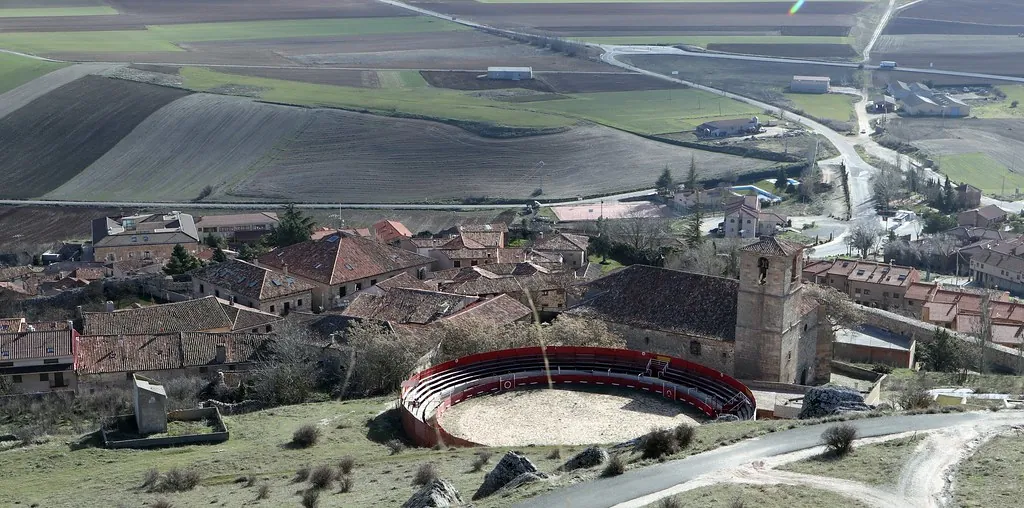
The houses are built from stone, with thick walls and tiled roofs. There is nothing decorative about them. Everything is practical. Small windows, solid doors, and enclosed yards point to a past tied closely to farming and livestock.
At the centre stands the church of San Juan Bautista. The building seen today has been altered over the decades, something common in villages of this size. Even so, it keeps the straightforward character typical of mountain churches in this part of Spain: a modest tower, stone construction, little else.
There are no grand squares or carefully arranged viewpoints. Negredo is better understood by walking slowly, noticing how the houses lean into one another, almost as if they are bracing against the wind.
It is a place that asks for observation rather than attention. The details are subtle, but they are there.
Beyond the houses
What surrounds Negredo often becomes more interesting than the village itself.
The area is made up of ravines, gentle slopes and stretches of pine forest. Old paths lead away from the village, routes once used to move between neighbouring settlements. A short walk along them opens up views across the sierra.
In the rocky cliffs, vultures are a common sight, circling on the thermals. With some luck, an eagle might appear as well. The terrain is open enough that these birds are easy to spot, even without binoculars.
The paths are not always clearly marked. This is not a managed natural park with signposts at every turn. Sometimes there are only painted marks or small piles of stones indicating the way forward. It is not especially difficult terrain, but it does require paying attention.
Walking here feels unstructured. There is no set route you have to follow, no defined highlight waiting at the end. The experience comes from moving through the landscape and taking in the shifts in terrain and light.
When night falls
Night in Negredo is properly dark.
Many rural areas speak of clear skies, but here it becomes immediately obvious. Step a little outside the village, look up, and the number of visible stars can be surprising.
On clear nights, the Milky Way is easy to distinguish. The silence deepens as well. Any sound stands out: an owl, the wind moving through the pines. Without background noise, even small things feel amplified.
It is not something that needs hours. A few minutes looking at the sky is enough to understand what makes this place different. The experience is brief, but it leaves an impression.
Before you go
A bit of planning helps. Negredo is extremely small and does not have services aimed at visitors.
Most people come from other villages in the area or include it as a stop on a wider route through the Sierra Norte. It makes sense to think ahead about basics such as fuel, food and timing. There are no shops or bars waiting for someone who arrives unprepared.
It is also worth adjusting expectations. Negredo is not about “seeing things” in the usual sense. It suits those who are happy to spend a short time somewhere quiet, walking a little, pausing to look at the landscape, and then moving on.
That is how Negredo works best: a short walk, a stretch of stillness, and the sense of having found one of those points on the map where Spain seems to have fallen silent for a long while.