Full Article
about Pálmaces de Jadraque
Known for its reservoir, good for swimming and triathlons; welcoming village
Hide article Read full article
A Small Village by the Water
Tourism in Pálmaces de Jadraque begins with understanding where it stands. The village lies in the Sierra Norte of Guadalajara, in Castilla La Mancha, among gentle hills and holm oak woodland. Its setting is now clearly shaped by the Pálmaces reservoir, built in the 20th century, whose sheet of water can be seen from various points around the municipality.
With around fifty registered residents, Pálmaces retains the scale of the mountain villages that were left outside major road networks and recent development. It is not a place that expanded or reinvented itself. Instead, it remains compact and quiet, defined as much by what it lacks as by what it preserves.
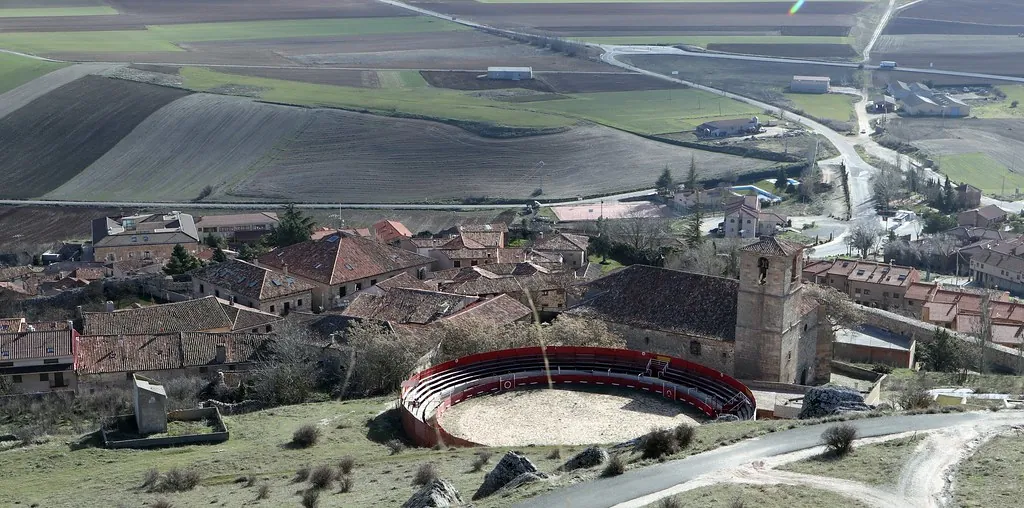
Reaching the village involves crossing an open agricultural landscape. Cereal fields stretch out between patches of encinar, the Mediterranean holm oak woodland typical of central Spain, while shallow ravines descend towards the reservoir. As the road approaches the village, it narrows and the pace naturally slows. This is not somewhere stumbled upon by accident. Visitors usually arrive with intention.
The village centre is small and tightly grouped. Stone masonry houses dominate, topped with curved clay roof tiles. Many have been renovated, yet they maintain their traditional structure and proportions. Streets are short and slightly sloping, arranged around a modest central square where the parish church stands.
The church has a discreet presence, in keeping with the size of the settlement. Built in stone, with simple volumes and a tower that acts as a visual reference point on arrival, it is not monumental. Its importance lies in how it reflects the organisation of these mountain communities, where the square and the church formed the social heart of village life.
At the edges of Pálmaces, the terrain quickly opens up. Paths leading out into the countryside offer views of the reservoir’s water surface and the surrounding mosaic of holm oaks, cultivated fields and low hills that characterise this part of the province of Guadalajara.
Walking the Landscape
The most natural way to explore Pálmaces de Jadraque and its surroundings is on foot, following the agricultural tracks that begin within the village itself. Many trace older routes once used to reach vegetable gardens, pasture or cereal plots. Along the way, traces of rural life remain visible in dry stone walls, small watering troughs and occasional fountains.
These elements speak quietly of a landscape shaped by subsistence farming and livestock rather than large-scale agriculture. The paths are not formal hiking trails in the modern sense, but practical routes that continue to link the village to its territory.
The presence of the Pálmaces reservoir introduces a different scale. Its accessible shores allow a clear view of the relationship between water and the agricultural land around it. The reservoir is a 20th-century intervention, yet it has become part of the visual identity of the area.
On calm days, birds of prey can often be seen gliding above the holm oak woodland. Smaller wildlife appears along field margins. The setting encourages slow observation rather than structured activities. There are no marked circuits or visitor centres, only open countryside shaped by long use.
In autumn, as in much of the Sierra Norte, there is interest in mushroom picking in nearby woodland. Anyone considering this should check current local regulations and proceed with caution. The activity forms part of seasonal rural life in the region, but it requires awareness of environmental rules and safety.
It is important to note that there are no bars or tourist services in the village. This is worth bearing in mind before visiting. Those who spend the day here generally bring their own food or travel on afterwards to nearby municipalities where there is more activity.
Summer Festivities and Village Ties
The patron saint festivities take place in summer, usually around August. During those days, Pálmaces changes rhythm. Families with connections to the village return, and the central square fills once again with people.
Religious events are organised alongside simple activities. The focus is less on a formal programme and more on neighbourhood reunions. These gatherings provide one of the clearest expressions of continuity between those who live in Pálmaces all year and those who maintain a family house but reside elsewhere.
For much of the year, the population remains small and daily life quiet. In August, the temporary increase in residents alters the atmosphere without transforming the scale. The streets that are usually empty regain voices and movement. The church and square return to their traditional role as meeting points.
These celebrations help sustain links between generations and maintain a sense of belonging that extends beyond permanent residence. In villages like Pálmaces de Jadraque, this seasonal return forms an essential part of community life.
Planning a Visit
Pálmaces de Jadraque lies to the north of the city of Guadalajara, roughly an hour away by car. The usual route passes through Jadraque before continuing along local roads towards the reservoir and the village.
The settlement itself can be explored in a short time. Its appeal lies less in individual monuments and more in its setting and atmosphere. A visit makes greater sense when combined with a walk along the surrounding tracks or with stops in other villages of the Sierra Norte.
Given the absence of regularly open services in the municipality, it is advisable to bring water and some food. There are no permanent tourist facilities, and daily life follows the rhythm of a small rural community rather than that of a visitor destination.
Pálmaces de Jadraque offers a clear example of inland rural Castilla La Mancha: agricultural land shaped by long use, modest architecture, and a reservoir that has redefined the horizon without erasing older patterns. It suits those interested in quiet landscapes and in understanding how small mountain villages in Guadalajara continue to function with very limited population.
There are no major sights to tick off, no structured attractions. What defines the experience is scale. The village, the church, the square and the surrounding fields all belong to a human dimension that has changed little over time. In that continuity, Pálmaces de Jadraque finds its identity.