Full Article
about Paredes de Sigüenza
Near Sigüenza; retains stretches of wall and a medieval feel.
Hide article Read full article
A village that reveals itself quietly
A cowbell sounds somewhere behind a stone wall, then fades. What follows is not an empty silence. There are footsteps on gravel, a door closing slowly, wind slipping down the hillside. That is often how a visit to Paredes de Sigüenza begins, a very small village in the Sierra Norte of Guadalajara where only around twenty people live throughout the year.
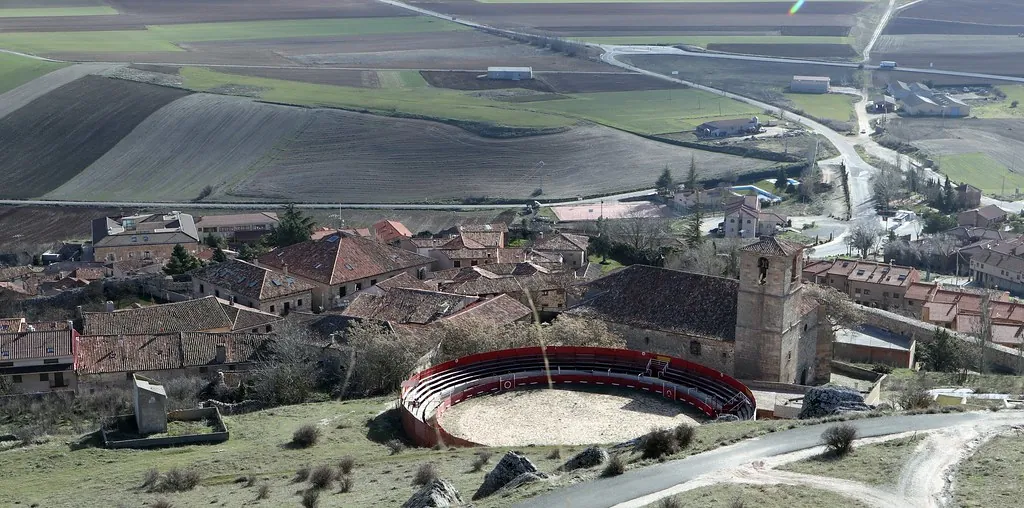
From the road, it appears all at once. A handful of stone houses, reddish roofs, and the occasional open enclosure facing the fields. There is nothing monumental here. The impression is different: time has moved at its own pace for decades, without urgency.
The surrounding land has the rough character typical of this part of the sierra. Low holm oaks and scattered junipers spread across rolling ground that fades into shallow ravines. In winter, the light is sharp and clear. The greys of the stone and the browns of the earth stand out more distinctly, almost harsh in their clarity.
Short streets, solid walls
The village can be covered in minutes, but it rewards a slower walk. Streets are short and bordered by irregular masonry walls. Heavy wooden gates still carry marks from years of use. Some old window grilles retain a dark iron tone that contrasts with the whitewashed façades.
The parish church rises simply, with a solid presence and little decoration. Its tower, straight and restrained, can be seen from the surrounding fields. On windy days the air hits the walls with force, and the building feels designed to endure long winters rather than to impress.
At weekends or during summer there may be a little more movement, as many houses only open for holidays. During the week, especially in the morning, it is common to walk through without meeting anyone at all.
Tracks into the open landscape
Several dirt tracks lead out from Paredes de Sigüenza, connecting it with other tiny settlements in the area. These are wide paths, shaped over time by tractors and livestock.
The landscape becomes clearer once outside the village. With a bit of distance, Paredes is reduced to a cluster of rooftops set among open fields. Above, the sky often carries the slow movement of griffon vultures, circling on rising currents from the ravines.
A practical note fits naturally here. It is worth bringing water and an extra layer of clothing, even in spring. The wind shifts quickly in this part of the sierra, and there are few places to take shelter once out on the tracks.
Close to Sigüenza
A few kilometres away lies Sigüenza, a much larger town with a historic centre known across the province. Its cathedral dominates the skyline and draws most of the visitors who come to this area.
Many people pair the two places in a single day. Sigüenza offers streets to wander and a stronger sense of history on display, while Paredes shows what a village looks like when it has remained outside the main flow of tourism. The contrast is immediate and easy to notice.
Food and everyday rhythms
With such a small population, eating out usually means heading to nearby villages or to Sigüenza. Even so, the food associated with this area follows long-standing traditions. Dishes such as roast lamb and migas, a rustic preparation based on fried breadcrumbs, are typical, along with honey from the sierra and cheeses made in the province.
These are foods shaped by cold weather and agricultural work, designed for long days rather than for show. They reflect the conditions of the land and the rhythm of life that still defines much of the region.
When the village fills again
The patron saint festivities usually take place in summer. At that time, families who now live in other cities return, and the village shifts in tone. More cars appear, doors remain open, and conversations stretch out into the evening as the heat begins to ease.
For the rest of the year, Paredes de Sigüenza returns to its usual scale. It remains small, exposed to the wind that moves across the sierra, and set beneath a wide horizon where the stars appear earlier than expected once night falls.