Full Article
about Pinilla de Jadraque
Small town with a notable Romanesque church; Cañamares River valley
Hide article Read full article
A Slow Morning in the Village
Early in the day, the stone still holds the night’s chill. In Pinilla de Jadraque, light arrives gradually, slipping into narrow streets and sliding across masonry façades. It brings out the reddish tones of some roof tiles and the rough grey of the walls. There is a faint smell of damp earth, and of recently lit firewood drifting from a chimney.
If you stand still for a moment in the square, which feels more like a small widening between houses than a formal plaza, the soundscape is minimal. A door opens somewhere, a car passes now and then, and wind moves down from the surrounding hills. The quiet is not staged. It comes from the fact that this is still a working village, not a place arranged for visitors.
Tourism in Pinilla de Jadraque has the feel of a calm visit to somewhere that continues its own rhythm. Very few people live here year-round, and that shapes everything. During the week, shutters are often closed. On the edges of the village, vegetable plots are carefully tended. Footsteps echo a little more than expected along the streets.
A Hillside Settlement of Stone
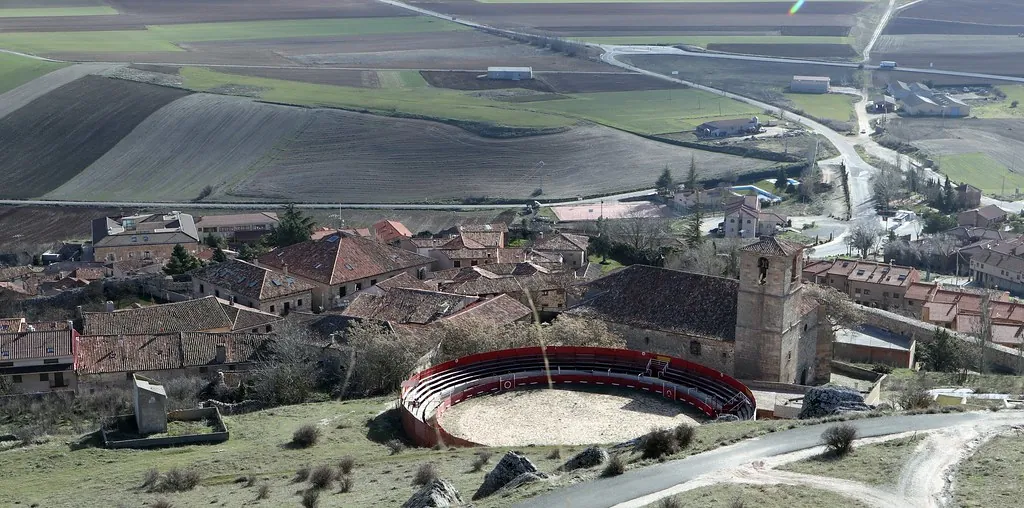
Pinilla belongs to the Sierra Norte of Guadalajara, an area that sits between the open plateaus of the Alcarria and the first ridges of the Sistema Central mountain range. The village adjusts to the slope with an irregular layout. Streets rise and dip without much apparent order, small courtyards sit alongside homes, and stone walls are built from whatever materials were available.
Many houses still follow a traditional structure. The ground floor is solid, with thick walls of stone or adobe, and roofs are covered with curved tiles. Some properties are well maintained, while others show signs of age, with slightly warped beams or façades where the limewash has worn away over time. This contrast says a lot about recent decades in villages like this, shaped by long periods of emigration and occasional returns during the summer months.
At the centre stands the parish church, dedicated to San Salvador. It is not large or heavily decorated, yet its tower remains the main visual reference when approaching along the road. On festival days, the area becomes livelier than usual. For most of the year, however, the surroundings remain quiet.
Paths Beyond the Last Houses
A short walk is enough to leave the final row of houses behind. The landscape opens into gentle hills covered with pines, scattered holm oaks and low scrub. Between these are traces of older agricultural use: small terraces, circular threshing floors and dry stone walls that still shape the terrain.
Several rural paths lead out from the village, linking it with other nearby settlements in the valley. They are not marked as official routes, but they are easy enough to follow at an unhurried pace. In spring, the edges of the paths fill with wildflowers, and the air carries a fresh, green scent that lasts only a few weeks. By autumn, the land shifts to ochre tones, and the ground crunches underfoot.
Wildlife is part of the experience, though never guaranteed. Birds of prey can often be seen gliding above the hills. Occasionally, a roe deer darts across the scrub if the path is quiet.
Light, Shadow and Night Skies
Light plays a key role in how the village is perceived. At sunrise, when the sun begins to touch the rooftops from the hillside side, the stone surfaces gain texture and warm golden tones appear across the façades. By late afternoon, the effect repeats from the opposite direction. Shadows stretch out, and the village seems even smaller within the valley.
At night, the sky is usually free from significant artificial light. On clear evenings, the bands of the Milky Way are visible, something that has become increasingly rare near urban areas. The darkness here is part of the atmosphere, reinforcing the sense of distance from busier places.
Before You Go
Pinilla de Jadraque is a very small settlement, and services are not always available. Anyone planning to spend several hours walking in the surrounding area should bring water and some food from the outset.
The final stretch of access is along narrow local roads. They are generally in good condition, though it is best to drive slowly, especially when passing through villages in the valley.
For those seeking quiet, it is worth avoiding weekends in August and certain public holidays. These are the times when families who still keep homes in the village return, and the atmosphere becomes noticeably livelier. For the rest of the year, Pinilla settles back into its usual pace, slow and understated, marked mainly by the sound of wind moving across the hills.