Full Article
about Prádena de Atienza
Mountain village at the foot of Alto Rey; natural setting of great value
Hide article Read full article
On the northern slope of the Sierra de Pela
Understanding tourism in Prádena de Atienza begins with understanding where it is. The village stands at around 1,145 metres above sea level, on the northern slope of the Sierra de Pela, within a landscape of high plains where climate and livestock have shaped daily life for centuries. This is Castilla La Mancha at its most austere: wide horizons, open ground and settlements built to withstand wind and cold.
The houses reflect that logic. Local stone, thick walls and small openings are common features, designed to offer protection during long winters. The built fabric is practical rather than decorative, closely tied to the realities of mountain life.
Human presence here has always been modest. For generations, the local economy relied on livestock and small-scale crops, enough to support families scattered across very small hamlets. That scale is still visible today. Houses cluster together without a rigid street plan, and corrals and outbuildings recall the village’s agricultural function.
The immediate surroundings are those of the Sierra de Pela and its páramos, high, open plateaus with juniper and savin trees scattered in places. It is not an exuberant landscape. Instead, it feels restrained, shaped by centuries of grazing. The absence of large towns nearby also has its effect. At night, the sky is often seen with striking clarity, something many people from the area remark upon when they return in summer.
Administratively, Prádena belongs to the municipality of Atienza, just a few kilometres away. Historically, Atienza acted as the main settlement for this part of the sierra. Today, the permanent population in Prádena de Atienza is very small. Many houses only open at weekends or during the summer months, which gives daily life a quiet, intermittent rhythm.
The parish church and the shape of the village
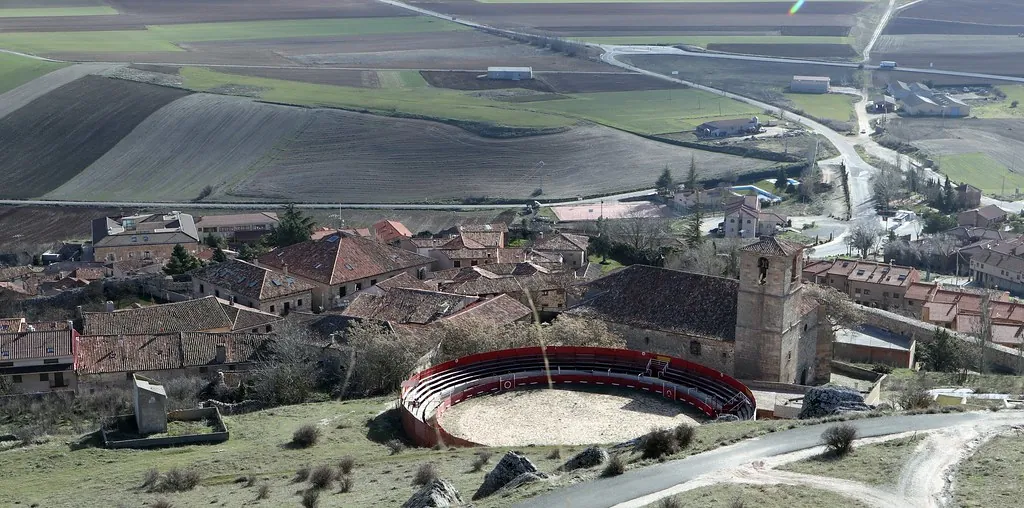
The village is organised around a small square where the parish church stands, dedicated to the Asunción. The building is simple in appearance, probably constructed in the 16th century and later altered, as happened with many rural churches in the area. Its structure is sober, in keeping with the size of the settlement, and inside there is a modest altarpiece.
Around it, the houses follow the typical architecture of the sierra. Rubble masonry walls, tiled roofs and orientations chosen to shield against the coldest winds define the streetscape. In some homes, features linked to livestock use can still be seen, such as wide gates or spaces that once served as stables.
From the edges of the village, the land quickly opens out towards the páramos. There are no large forested areas here. The landscape is broad and largely unobstructed, making it easy to grasp the geography of this part of the Sierra de Pela at a glance.
Old paths across the paramera
The tracks leading out of Prádena de Atienza follow old livestock and agricultural routes. Many connect with other small hamlets or with tracks heading towards Atienza and different points in the sierra. Walking along them offers insight into how people moved around before modern roads became common.
Across these high plains, birds of prey are frequently seen gliding over the open fields. The clear terrain makes it easier to observe them from a distance, provided that walkers remain calm and keep to the paths.
The sense of space is constant. There are few visual barriers, and the combination of altitude and openness defines the experience of the paramera landscape. It is a terrain shaped more by use than by spectacle, where grazing has left a long imprint.
Atienza, the historic centre of the area
To understand the wider territory, it helps to visit nearby Atienza. For centuries, it served as the political and commercial centre of the area. Markets, trades and celebrations were concentrated there, drawing in the population from surrounding villages such as Prádena.
One of the best-known events is the Caballada, linked to Pentecost Sunday and to a medieval tradition that remains well known in the region. Although everyday life in villages like Prádena is now quiet, dates such as this continue to shape the local calendar.
Atienza is also where visitors will find bars and shops offering traditional serrana cooking. Dishes include hearty stews, products from the matanza, the traditional pig slaughter that supplied preserved meats for the year, and cheeses made from sheep’s milk produced in the surrounding comarca. These foods reflect the same livestock-based economy that sustained Prádena for generations.
A very small village today
Prádena de Atienza can be walked through in a matter of minutes. There are no dedicated tourist services and no extensive monumental complex. What remains is a small cluster of houses well integrated into the landscape of the sierra, along with the feeling of being in a place where depopulation has altered daily life more than the physical appearance of the village.
The built environment has changed little in comparison with the demographic shift. Many homes stand closed for much of the year, reopening when families return for holidays or weekends. The rhythms are seasonal, tied more to memory and tradition than to economic activity.
Those who make the journey here will find above all silence, open tracks and a clear reference point for how many villages in the Sierra Norte once were before much of the population moved away. Prádena de Atienza does not present itself as a destination of monuments or services. Instead, it offers a direct encounter with the high plains of the Sierra de Pela and with a way of life shaped by altitude, climate and livestock over centuries.