Full Article
about Robledo de Corpes
Literary setting of the *Cantar del Mío Cid* (Affront of Corpes); mountain setting
Hide article Read full article
The Sound of Wind in the Oak Woods
Morning frost still grips the shadowed side of the street. Up here at a thousand metres, in the Sierra Norte of Guadalajara, the cold has a physical weight. Robledo de Corpes is quiet, a settlement of thirty-nine souls where the wind moving through the surrounding robledales is the first thing you hear. The silence that follows isn’t empty. It’s layered with the creak of a wooden shutter, the distant call of a crow.
You reach it on a road that climbs through valleys of blond grass and sudden, dark stands of pine. The landscape simplifies until there’s just sky, stone, and the stubborn evergreen of the trees.
The altitude is a fact you feel in your chest. Winters are long, with snow that lingers on rooftops for weeks. Summers are dry and sharp with the scent of hot resin. But in late October, if the autumn rains arrive, the oak woods ignite. They burn a brief, coppery red against the constant green of the pines.
Some will tell you Robledo de Corpes is named in the Cantar de Mio Cid. The link is a line in an old book. The village’s true rhythm was set by harder things: the seasonal move of sheep, the sowing of rye in thin soil, the management of this persistent cold.
The Grammar of Stone
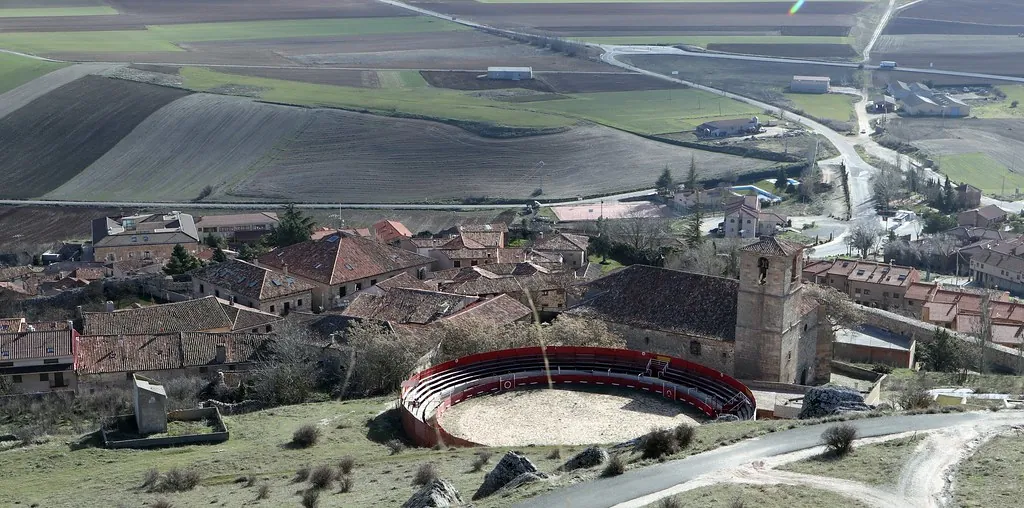
The church of San Gil is built from the same rough stone as every other building. It’s a sober block with a simple espadaña bell gable. There are no grand carvings. Its virtue is endurance, a structure made for mountain winters.
You can walk every lane in twenty minutes. Don’t. Stop instead. Look at the wooden balconies, their grain weathered to a soft grey. Notice the old doors fastened with iron nails as wide as your thumb. In some walls, you can trace the arched ghost of a bread oven, or see an iron ring where an animal was once tied. This isn’t preservation. It’s what was left when daily life changed course.
The light becomes specific here. In deep afternoon, it cuts between houses, laying long geometric shadows across the cobbles, turning the village into a pattern of warm stone and cool shade.
Where the Cobbles End
The village stops abruptly. One moment you’re on paved lane, the next your boots are on hard earth among scrub and young oaks. The paths aren’t signposted. They are livestock trails, forestry tracks, routes made by people going to check on sheep or look for mushrooms.
Carry a map or have a GPS route loaded. It’s easy to mistake one deer path for another, especially in the steep ravines to the north.
You choose your effort. A low amble through the oak woods brings the scent of damp moss and crushed thyme. A climb toward the peaks brings a wind that pulls at your jacket and views across successive ridges of sierra. The ground is almost always stony. Start back well before dusk. When the sun drops behind the ridge, the temperature follows it down.
You may not see large animals, but you will hear them. The heavy rustle in the brush is often a roe deer. The low whoosh overhead is likely griffon vultures riding a thermal. This is their space. You are passing through.
Provisions and Season
Do not come to Robledo de Corpes expecting to find an open bar or a restaurant. There usually aren’t any. People bring what they need, or they drive twenty minutes to a town like Atienza for a meal.
The local food is born of necessity: sustenance for people who worked outside. You might find it in homes or at a village festival—hearty spoon dishes like migas pastoreras or gachas, lamb from sheep that grazed these same slopes.
Autumn turns attention to the forest floor. After good rains, people go out at dawn with baskets, knowing which clearings in the pine woods yield níscalos. If you forage, check Castilla-La Mancha’s current picking rules first. And watch your footing: a carpet of wet pine needles over clay is treacherously slick.
Pace
Robledo de Corpes has no checklist. It has weather you feel on your skin and a human scale that makes you aware of your own footsteps. It asks you to slow down to its pace: the pace of walking, of watching clouds stack up over a ridge, of hearing how wind sounds different in pines than it does in oaks.
Its mention in medieval poetry feels incidental next to the sight of a shepherd moving his flock along an ancient drovers’ road, or the smell of woodsmoke on a still January morning.
Come here for space and for a quiet that feels earned. Come with sturdy shoes, your own water, and an understanding that plans are provisional here, subject to review by the sky and the state of the track. Hurry would miss the point entirely