Full Article
about Santiuste
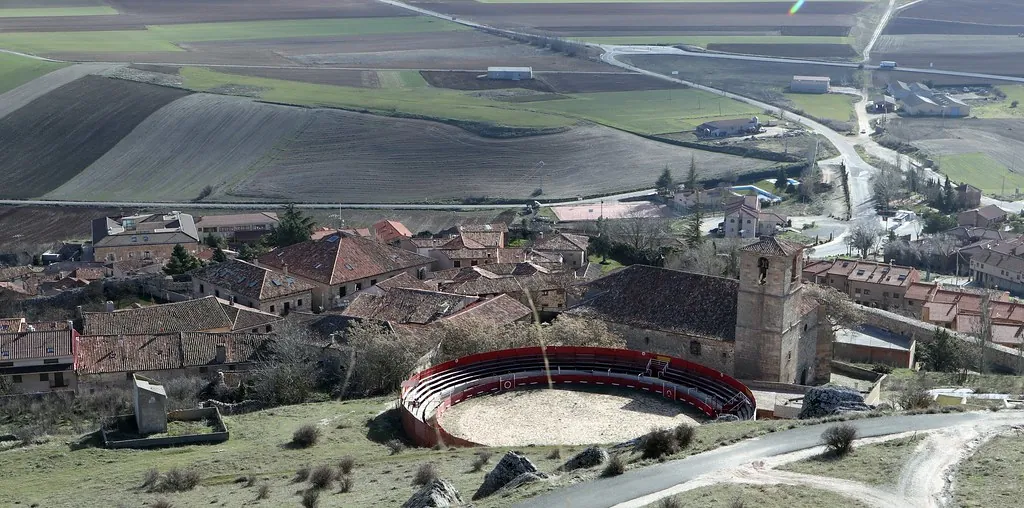
Village in the Reguerones valley; simple rural architecture
Hide article Read full article
A village shaped by distance and altitude
Tourism in Santiuste begins with a simple fact: this is a very small village in the Sierra Norte of Guadalajara, sitting at around 960 metres above sea level, where only about fifteen people live today. It lies on the northern side of the range, in an area known for long winters and a certain remoteness in its connections to the outside. Rather than a structured destination designed for visitors, Santiuste stands as a reflection of what many rural settlements in this part of Castilla-La Mancha were like before the depopulation of recent decades.
The houses gather loosely around the paths, without strict planning. They are built from local stone and topped with tiled roofs. Wood appears in eaves and in small agricultural outbuildings. There has been no recent urban development and few major alterations, so what you see largely responds to the needs of a livestock-based, subsistence economy that shaped daily life here for generations.
Local context and built heritage
The name Santiuste comes from Saints Justo and Pastor, to whom the parish church is dedicated. The building is modest, typical of many mountain villages: a single nave, masonry construction and a simple bell gable rising above the rooftops. Its importance lies less in artistic value and more in its role within the community. For many years, the sound of the bells marked working hours, called people together or signalled problems in the surrounding countryside.
Domestic architecture follows the same practical approach. Thick stone walls help retain warmth during winter and keep interiors cool in summer, an essential feature in a place where wind and frost are part of everyday conditions. Some houses still show traces of old pens or small spaces used to store firewood and grain.
The landscape around Santiuste explains much of its history. Nearby slopes alternate between pine forests and areas of holm oak and Pyrenean oak, with meadows in between that were traditionally used for grazing livestock. Roe deer are often seen at dawn, and signs of wild boar appear along the edges of paths. Birds of prey are also common, taking advantage of air currents rising from the valleys.
Walking routes through the sierra
The surroundings are best explored on foot. Old paths that once connected Santiuste with other villages in the sierra are still in use, although many now function as local trails. Walking along them gives a clear sense of how the territory was organised before the arrival of cars: gentle mountain passes, seasonal streams and stretches of woodland where the only constant sound is the wind.
In autumn, the pine forests attract people interested in mushroom foraging. As in the rest of the Sierra Norte, collecting is regulated, so it is advisable to check the rules before heading out and to be certain about which species are being gathered.
Another defining feature is the night sky. Limited artificial lighting and the distance from large urban areas mean that on clear nights the Milky Way can be seen with notable clarity.
Traditions and shared moments
With such a small population, collective life is naturally limited, yet certain dates still bring people together, especially those with family ties to the village. The feast of San Justo y San Pastor is usually celebrated in summer, when relatives who now live elsewhere return. It functions less as an outward-facing festival and more as a meeting point for neighbours and descendants.
Other traditional practices still appear in some households, though less frequently than in the past. These include the matanza del cerdo, the traditional pig slaughter carried out for household consumption, the care of small flocks and work in kitchen gardens. They are remnants of a way of life that sustained these mountain villages for centuries.
Getting there and moving around
Santiuste is reached by local roads that cross the Sierra Norte of Guadalajara. It is best approached without hurry, and with the understanding that services are found in larger nearby towns.
The village itself can be explored in a short time. The main interest lies in walking the paths that lead out into the surrounding landscape and observing how the settlement fits into it. The appeal here is not about ticking off sights, but about understanding a very small place that still preserves the structure and character of traditional mountain villages.