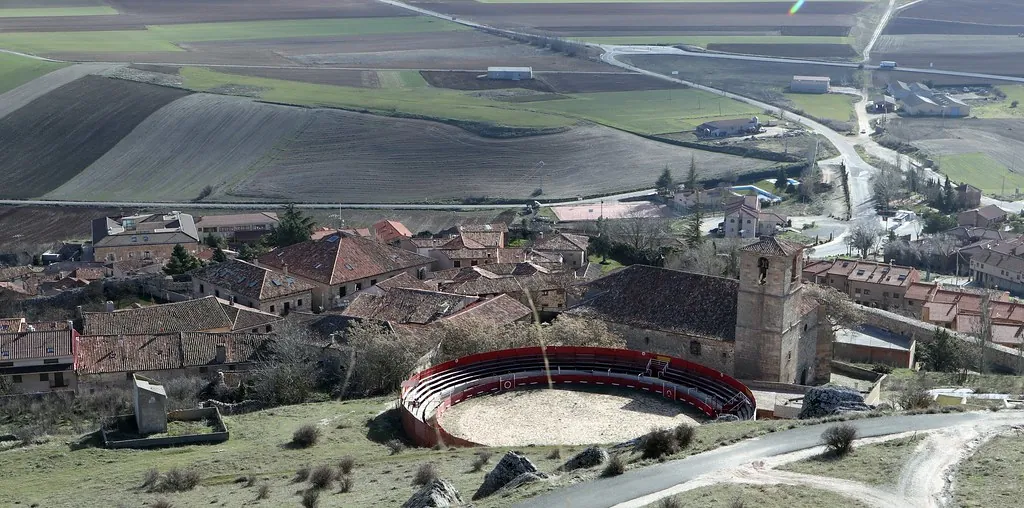
Saúca - Flickr
santiagolopezpastor · Flickr 5
Castilla-La Mancha · Land of Don Quixote

Saúca

The church bell in Sauca still marks the hours, yet few people remain to hear it. Forty-seven residents are listed on the municipal roll, and on a ...

47 inhabitants · INE 2025
1100m Altitude

Why Visit

Mountain Church of the Assumption (Romanesque) Romanesque Route

Best Time to Visit

summer

Assumption Festival (August) agosto

Things to See & Do
in Saúca

Heritage

  • Church of the Assumption (Romanesque)
  • Forge

Activities

  • Romanesque Route
  • Hiking

Festivals
& & Traditions

Fecha agosto

Fiestas de la Asunción (agosto)

Las fiestas locales son el momento perfecto para vivir la autenticidad de Saúca.

Full Article
about Saúca

Known for its valuable porticoed Romanesque church; set amid hills.

Ocultar artículo Leer artículo completo

The church bell in Sauca still marks the hours, yet few people remain to hear it. Forty-seven residents are listed on the municipal roll, and on a weekday morning you can walk the single main lane without meeting any of them. At 1,100 m above the cereal plains of Guadalajara, the village sits just below the tree line: pines and Spanish oak press in from the north, while the land falls away southwards towards the distant Tagus gorge. The air is thinner, the light sharper, and the night sky so clear that Orion seems close enough to snag on the bell-tower.

Stone houses shoulder the slope, their timber doors painted the traditional ox-blood, balconies no bigger than a single flagstone. Rooflines sag in gentle accord with the granite beneath; generations have accepted the gradient rather than flatten it. Chimneys are oversized for a reason—winter arrives in October and can loiter until late April. When snow blocks the access road, which happens most years, the place folds in on itself: no shop, no bar, no mobile signal under heavy cloud. What remains is wood smoke, dog bark and the soft clink of a distant tractor trying to clear a track.

The slow reveal

There is no ticket office, no interpretation centre, no yellow arrows painted on walls. The appeal of Sauca is cumulative. Start at the top where the lane squeezes between two-storey houses; note how the upper floors are set on timber corbels so the eaves almost touch. Halfway down, the parish church—Masonry patched in three centuries—opens its porch onto a wedge-shaped plaza the size of a tennis court. Inside, the single nave smells of candle wax and damp stone; the font is 16th-century, the electric heater 1989. Locals claim the font cover survived Civil War looting because someone used it as a chicken trough—no one bothered to steal it.

Continue past the last dwelling and the lane turns into a farm track that climbs through pine plantation. Within ten minutes the village shrinks to a grey ripple on the hillside while the Sierra Norte rolls out in cobalt folds. This is not hiking country of high drama; gradients are steady, waymarking sporadic, but the reward is solitude. Roe deer prints cross the path, and green woodpeckers yaffle overhead. Turn back when the sun drops behind the massif—nightfall is sudden and the descent lane is unlit.

What you won’t find (and why that matters)

Search Sauca for a restaurant and you will leave hungry. The nearest place serving a hot meal is twelve kilometres away in Tamajón, open only at weekends outside summer. Bring supplies or book the solitary self-catering apartment, El Refugio de la Sauca, whose owner Carmen leaves a basket of eggs, bread and chorizo if you arrive after shops shut. The flat has a proper fireplace—essential in January when indoor temperatures flirt with zero—and a small balcony that catches the morning sun before the rest of the village sees it.

Don’t expect Wi-Fi to stream box-sets; the connection wheezes at 3 Mbps on a good day. Mobile coverage is patchy inside stone walls, perfect for anyone practising digital detox, disastrous if you need to check in with the office. The village trades distraction for space: the night sky delivers shooting stars at a rate you forgot existed, and the loudest sound after midnight is the gurgle of an ancient gravity-fed water cistern.

Season by season

April brings almond blossom on protected south-facing slopes, but nights stay cold enough to frost the windscreen. By late May the high meadows are speckled with wild peony and the first orchids; day temperatures reach 18 °C yet you still need a fleece at dusk. These weeks are ideal for walking the old mule path to Valdepeñas de la Sierra—six kilometres one way, no facilities, so carry water and a sandwich.

High summer is surprisingly bearable thanks to altitude. At midday the thermometer may read 28 °C, humidity is low, and shade from the pine belt cools the air by five degrees. Still, start walks early; afternoon sun is fierce and there is no café terrace in which to recover. August fiestas swell the population to perhaps 200 for a long weekend: open-air mass, a communal paella cooked on wood fires, and a disco that pounds across the empty threshing floors until 4 a.m.—then silence returns with the hangover.

October belongs to mushroom hunters. Boletus edulis and Lactarius deliciosus appear after the first autumn rains; locals guard patches like family secrets. A permit (free) is required for collection—apply online through the regional website, print it, and carry ID. The forest guard does patrol; fines start at €300 for a basketful taken without paperwork.

Winter is the make-or-break season. Snow transforms the landscape into a high-altitude Christmas card, but the CM-101 county road is not first on the gritting schedule. A 4×4 with chains gets through; a hire Corsa on summer tyres does not. If you book between December and March, confirm the forecast and pack blankets, even for a day trip. When conditions close the pass, Sauca becomes an island for two or three days—electricity permitting.

Eating without a restaurant

Provisions must be fetched before you climb the mountain. In Guadalajara’s covered market, buy queso de oveja from the shepherd’s stall (€14 a kilo, wrapped in waxed paper) and a fist-thick slab of jamón serrano from the Sierra de Albarracín. Add a bottle of Tempranillo from the nearby Beteta cooperative—under €6 and sturdy enough for cold nights. In Tamajón the bakery opens at seven; the mollete (soft bread roll) stays fresh for about four hours, just long enough to reach Sauca and toast it over olive-wood embers.

If you crave something hot without cooking, drive twenty-five minutes to El Yugo in Majaelrayo, a no-frills bar that serves patatas a lo pobre—potatoes fried in olive oil with green pepper and onion—plus a fried egg for €8. They close on Tuesdays and don’t take cards.

Practical fragments

Getting there: From Madrid, take the A-2 to Guadalajara, then the N-320 towards Sigüenza. After 40 km turn onto the CM-101 signed for Molina de Aragón; Sauca is 12 km beyond Tamajón. The final stretch is narrow but paved—meet a lorry and someone must reverse. There is no petrol station after Guadalajara; fill the tank.

Where to sleep: Apart from El Refugio, the closest hotels are in Tamajón (hostal, €55 double, basic) or the smarter Hotel Rural Castillo de Sol in Valdepeñas (€90, pool, closed January). Wild camping is tolerated beside the pine belt provided you leave no trace; fires are banned in summer.

What to bring: Stout shoes for loose granite paths; a map—the IGN 1:50,000 sheet 498 is more reliable than phone GPS once tree cover thickens; cash, because no one accepts plastic; and a head-torch for the short tunnel between houses where the street lighting gives up.

The honest verdict

Sauca will not suit travellers who measure value by attractions ticked. It offers instead a calibration point for urban clocks: a place where bread is still delivered from a van three times a week, where the elderly greet strangers because silence is rarer than company, where altitude and weather dictate plans rather than apps. Come for two quiet days, stay for four if you need to remember what your own thoughts sound like. Leave before you start resenting the absence of espresso—nostalgia curdles quickly once boredom sets in.

Key Facts

Region
Castilla-La Mancha
District
Sierra Norte
INE Code
19251
Coast
No
Mountain
Yes
Season
summer

Livability & Services

Key data for living or remote work

2024
TransportTrain 12 km away
Housing~5€/m² rent · Affordable
Sources: INE, CNMC, Ministry of Health, AEMET

Official Data

Institutional records and open data (when available).

  • IGLESIA DE SAÚCA
    bic Monumento ~0.4 km
  • IGLESIA DE SAN JUAN BAUTISTA
    bic Monumento ~2.5 km

Planning Your Visit?

Discover more villages in the Sierra Norte.

View full region →

More villages in Sierra Norte

Traveler Reviews