Full Article
about Sienes
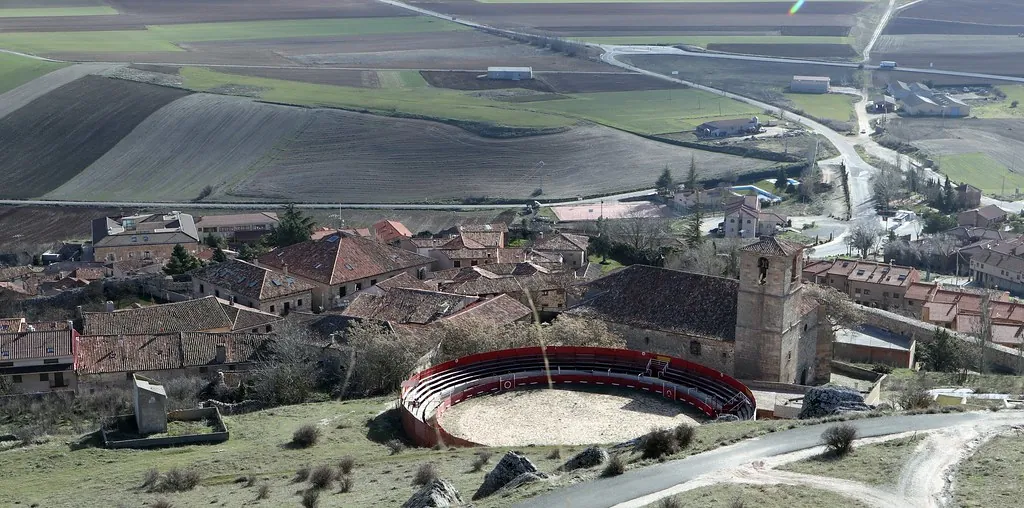
Mountain village with a Romanesque church and a valley setting.
Hide article Read full article
A Village Shaped by Height and Distance
Tourism in Sienes is defined above all by its setting. The village lies in the Sierra Norte of Guadalajara, on the upper strip that looks towards the Sierra de Pela, at more than a thousand metres above sea level. This is high ground: pine forests, scattered juniper and open plateaus where settlements are small and the distances between them are felt.
Sienes has only a few dozen residents. It retains the scale of the mountain hamlets that never expanded beyond what was strictly necessary. There is no sense of outward growth or later enlargement. The village remains compact, close to the land and shaped by it.
The layout reflects this adaptation. Streets are short. Stone houses stand with thick walls and tiled roofs, many with large wooden gates that point to a long history of livestock use. Rather than a sequence of standout buildings, Sienes reads as a whole. There is no clearly defined monumental centre. The interest lies in the ensemble, in how the buildings sit together and respond to the climate and terrain.
This is not a place of grand façades or architectural set pieces. Its character comes from proportion and restraint, from materials taken from the surrounding area and used with practical intent.
Santa Eulalia and the Role of the Parish Church
The parish church is dedicated to Santa Eulalia. It is a simple building, constructed in masonry and altered in later periods, with reforms that appear to date at least in part to the 18th century. The church is neither large nor particularly elaborate. Even so, it stands out within the village fabric.
In settlements of this size, the church historically fulfilled a role that extended beyond religion. It was a meeting place, a setting for communal decisions and, in many cases, the only building with a certain architectural presence. That wider function helps explain its importance in Sienes. The church forms a visual and social reference point, even if its design is modest.
There is no suggestion of elaborate decoration or grand interior schemes. What matters here is continuity. The building reflects the rhythm of rural life over centuries, anchored in a community that has always been small.
A Border Landscape
This part of the province has long been a territory of passage between different regions. The mountain ranges that separate Guadalajara from Soria and Aragón have for centuries acted as a natural frontier, defined more by geography than by administrative lines.
From the surroundings of the village there are long views towards the ridges of the Sierra de Pela. The landscape alternates between pine woods and areas of low scrub, with high meadows opening out across the plateau. It is not spectacular in an obvious or dramatic sense. Instead, it is representative of the interior Castilian sierra: broad, somewhat austere and marked by wide horizons.
The sense of space is constant. Settlements appear at a distance, and the terrain shapes movement and perspective. The mountains here do not rise sharply in jagged peaks. They form cordales, elongated ridges that structure the skyline and define routes across the territory.
That condition of borderland has influenced daily life over time. The area has been a crossing point between neighbouring provinces and historic regions, its identity tied to terrain rather than to shifting political boundaries.
Walking Out from the Village
The tracks that leave Sienes are mostly traditional routes, used for agricultural work or to connect with nearby villages. Some head into the pine forests. Others cross more open stretches of plateau.
They are not always signposted. Anyone planning to walk beyond the immediate surroundings should have basic orientation skills or carry a map. The ground typically alternates between stony sections and dirt tracks, with moderate changes in level rather than steep ascents.
Walking here is less about marked itineraries and more about following historic paths. The routes were created for practical purposes, not leisure. That lends them a directness that suits the landscape.
In autumn, mushroom foraging is common in the nearby woods. As in other parts of the province, collection is usually regulated, so it is advisable to check the current rules before setting out. The activity forms part of seasonal life in the sierra, linked to the rhythm of the forests rather than to organised tourism.
A Very Small Community
With such a limited population, everyday life in Sienes changes noticeably depending on the time of year. In winter, activity is minimal. It is not unusual to walk through the streets without encountering anyone.
Summer and some weekends bring a different atmosphere. Owners of second homes and families with ties to the village return, increasing the sense of movement and sociability. Even then, the scale remains small.
The main celebrations are usually centred on the feast of the Asunción, in mid-August. In Spain this refers to the Assumption of the Virgin Mary, a significant date in the Catholic calendar and a common focus for local festivities. In Sienes, these celebrations are primarily intended for those who maintain a relationship with the village rather than for attracting passing visitors.
The difference between seasons underlines how closely the village is tied to its resident community. Numbers matter here. A handful of extra people can alter the rhythm of daily life.
When to Visit Sienes
Spring and autumn are generally the most rewarding seasons for exploring the area. Temperatures are mild and the surrounding countryside is active, whether in fresh growth or autumn colour. Summer, thanks to the altitude, is more bearable than in other parts of Castilla La Mancha, although the village remains very small and offers few services.
Sienes is not a destination chosen for monuments or a packed cultural calendar. It makes more sense as part of the broader landscape of the Sierra Norte. The appeal lies in its scale and its integration into the terrain. This is a minimal settlement on high ground, still keeping the unhurried pace of the mountain sierra.
For travellers interested in rural Spain beyond headline attractions, Sienes offers a clear example of how geography shapes community. Its streets, church and paths all reflect that relationship with altitude, distance and season.