Full Article
about Sigüenza
City of the Doncel; top tourist destination with a cathedral and a castle-turned-parador
Hide article Read full article
From the A-2 motorway, Sigüenza rises like a pale rocky hill in the middle of the cereal plains. The town has clung to this height for more than two thousand years. The Celtiberians knew it as Segontia, and the Romans later incorporated it into the network of roads that crossed the Meseta, Spain’s vast central plateau. Visigoths and Muslims followed, strengthening the site’s defensive role.
When Bishop Bernardo de Agén took the town in the 12th century, its strategic value was obvious: this was a control point between Castile and the Levante, the eastern territories towards the Mediterranean. From that moment, the Sigüenza seen today began to take shape, organised around a cathedral and an episcopal authority that shaped local life for centuries.
Sigüenza is not simply a pretty settlement on a hill. It is, above all, an episcopal city built to oversee territory. That logic remains visible in its cathedral, its castle and the way the houses adapt to the slope. Here, history is embedded in the stone itself.
The Cathedral and the Stone That Tells the Story
Construction of the Catedral de Santa María began shortly after the Christian conquest. The building does not belong to a single architectural style. Instead, it reflects a long process of additions and alterations over time. Romanesque features survive in the earliest structure. Gothic elements appear in various sections of the nave. Renaissance influences can be seen in spaces such as the sacristy.
It is best understood not as a finished project, but as a building shaped across centuries. Each phase left its mark, responding to new needs and tastes while maintaining the cathedral’s central role in the city.
Inside the Capilla de Santa Catalina lies one of Sigüenza’s most famous figures: the Doncel de Sigüenza, Martín Vázquez de Arce. He died in the Granada War at the end of the 15th century. His alabaster funerary sculpture shows him reclining, absorbed in a book. Rather than presenting an epic image of a fallen warrior, the monument suggests a family intent on securing remembrance within the cathedral’s walls.
Outside, along the southern wall, several anthropomorphic tombs carved directly into the rock can still be seen. These burials predate the current cathedral building. They are a reminder that this hill was already a place of significance long before the structure that now dominates it.
The Castle Above the Town
At the highest point stands the castle, overlooking the entire urban layout. The fortress began to take shape in the 12th century as both a residence for the bishops of Sigüenza and a defensive element within the newly consolidated Castilian territory.
Over time, it underwent alterations and witnessed turbulent episodes. Tradition places the imprisonment of Blanca de Borbón here in the mid-14th century. She was the wife of King Pedro I, and her confinement adds a layer of political drama to the castle’s history.
Today the building has been restored and operates as accommodation, yet its structure remains clear. Thick walls define the perimeter. There is an interior courtyard. Towers mark its outline, and its elevated position offers wide views over the town below.
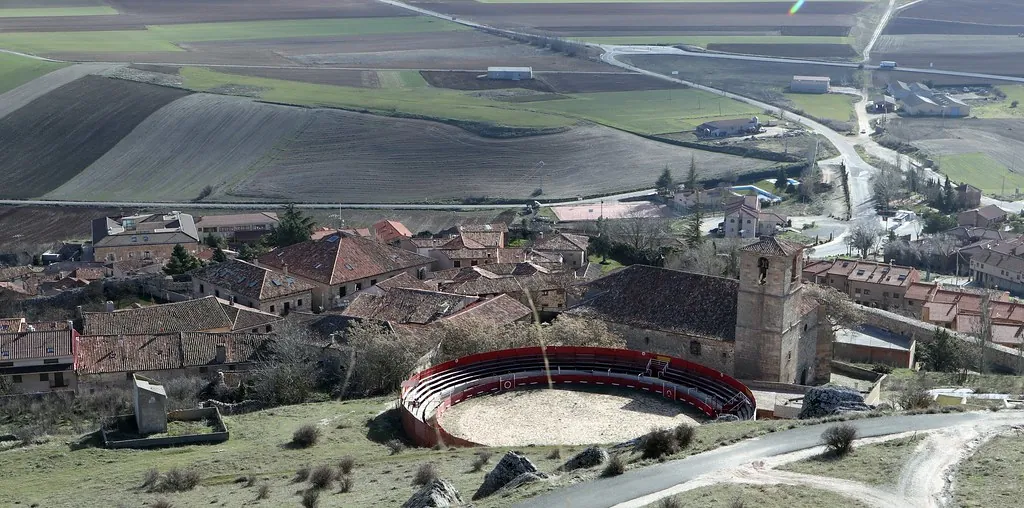
From this height, the form of the historic centre becomes easy to read. Streets climb towards the cathedral, while houses gather around the plaza mayor. The arrangement reflects its origins as a planned episcopal stronghold, with religious and defensive power at its core.
Food from the Sierra
In this part of the Sierra Norte de Guadalajara, local cooking revolves around lamb and livestock products. Roast lamb prepared in a wood-fired oven remains common for celebrations and weekends.
Other dishes are closely linked to rural life. Migas, made from fried breadcrumbs, are often served with grapes or cured meats. The ingredients reflect a landscape shaped by herding and agriculture rather than large-scale urban trade.
Sheep’s milk cheeses are produced in the area, typically matured for long periods and known for a pronounced flavour. As for sweets, convent traditions left a lasting mark. Recipes based on almonds, egg yolk and sugar still circulate in homes and bakeries. These simple foundations define much of the local confectionery heritage.
Walking the Surroundings
The area around Sigüenza offers straightforward walks that help make sense of the landscape of the Sierra Norte de Guadalajara. Paths circle the town and pass by historic buildings such as the Casa del Doncel, a 15th-century urban palace with a Gothic gallery on its façade.
Beyond the urban centre, scattered hermitages appear along agricultural tracks. The terrain opens into cereal fields punctuated by isolated holm oaks and small limestone ridges that signal the nearby sierras. The landscape feels shaped by long use rather than dramatic intervention.
In autumn, flocks can still be seen moving along these traditional routes, following ancient livestock trails. The sight reinforces the continuity between past and present. The same paths that once structured the local economy remain part of daily life.
Planning a Visit
Sigüenza is well connected by road to the Henares corridor and to Madrid via the A-2. A regional train from the capital also reaches the town.
The historic centre can be explored on foot without difficulty, although some streets are steep. The cathedral usually separates visiting hours for worship and tourism, so it is sensible to check before entering.
In the lower part of town, near the station, there are areas where cars can be left before walking uphill. Throughout the year, historical re-enactments and themed markets take place, filling the streets of the old quarter. Visiting during one of these weekends means encountering a livelier atmosphere, along with larger crowds.
Sigüenza’s identity is inseparable from its role as a city designed to control territory. The cathedral expresses spiritual authority. The castle reinforces defence and governance. The layout of the streets adapts to the hillside with clear purpose. Together, these elements explain why this hilltop settlement has endured for more than two millennia, its story written directly into the stone that supports it.