Full Article
about Ujados
Small mountain village; Romanesque church and peaceful setting
Hide article Read full article
A village on the edge of the plateau
In the Sierra Norte of Guadalajara, close to the border with Soria, tourism in Ujados begins with a simple question: where exactly are you? The village sits at 1,152 metres above sea level, in a transition zone between the mountain ranges of the Sistema Ibérico and the Castilian plateau. The landscape reflects that in-between character, neither fully high mountain nor open plain.
Around twenty people live here today. That figure explains much about Ujados: the quiet atmosphere, the unhurried pace of daily life, and the vulnerability of a settlement that for centuries relied almost entirely on the land. There are no distractions or grand attractions competing for attention. What draws visitors is the sense of scale and the close relationship between village and surroundings.
Medieval roots and the influence of Atienza
Ujados is historically linked to the medieval repopulation of this part of Guadalajara. After Castilian control of the area was consolidated between the 12th and 13th centuries, many villages in the sierra were incorporated into the Comunidad de Villa y Tierra de Atienza. This was a medieval administrative system that organised territory and regulated the use of pasture and woodland. Ujados formed part of that structure for centuries.
It was never a large settlement, but it played its role within a dispersed network of small villages. The local economy revolved around livestock, particularly sheep, along with small cultivated plots adapted to a harsh climate. Nearby hills provided timber and grazing land. This direct dependence on the surrounding terrain shaped both the size of the village and its compact layout.
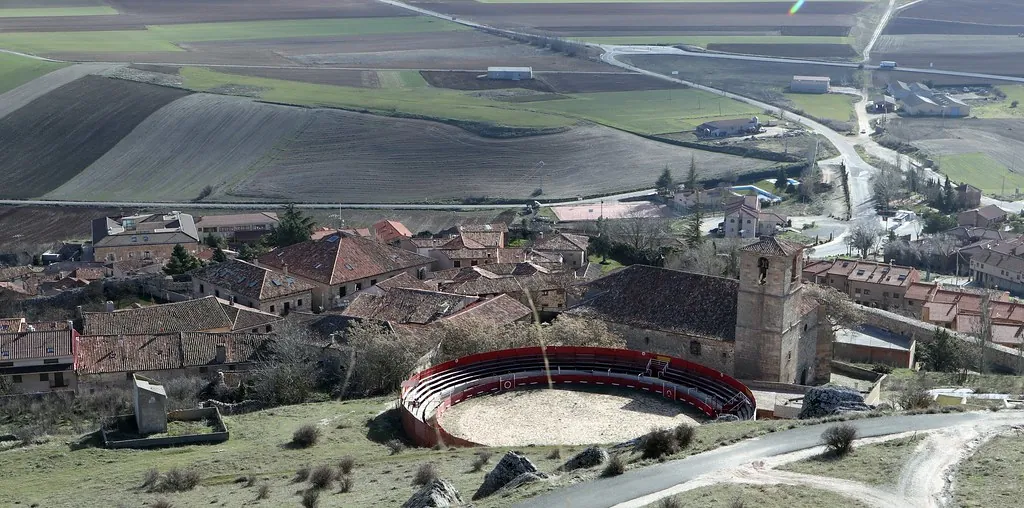
At the centre of the settlement stands the parish church of San Bartolomé. The present building largely reflects alterations from the early modern period, probably carried out between the 16th and 17th centuries. This pattern was common in rural churches across the region, where earlier and simpler structures were replaced or expanded. San Bartolomé is a sober, single-nave church built in the same stone that appears in many of the village houses, reinforcing the sense that everything here comes from the same ground.
Stone, tile and narrow streets
The architecture of Ujados follows a clear logic: keep out the cold and make use of what is close at hand. Traditional houses are built with thick stone walls and tiled roofs. The materials are practical, durable and suited to the altitude.
The streets are short and narrow, designed for movement on foot or with animals rather than modern vehicles. There are no grand buildings and no expansive squares. The village grew slowly and in a contained way, without large-scale expansion. As a result, walking through Ujados does not take long, yet it rewards a slow pace.
Old doorways, small enclosed yards and masonry walls mark out what were once vegetable plots or spaces for livestock. These details speak of a rural economy that depended on careful use of limited resources. The compact layout also reflects the need for shelter from winter conditions, with buildings clustered together against the cold.
The surrounding hills and forests
The landscape around Ujados is not a backdrop but an essential part of the place. Scots pine forests cover many of the slopes, mixed with Pyrenean oak and some areas of holm oak. For generations these hills have been used for timber and grazing, shaping both livelihoods and scenery.
Wildlife typical of these mountain ranges lives here: roe deer, wild boar and foxes, along with various forest bird species. Animals are not always visible, yet their tracks often appear along paths and in clearings.
From higher ground near the village, the terrain opens out towards peaks that rise above 1,500 metres in the nearby sierra. The feeling is one of space and relative isolation, something increasingly rare in other parts of the province. The views are not about dramatic landmarks but about breadth and continuity, a succession of wooded slopes and open stretches.
Walking old routes
Several paths leave directly from the centre of the village and lead into the surrounding hills. Many of them were once livestock routes or access tracks to fields and meadows. Not all are signposted, though they remain passable.
The character of these walks changes with the seasons. In spring, streams carry more water and the hills turn greener. Autumn transforms the oak woods, altering their colour completely. Winter often brings snow at this altitude, and some tracks can remain covered for days.
The area is also known for traditional mushroom gathering when the season arrives. As elsewhere in the sierra, it is important to know the species well and to respect any regulations that may apply at the time.
Practicalities
Ujados is very small and has no tourist services or shops. Most visitors come from other villages in the Sierra Norte, spending time here walking in the surrounding countryside or exploring the compact settlement.
The roads leading to the village are local and run through wooded areas. It is best to approach without haste and to check the weather forecast in winter, when conditions can change quickly in this part of the sierra.
Ujados does not present itself as a destination of headline sights. Its appeal lies in understanding its setting, its history within the Comunidad de Villa y Tierra de Atienza, and its continued existence at 1,152 metres between mountain and plateau. For those interested in rural landscapes and small-scale history, that is more than enough.