Full Article
about Valdelcubo
Mountain village bordering Soria; church with Mudéjar coffered ceiling
Hide article Read full article
Evening Light on the Limestone Ridge
At around five in the afternoon, when the sun begins to dip over the high plateau, the light slips through the low trees and clings to the pale stone of the Iglesia de la Asunción. Facades turn a brownish, almost golden shade, and the pace of the village slows. It is the hour of small sounds: the tap of a sheet-metal door, a distant sheep, wind brushing past scattered holm oaks.
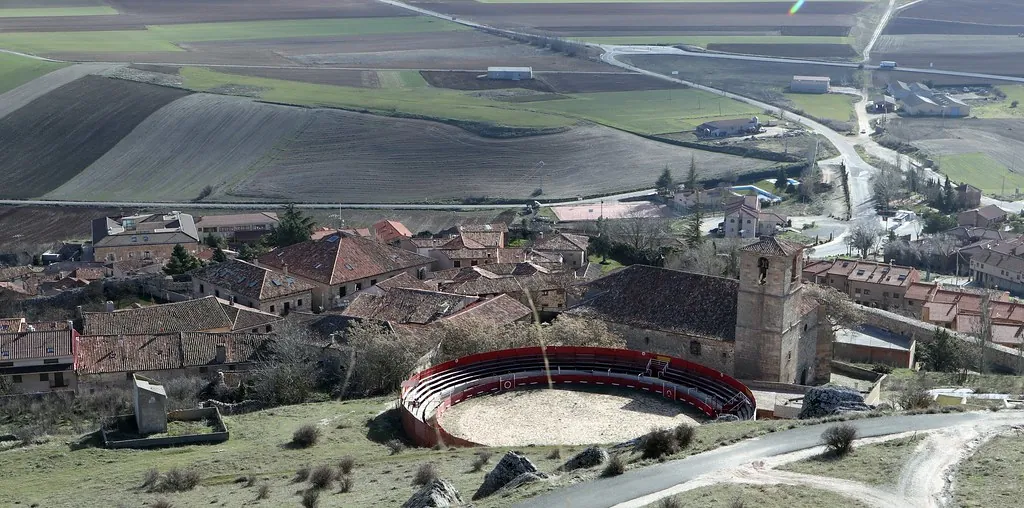
Valdelcubo is home to around forty people today. The houses form a compact cluster on a small limestone rise, surrounded by fields where wheat and barley are still sown when spring arrives. At about 1,070 metres above sea level, in the Sierra Norte of Guadalajara, silence is close to literal. It is broken mainly by birds of prey gliding overhead or by dry air moving through the higher branches.
The houses follow a simple pattern: thick stone walls, curved terracotta roof tiles typical of central Spain, and wooden gates showing layers of worn paint and years of use. At the centre stands the parish church, dedicated to the Virgen de la Asunción. Its origins are usually placed in the 16th century. The limestone bell gable rises just enough to act as a landmark when approaching by road.
Short Streets and Stone Enclosures
Walking around Valdelcubo takes little time. Half an hour at an unhurried pace is enough, perhaps longer if you stop to look at the corrales, the stone livestock enclosures that still stand in places. Some streets retain cobbled sections; others are compacted earth, pressed down by decades of passing cars and animals.
Iron rings still hang from several gates. Inside the corrales, traces of the livestock life that sustained the village for generations remain visible. An old rope, a rusted pulley, a stone trough fixed against a wall. These are small details, yet they speak clearly about how daily life once revolved around sheep and seasonal rhythms.
At the western edge of the village, a wide dirt track leaves the last houses behind. From there, agricultural tracks begin to thread into the low mountains. The transition is immediate. The compact settlement gives way to open land, and the sense of exposure increases with each step.
Across the Páramo: Open Land and Thyme
The landscape around Valdelcubo is broad and uncluttered. Gentle hills covered in cereal crops blend with patches of sparse holm oak, gorse and low rockrose. On dry days, the scent of thyme rises when you brush the edges of the path.
There are not many signposted walking routes, but the agricultural tracks are easy to follow. Many coincide with older paths once used by livestock when transhumance, the seasonal movement of herds between grazing grounds, was more common in the area. Walking at a steady pace, you can reach low high points from which kilometres of rolling fields stretch out, with other small villages scattered across the horizon.
Birds of prey make full use of the air currents here. Griffon vultures are often seen circling above nearby rocky outcrops, and kestrels can hover almost motionless against the wind. Their presence reinforces the scale of the landscape. Human activity feels minimal, the sky large.
The openness means there is little shelter beyond the village itself. In summer, the midday sun falls hard on the plateau and shade is scarce once you leave the built-up area. The terrain is not difficult, but the exposure is real.
Hard Winter Light, Clear Autumn Horizons
Photography in Valdelcubo depends heavily on the season. In winter, the light is crisp and sharply defines every fold in the limestone rock. The air often feels especially clear at this altitude, and contours stand out with precision.
In autumn, once the cereal is no longer tall, the land turns more ochre. Strong contrasts appear between soil and sky, particularly on days when clouds move quickly across the plateau. Each season shifts the palette, though the essential forms remain the same.
The first and last hours of the day are usually the best for walking around the village and its surroundings. Early morning brings cool air and long shadows. Late afternoon, as the sun lowers, returns that golden tone to the church stone and the village walls.
At night, darkness is genuine. Artificial lighting is minimal, and if the atmosphere is clear, the number of visible stars can surprise even those used to rural settings. The sky feels close and wide at the same time, unbroken by the glow of larger towns.
Practicalities and a Brief Summer Revival
Valdelcubo is very small and has no services for eating or staying overnight. If you plan to spend several hours in the area, it makes sense to bring water and something to eat. For bars, shops or accommodation, you will need to travel to other villages in the comarca or to larger towns elsewhere in the province of Guadalajara.
For this reason, Valdelcubo is often used as a quiet stop within a broader route through the Sierra Norte. It suits those looking to slow down, to walk without distraction and to observe the details of a landscape shaped by agriculture and livestock over centuries.
For much of the year, the village remains extremely calm. In summer, particularly in August, many families who still keep houses here return for a few days or weeks. The atmosphere shifts noticeably. Celebrations in honour of the Virgen de la Asunción bring together residents and people who come back from Madrid or Guadalajara. Tables appear in the street, conversations stretch into the evening, and the church bells set the rhythm of the day.
Outside those dates, Valdelcubo returns to its usual scale. Few houses are open. Wind crosses the old threshing grounds at the edge of the village. Calm settles again, in a way that can feel unexpected for visitors arriving from busier parts of Spain.
Valdelcubo does not offer monuments in abundance or a packed itinerary. What it does offer is space, light and a clear sense of proportion. On a limestone rise in the Sierra Norte of Guadalajara, daily life continues at a measured pace, watched over by a 16th-century church and the wide sky above the plateau.