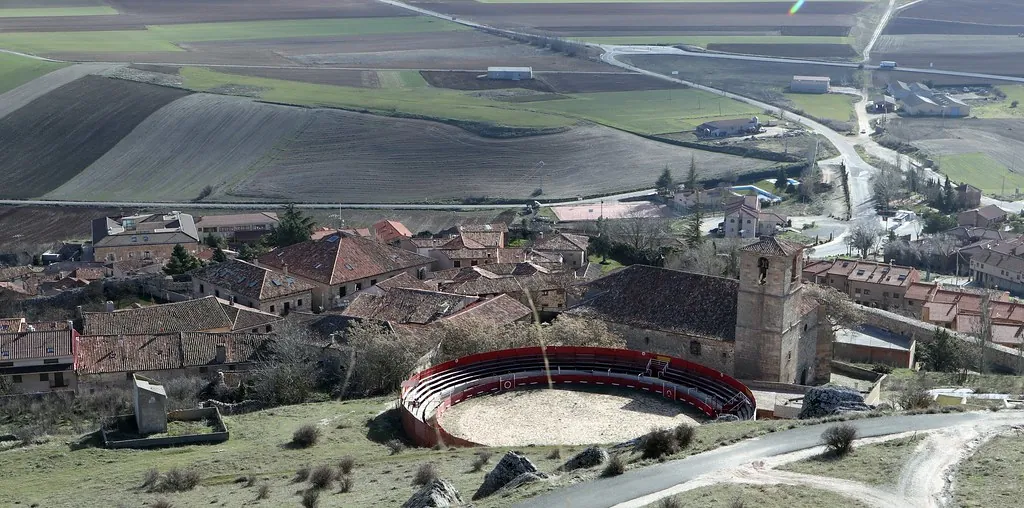
Vista aérea de Viana de Jadraque
Instituto Geográfico Nacional · CC-BY 4.0 scne.es
Castilla-La Mancha · Land of Don Quixote

Viana de Jadraque

The church bell strikes noon, and the sound carries clear across the valley. Forty seconds later, it strikes again—either the clock-keeper's having...

41 inhabitants · INE 2025
870m Altitude

Why Visit

Mountain Church of the Assumption Walks along the river

Best Time to Visit

summer

Assumption festivities (August) agosto

Things to See & Do
in Viana de Jadraque

Heritage

  • Church of the Assumption
  • flour mill

Activities

  • Walks along the river
  • relaxation

Festivals
& & Traditions

Fecha agosto

Fiestas de la Asunción (agosto)

Las fiestas locales son el momento perfecto para vivir la autenticidad de Viana de Jadraque.

Full Article
about Viana de Jadraque

Small village in the Salado valley; mill and riverside setting

Ocultar artículo Leer artículo completo

The church bell strikes noon, and the sound carries clear across the valley. Forty seconds later, it strikes again—either the clock-keeper's having a laugh, or the mechanism's given up after forty years. In Viana de Jadraque, population thirty-nine, this counts as morning entertainment.

Perched on the lower slopes of the Sierra de Pela, this stone hamlet sits higher than Ben Nevis's summit car park. The air thins noticeably as the road corkscrews upwards from the provincial capital Guadalajara, forty-five kilometres north-east. What begins as wheat fields and motorway service stations transforms into oak scrub and vertiginous drops, until suddenly the village appears—clustered around its mismatched bell tower like barnacles on a rock.

The Architecture of Survival

Every building here tells the same story: thick masonry walls designed for winters when the mercury plunges below minus ten, tiny windows to keep out the July heat, and roofs pitched just steeply enough to shed snow. The church of San Pedro Apóstol dominates the irregular plaza, its seventeenth-century bulk disproportionate to the surrounding single-storey cottages. Step inside and the temperature drops another five degrees; the stone flags have been worn smooth by centuries of parishioners, though these days the priest visits only monthly and folding chairs outnumber the faithful.

Walk the three principal streets—Calle Real, Calle de la Iglesia, and the gloriously named Calle Sin Nombre—and you'll spot the tell-tale signs of a village negotiating its own obsolescence. Number 14 Calle Real has fresh shutters and a satellite dish; next door, number 16 gapes open to the weather, its roof beams skeletal against the sky. Rehabilitation grants from the regional government have saved perhaps a dozen houses, turning them into weekend retreats for madrileños seeking proper dark skies. The rest slump gently back into the earth from which they were quarried.

Walking Through Layers of History

Forget waymarked trails and visitor centres. Here, hiking starts where the tarmac ends. The old livestock track heading north from the village fountain connects to a web of medieval paths that once linked La Mancha's hill towns. Follow the stone-lined channel upwards for ninety minutes and you'll reach the ruins of Viana's predecessor, abandoned during the fifteenth-century plague outbreaks. Foundations of forty-odd houses remain visible, together with a threshing circle carved directly into the bedrock. Nobody charges admission; nobody's around to collect it.

The Sierra de Pela proper begins another three hundred metres above the village. In May and June, these slopes explode with colour—purple thyme, yellow cytinus, white rockrose—painted across limestone scree that crunches like broken crockery underfoot. Griffon vultures wheel overhead, their two-metre wingspans casting moving shadows across the path. Carry water: the nearest spring dried up in last decade's drought, and the bar (singular) keeps irregular hours dictated by its proprietor's arthritis.

October brings a different crowd. Cars with Madrid number plates appear at dawn, their boots loaded with wicker baskets and cautionary tales about mistaken identity. Mushroom hunting transforms solitary shepherds into competitive foragers, each guarding their porcini patches with the jealousy of a Yorkshire allotment holder. The regional government publishes an annual map of permitted collecting zones; ignore it at your peril—plain-clothes forest agents can levy on-the-spot fines exceeding two hundred euros for unauthorised picking.

What Passes for Civilisation

The village shop closed in 2003 when its proprietor retired to Valencia. These days, supplies require a twenty-minute descent to Tamajón, where the petrol station doubles as grocery, pharmacy, and gossip exchange. Stock up accordingly before ascending, particularly on weekends when the solitary road acquires the atmosphere of a single-track Highland pass with added Spanish drivers.

Accommodation options remain limited to three restored houses available for short-term rental through the regional tourism board. Expect stone floors, wood-burning stoves, and Wi-Fi that functions when the wind blows from the correct quadrant. Prices hover around €80 per night for two people, minimum stay two nights—hardly outrageous when divided among a group, though remember to bring every consumable including coffee, olive oil, and toilet paper. The alternative lies seventeen kilometres away in the slightly larger (population 212) village of Valdepeñas de la Sierra, where Casa Rural La Fuente offers proper breakfasts and hot water that doesn't require twenty minutes of coaxing.

Seasons of Silence

August scorches. Temperatures regularly exceed thirty-five degrees by mid-morning, and the mountain breeze that makes coastal Spain bearable fails to materialise at this altitude. Spanish holidaymakers arrive regardless, occupying their grandparents' houses for the fiesta weekend around the fifteenth, when the population temporarily swells to perhaps two hundred. The church bell manages to strike correctly for three consecutive days—somebody clearly cares during festival season.

Winter arrives abruptly, usually during the first week of November. Snow can isolate the village for days; the regional government keeps a small plough based in Tamajón, but priority goes to the main road connecting the county towns. Carry blankets and provisions between December and March, even for what appears a straightforward day trip. The compensation comes in crystal-clear air that renders the Guadalajara plains fifty kilometres distant in photographic detail, and night skies unpolluted by anything brighter than the occasional passing satellite.

Spring and autumn provide the sweet spot. April's wildflowers transform abandoned terraces into impressionist canvases, while late September offers comfortable walking temperatures and the added theatre of migrant birds following the Jarama valley southwards. These shoulder seasons also coincide with reasonable accommodation rates and the highest probability of finding the bar open—though calling ahead remains advisable, if only to prevent disappointment and a twenty-kilometre drive for a coffee.

The Arithmetic of Decline

Demography here operates like mathematics from another century. The village school closed when attendance dropped below seven pupils in 1998. The last permanent resident under fifty departed for university in 2012 and never returned. Yet Viana de Jadraque refuses complete expiration. New owners from Madrid and Valencia inject weekend energy, their hired 4x4s contrasting sharply with locals' battered Renault 4s. Whether this represents genuine rural regeneration or merely urbanites playing at country life depends entirely on your perspective—and perhaps on whether you're relying on the village for anything beyond weekend amusement.

Drive away at dusk and the settlement shrinks rapidly in the rear-view mirror, until only the church tower remains visible against the mountain silhouette. Eventually that too disappears, leaving just the echo of that erratic bell and the realisation that places like Viana de Jadraque persist not despite their isolation, but because of it. The village will probably outlast us all—though the clock might still struggle with accurate timekeeping.

Key Facts

Region
Castilla-La Mancha
District
Sierra Norte
INE Code
19314
Coast
No
Mountain
Yes
Season
summer

Livability & Services

Key data for living or remote work

2024
TransportTrain station
Housing~6€/m² rent · Affordable
Sources: INE, CNMC, Ministry of Health, AEMET

Planning Your Visit?

Discover more villages in the Sierra Norte.

View full region →

More villages in Sierra Norte

Traveler Reviews