Full Article
about Villares de Jadraque
Mountain village with golden stone; quiet setting
Hide article Read full article
At the End of the Road
Some villages appear because they happen to be on the way to somewhere else. Others turn up at the end of a minor road, just as you begin to wonder if you have taken a wrong turn. Villares de Jadraque belongs firmly in the second group.
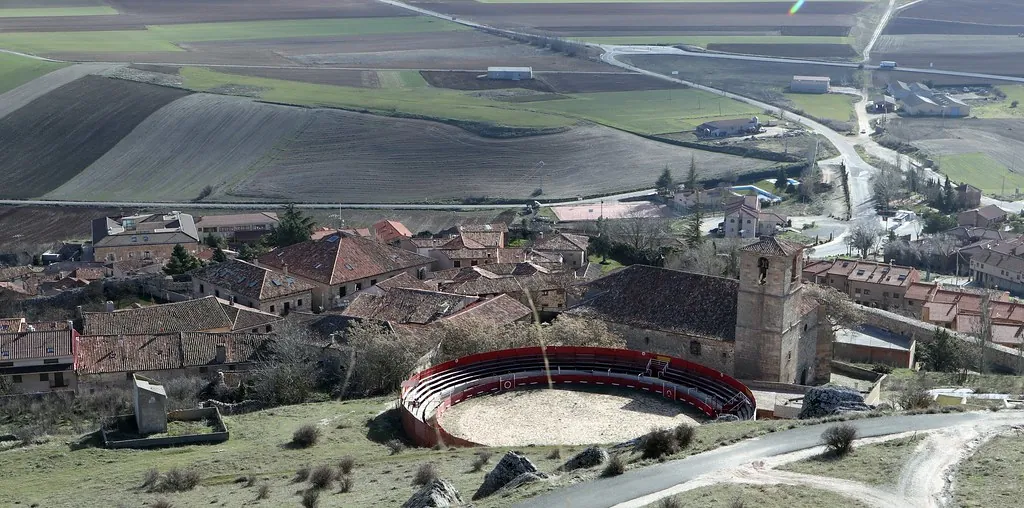
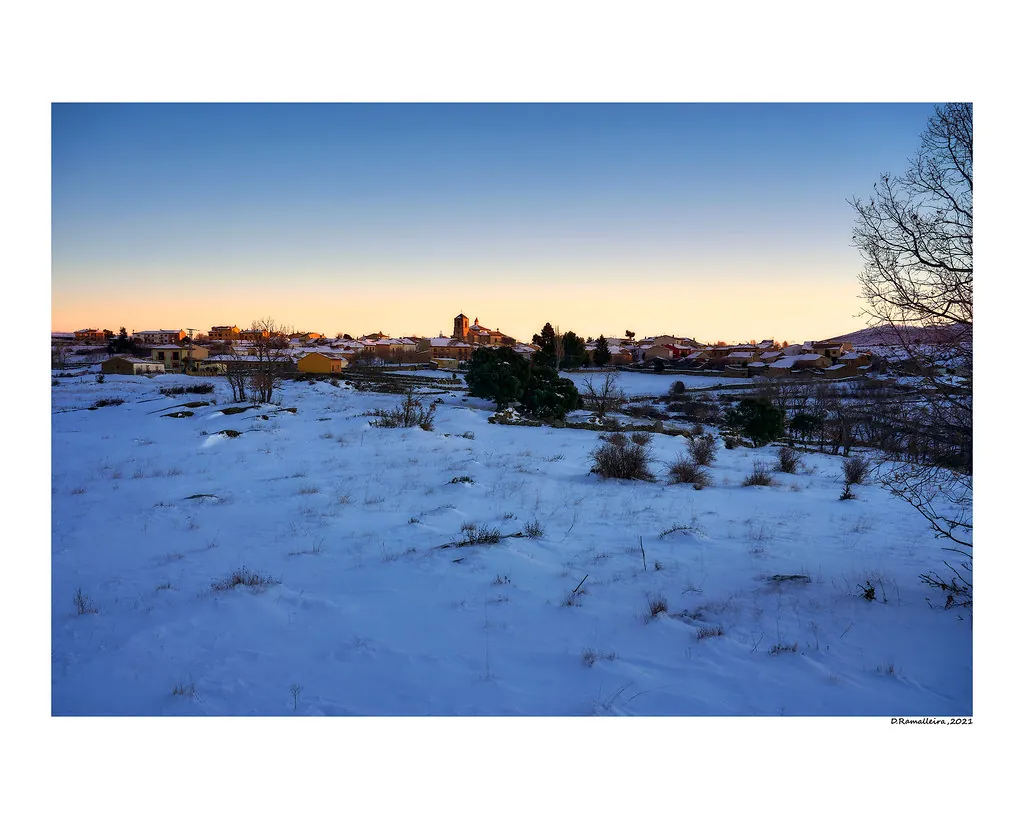
Set at around 1,050 metres above sea level, on the high plateau that surrounds the Sierra de Pela, this small settlement in the Sierra Norte of Guadalajara seems to exist in a kind of pause. Not in the sense of an open-air museum, but more like a place where change simply arrives more slowly. The village consists of barely a dozen streets, lined with houses built from stone and adobe, their large wooden gates bearing the marks of several decades. Many still have corrals and agricultural features that recall a time when daily life revolved around the land.
Walking through Villares does not feel like visiting a tourist destination. It feels more like passing through a place that continues at its own rhythm, even if fewer people remain each year. With just 39 registered inhabitants, silence forms part of the landscape almost as much as the surrounding fields.
A Landscape Shaped by Wind and Stone
The wider comarca has a very distinctive character. Ravines open up unexpectedly in the terrain, rocky slopes break the horizon, and fields shift in colour with the seasons. Here and there, a holm oak or juniper interrupts the sweep of the plateau. Traditional activity in this part of Guadalajara has long centred on livestock and extensive farming, and that history is written into the architecture: thick walls, generous corrals, and buildings designed to withstand long winters and persistent wind.
Modern infrastructure is limited, and that too tells a story. There have been few major transformations over recent decades, something that becomes clear as soon as you take an unhurried walk. The sense is not of abandonment, but of continuity on a smaller scale.
A Slow Walk Through the Village
Villares de Jadraque is not a place for ticking off monuments. It rewards a slower approach, noticing small details rather than searching for headline sights. The main street more or less follows the original layout of the village, and it does not take long to explore. In half an hour, walking at an easy pace, most of it can be seen.
The parish church of San Juan Bautista stands slightly above the surrounding houses. Built in limestone, it is a simple structure with a semicircular arched doorway that appears to be one of its oldest elements. A tower serves as the bell tower, rising above the rooftops and visible from several corners of the village.
Around the church and along the streets, small family vegetable plots still survive. Outbuildings show traces of old brickwork, and tools that are rarely used today can still be recognised. Large wooden gates reinforced with sturdy metal fittings guard entrances to former corrals. On some façades, marks and inscriptions made by residents decades ago remain etched into the surface.
It is not a long stroll, but it offers an insight into how an agricultural village in this part of Castilla La Mancha was organised. The layout, the materials and the scale all reflect a community shaped by farming and livestock rather than by passing visitors.
Walking Out into the Open
If anything defines Villares de Jadraque, it is what lies beyond its last houses. Step onto any of the surrounding tracks and you are immediately in an open landscape of ravines that carry water in rainy periods, limestone scree and low scrub well adapted to dry summers.
In spring and early summer, the air carries the scent of thyme and other aromatic plants that grow between the stones. On clear days, the views towards the Sierra de Pela stretch wide across the plateau. From these higher points, it becomes easier to understand why villages here were established on elevated ground, where sightlines and exposure mattered.
Winter brings a different mood. Wind often takes centre stage, sweeping low clouds quickly across the fields. This is a familiar scene in this part of Guadalajara, where weather can shift rapidly and the openness of the terrain leaves little shelter.
The traditional paths that once linked Villares to neighbouring hamlets can still be followed, although many lack recent signposting. With a map or by asking a local resident, it is straightforward to find simple routes for a walk in the surrounding countryside. Along the way, large birds can often be seen gliding above the ridges, while smaller species dart through the scrub.
Autumn introduces another seasonal rhythm. After the rains, mushrooms appear in certain areas of the fields. Local people who go out to collect them do so carefully, aware that not every variety is easy to identify.
And then there is the night. Light pollution is practically non-existent here. When the sky is clear, the stars appear with a sharpness that is difficult to imagine in a city. A short walk along any dirt track away from the village is enough to stand and look up for a long while, with no artificial glow to interfere.
Food and Practicalities
It is best to know in advance that Villares de Jadraque has no bars or restaurants. This is one of those villages where, if planning to spend a few hours, bringing provisions from elsewhere is the most practical option.
From time to time, a resident may sell local produce such as lamb or embutidos, traditional cured meats, if asked in advance and if circumstances align. The cuisine of the area has always been rooted in rural life: migas, a hearty dish based on fried breadcrumbs, along with other substantial meals designed to sustain people through physical work and cold weather.
Villares de Jadraque does not attempt to impress, and it does not reinvent itself for visitors. Its appeal lies in its scale, its quiet persistence and the landscape that surrounds it. For those willing to follow a secondary road to its end, it offers a clear view of a way of life that continues, quietly, on the high plains of the Sierra Norte.