Full Article
about Almadén
UNESCO World Heritage Site for its historic mercury mines; it holds a unique industrial heritage.
Hide article Read full article
A place that smells of the underground
Roll down the car window on the approach and there is a smell that catches you off guard. It sits somewhere between sulphur and hot metal. At first it feels strange, then it starts to make sense. Almadén smells like what lies beneath it. Like earth that has been turned over for centuries.
This is not a place built around palaces or paintings on walls. Its story comes from a hole in the ground. It is tied to picks, red dust and long shifts below the surface.
The town that powered half the world
One way to understand Almadén is to imagine something essential being kept in an ordinary place. For centuries, that was effectively the case here.
The mercury extracted in Almadén was used to separate silver from ore in the Americas. The source was cinnabar, a striking red stone that almost looks artificial because of its intensity. From here, it travelled thousands of kilometres. Without that mercury, many of the American mines would have worked differently, or not in the same way at all.
Mining has stopped, but the site still sits at the centre of everything. Today, it can be visited as part of the Parque Minero. Visitors are given a helmet and taken down into a real gallery of the mine. This is not a reconstruction. It is underground, with damp walls and that constant sense of weight above you.
Some of these galleries are very old, with references to mining activity going back to Roman times. The visit helps make clear how deeply this place shaped everyday life. Free miners worked here, along with skilled labourers and prisoners sent to the mine. It was far from an easy destination.
A bullring where people live
Step back out into daylight and the contrast is sharp. Light, quiet streets, and a town that seems calm. Then the bullring appears.
This is not a typical one. It has a hexagonal shape, and around it are houses built directly into the structure. Balconies look straight onto the arena. At first glance, it feels like a vast inner courtyard where someone decided to hold bullfights.
It dates from the 18th century and had a practical purpose. It provided housing for mine workers, while also serving as a space for celebrations. People still live there today, which makes it all the more unusual. Daily life continues with an arena just below the windows.
Up to the castle for a sense of place
For a better view of how everything fits together, it is worth heading up to the Castillo de Retamar. What remains is closer to a defensive tower with fragments of wall, but the location matters more than the structure itself.
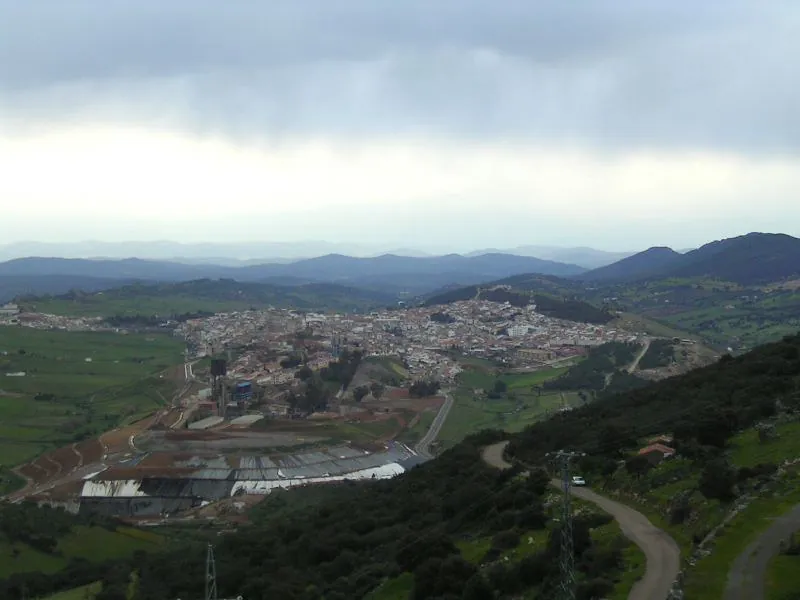
From there, the layout of the town becomes clear. Low houses, reddish roofs, and streets that do not follow neat, straight lines. Beyond that, the landscape is dominated by dehesa, with holm oaks and scrubland stretching outwards. On clear days, the Castilseras reservoir can be seen in the distance, breaking up the dry tones of the surroundings.
There are several easy routes in the area. These are not demanding walks, more like quiet paths through holm oak, rockrose and rosemary. The kind of walk taken slowly, without paying much attention to the time.
Food shaped by hard work
The food in Almadén reflects the people who cooked it.
Gazpacho manchego is still widely served. Despite the name, it has nothing to do with the cold soup from southern Spain. This is a hot stew made with meat, often game or chicken, and pieces of torta cenceña, a type of flatbread broken into the dish. It is filling and makes most sense in colder weather.
Migas appear frequently as well. They are based on bread, garlic and fat, with additions like chorizo or panceta. Sometimes grapes or something sweet are added for contrast. It is food designed to sustain long, cold working days.
There are also cured sheep’s cheeses from the area, and honey from the surrounding scrubland. The latter often carries strong flavours of thyme or rosemary.
When to go, and when to think twice
Spring and early autumn tend to be the most comfortable times to visit. There is more movement in the town, the countryside feels more alive, and walking does not become a test of endurance.
Summer brings intense heat. August in particular has a familiar pattern seen in many inland towns, with many locals away and a quieter atmosphere as a result.
Throughout the year, events linked to the town’s mining history take place, along with romerías in the surrounding countryside. At certain times, that brings a noticeable sense of activity.
A simple way to spend the day
Almadén is not a place that needs several packed days. It works better at a slower pace, over the course of one day.
A typical visit might start in the morning with a descent into the mine, followed by a walk through the centre. Sitting for a while in the main square fits naturally into the rhythm of the place. Later, heading up to the castle helps put the landscape into context.
After that, there is the option of driving out towards the Castilseras reservoir or along secondary roads in the Valle de Alcudia, where the open countryside still feels largely unchanged.
What makes Almadén stand out is not only what can be seen, but what it represents. For centuries, material from this town travelled far beyond it, reaching mines and economies thousands of kilometres away. Here, that story remains tied to the ground beneath your feet.


