Full Article
about Guadalmez
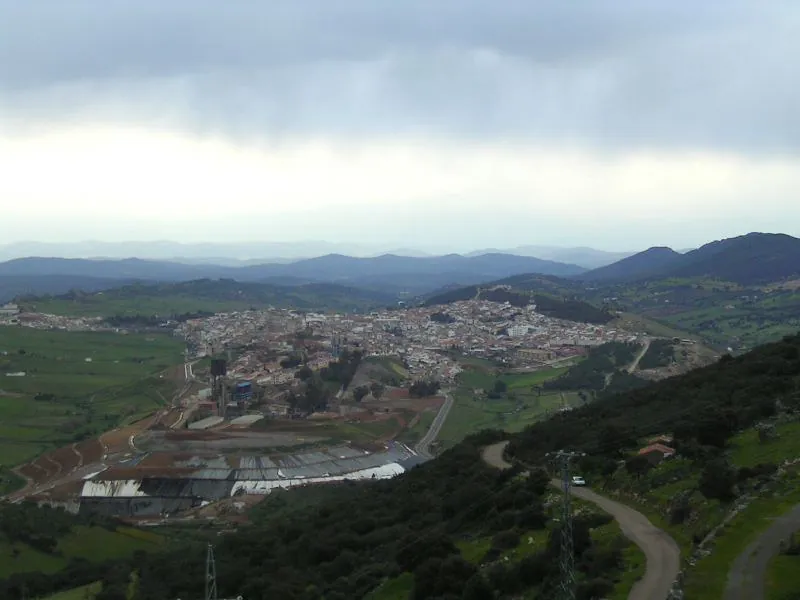
Set at the far west beside the river that gives it its name; a landscape of pastureland and natural border with Extremadura and Andalucía.
Hide article Read full article
A quiet arrival in the Valle de Alcudia
A drive across the Valle de Alcudia has a peculiar rhythm. For long stretches, very little seems to happen. Holm oaks spread across the landscape, an occasional livestock building appears, the road bends gently. Then Guadalmez comes into view.
This small town, home to around 700 residents, sits within a dehesa landscape that shapes everything more strongly than any urban plan. Anyone considering tourism in Guadalmez should keep this in mind from the start. The place moves at its own pace, and it makes no effort to speed up for visitors.
A town that keeps things simple
Guadalmez does not try to impress at first glance. Its streets follow the logic of a livestock town, organised just enough to support daily life. Whitewashed houses line the roads, topped with curved roof tiles. Large gates hint at corrals hidden behind them.
At the centre stands the church of Nuestra Señora de la Asunción. It is not a grand monument, yet it naturally becomes a point of reference. After wandering through the streets, this is where people tend to return. In small towns like this, the square and the church still serve a practical purpose: a simple meeting point that everyone understands.
A short walk reveals how the town has grown over time. There is no carefully preserved historic quarter designed for photographs. Instead, the layout reflects necessity. Houses were built when needed, then expanded as families grew. The result feels functional rather than curated, shaped by everyday life rather than long-term planning.
Where the dehesa begins
The defining feature of Guadalmez lies just beyond its edges. Leave the last houses behind and the dehesa of the Valle de Alcudia begins almost immediately. Holm oaks dominate the view, with occasional stretches of stone fencing and dirt tracks leading into livestock estates.
This is a place suited to unhurried walking. Many rural paths cross the area, though not all are signposted. It is common to rely on a map on your phone or to ask a local for directions before heading out.
At certain times of year, the surrounding countryside becomes more noticeable in subtle ways. Autumn brings one of those moments. The sound of deer can often be heard at dawn or as evening falls. Birdlife is also active in this part of the region, something that attracts those interested in observation.
The landscape does not present itself as a spectacle. It unfolds slowly, with small details that become clearer the longer you stay.
Traces of a mining past
The Valle de Alcudia was once an area of mining activity, and signs of that period still appear around Guadalmez. Old mine entrances can be spotted in the hillsides, and piles of debris interrupt the natural patterns of the terrain.
These remains are not set up as tourist attractions. There are no panels explaining their history or marked routes connecting them. They simply remain where they are, part of the landscape and a reminder that the town once depended on a different kind of economy before returning to a quieter, agriculture-based way of life.
It takes a bit of attention to notice them, but once seen, they add another layer to the surroundings.
Food shaped by the land
Local cooking follows the logic of the area. Ingredients come from what the land provides, and dishes reflect that simplicity. Iberian pork raised in the dehesa is a key element, along with hearty stews and traditional Manchego recipes such as migas, a dish made from fried breadcrumbs.
Meals here are straightforward rather than elaborate. There is no emphasis on presentation or modern twists. The focus stays on food that is filling and makes sense after a morning spent walking in the countryside or driving along long rural roads.
This style of cooking fits naturally with the pace of Guadalmez. It is practical, rooted in tradition, and closely tied to daily life.
Festivities through the year
Celebrations in Guadalmez follow the rhythm of the local calendar. Each season brings its own moments of gathering.
Summer is marked by festivities in honour of Nuestra Señora de la Asunción. These include processions and activities that take place in the streets, bringing the town together.
Winter has its own atmosphere. During San Antón, bonfires are a common sight. On cold nights in the valley, the fire serves both as warmth and as a place to gather and talk.
Semana Santa, or Holy Week, is also observed, though in a modest format. Processions are shorter, participation comes mainly from residents, and the overall feeling remains very much that of a small town.
These events do not aim for spectacle. They continue because they are part of the local rhythm, linking the year together in familiar ways.
Getting there and moving around
Guadalmez sits away from major routes, and that sense of distance is part of its character. Travelling by car is usually the most practical way to reach the town and to explore the surrounding area.
Public transport exists but does not always offer convenient schedules for those who want to take their time. The roads connecting Guadalmez with other villages in the Valle de Alcudia are secondary routes that cross long stretches of countryside.
Driving along them becomes part of the experience. The scenery changes very little from one place to the next, yet gradually a clearer picture of the region emerges.
Guadalmez fits easily into that kind of journey. It is a place to pause for a while, walk through the dehesa, enjoy a substantial meal, and then continue across the valley. Sometimes that is all that is needed.