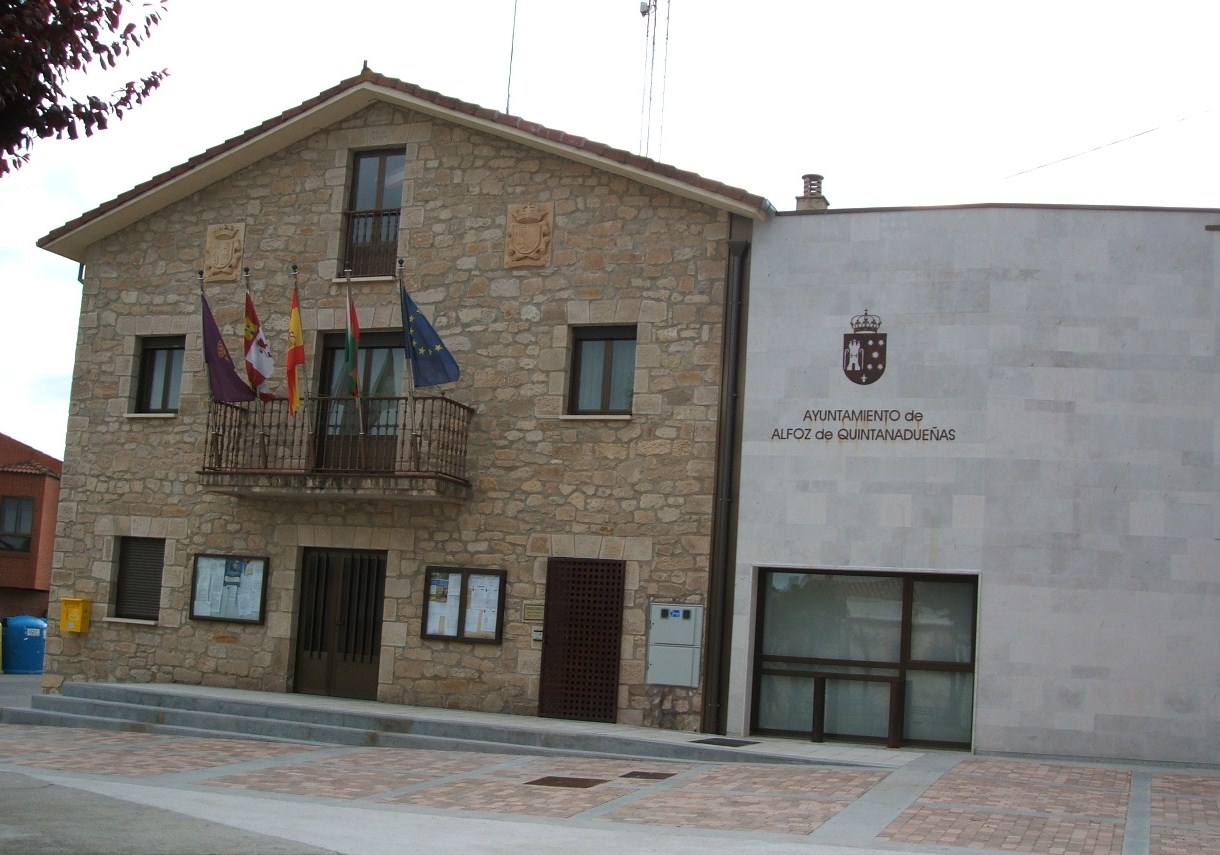
Ayuntamiento de Quintanadueñas1.JPG
Miguelmiguelmiguel · CC0
Castilla y León · Cradle of Kingdoms

Alfoz de Quintanadueñas

The cereal silos beside the A-1 are the first clue that you have arrived somewhere organised around grain, not tourists. They rise like concrete se...

2,158 inhabitants · INE 2025
845m Altitude

Why Visit

Mountain Church of Santa María Local hiking

Best Time to Visit

year-round

October festival of the Virgen del Rosario octubre

Things to See & Do
in Alfoz de Quintanadueñas

Heritage

  • Church of Santa María
  • Hermitage of the Martyrs

Activities

  • Local hiking
  • Cycling
  • Quiet life

Festivals
& & Traditions

Fecha octubre

Fiestas de la Virgen del Rosario (octubre)

Las fiestas locales son el momento perfecto para vivir la autenticidad de Alfoz de Quintanadueñas.

Full Article
about Alfoz de Quintanadueñas

A growing residential municipality in the Burgos metropolitan area; quiet and well connected.

Ocultar artículo Leer artículo completo

The cereal silos beside the A-1 are the first clue that you have arrived somewhere organised around grain, not tourists. They rise like concrete sentinels above the flat horizon, catching the late-afternoon light that bounces off kilometre after kilometre of wheat stubble. Alfoz de Quintanadueñas is not a place that announces itself with a dramatic gorge or a honey-coloured plaza; it simply begins where the slip road ends, scattering its five thousand inhabitants across a handful of low-rise barrios that merge almost imperceptibly with the surrounding farmland.

At 845 m above sea level, the air is thinner than on the Cantabrian coast ninety minutes north, and the wind carries the dry smell of straw rather than salt. This is the meseta, Spain’s central plateau, where summer midday heat can touch 38 °C and winter nights drop to –8 °C. Spring and autumn are the comfortable seasons: bright, breezy days when the wheat changes colour like a slow-turning traffic light—green in April, gold by late June, then the muted ochre of ploughed earth after the harvest.

What the word “alfoz” still means

The name is a leftover from the Reconquista, when an alfoz was the belt of dependent villages that fed a fortified town. Here the town was Burgos, twelve kilometres away, and the relationship still defines daily life. Locals shop in the city hypermarkets, commute to hospital jobs, and return at night to houses that are legally within the village boundary but separated by open fields. The council covers 62 km² yet there is no discernible centre: five parish churches, a health centre, two petrol stations and a primary school are dotted along the BU-901 like beads on a broken necklace.

Architecture is functional rather than pretty. Granite is plentiful, so walls are thick and grey; roofs of half-round terracotta tiles dip gently to cast iron gutters designed for snow load rather than romance. Adobe granaries—horreos—survive in back gardens, their wooden stilts raised to keep rats away from the grain. Here and there a 1950s palomar (dovecote) stands abandoned, its stone spiral staircase ending in mid-air, a reminder that pigeon squab once supplemented the peasant diet.

Walking without a selfie-stick audience

The best way to understand the place is to walk the caminos that link the scattered hamlets. These are wide farm tracks, graded for tractors, so navigation is simple: keep the wheat on one side, the sun on the other. A circular circuit south-east of the church of San Juan takes you past Las Abejas, a apiary that sells raw heather honey from a fridge on the porch (€6 for 500 g, leave coins in the honesty box). Continue for 4 km and you reach a copse of quejigos—Portuguese oaks—where hoopoes flicker across the path and the only sound is the mechanical chirp of a distant combine.

There are no way-markers, no souvenir stalls, and almost no shade; carry water and a hat. The reward is the horizon: a 270-degree sweep that ends at the limestone ridge of the Sierra de la Demanda, faintly blue, forty kilometres away. On a clear April morning you can just make out the radio mast above Burgos cathedral, a vertical pencil line that proves the city has not vanished.

Lamb, blood sausage and the chips safety-net

Food is Castilian country cooking—robust, meat-heavy, unapologetically salted. In the hotel Asador on the main road, lechazo (milk-fed lamb) arrives on a clay dish, flattened like a spatchcocked cushion, its skin blistered from the wood-fired oven. A half portion is still 400 g, so order for two unless you are ravenous; ask for it bien hecho if you dislike pink juices seeping into the roast potatoes. The local morcilla de Burgos is unusually light on rice, heavy on onion and fat, and collapses into dark grains that stain the plate like squid ink. Children or fussy adults can retreat to a simple pollo asado with chips (€12), cooked on the same grill but stripped of adventure.

Wine lists rarely leave the province: look for Ribera del Dueno crianza at €18 a bottle, or the house tinto from nearby Aranda for €2.50 a glass that tastes better after the second sip. Dessert is often leche frita—cubes of custard fried in breadcrumbs and dusted with cinnamon sugar, best eaten before they cool into glutinous bullets.

When to come, and when to stay away

The village functions as a commuter dormitory, so weekdays are quiet but services are open. Weekends bring visiting grandchildren and the low thud of moto-cross bikes on the dirt tracks; Sunday lunch tables fill by 2 p.m. and empty by 4.30. August fiestas—each hamlet chooses its own weekend—mean late-night verbena dances under fairy lights, free caldo (beef broth) ladled from iron cauldrons, and the casual sale of illegal fireworks. If you want silence, avoid those nights; if you want atmosphere, arrive on the Saturday, accept the thumping reggaeton, and book a room at the back of the hotel.

Winter can be startlingly cold. Frost lingers until eleven in the morning, and the wind that roars across the plateau has nothing to slow it until the Cantabrian mountains. Roads are gritted promptly—the A-1 is a freight artery to Portugal—but minor routes ice over. From December to February treat the place as a stopover with central heating, not as a rural idyll.

Beds, petrol and other practicalities

HQ La Galería is the only three-star option inside the municipal boundary: 42 beige rooms, double-glazed against truck noise, €72 bed-and-breakfast mid-week, free parking that fills with long-distance lorry drivers by 9 p.m. Its fibre-optic Wi-Fi actually reaches the upper floors, a pleasant surprise after the patchy 3G of the surrounding fields. Alternatives lie back towards Burgos: Hotel Rural Tierras del Cid in neighbouring Quintanadueñas village (9 km) has stone walls, under-floor heating and a small spa pool, useful if the wind is horizontal. Self-caterers can book Apartamentos Los Queseros—nine flats above the cheese shop in the hamlet of Mambrillas de Lara, kitchens stocked with olive oil and coffee pods at €94 a night.

There is no railway station; buses from Burgos run twice daily Monday-Friday, not at weekends. A hire car is essential. Fill the tank before you leave the city—the only 24-hour station here is card-only and frequently empty by Sunday evening. Cash machines are equally scarce; the nearest reliable ATM is inside the Repsol by the hospital roundabout on the N-234.

An honest verdict

Alfoz de Quintanadueñas will never compete with the tiled dazzle of Andalucía or the green gorges of Asturias. It offers instead a slice of everyday Castile: wheat fields that stretch to the edge of the sky, churches whose bells mark the hours for people rather than postcards, and restaurants where the house wine is poured without ceremony into thick glass tumblers. Come if you need a reset between Burgos cathedral and the Rioja vineyards, or if you simply want to walk until the only sound is the wind combing through barley. Stay a night, maybe two. Then point the car north, south, east or west—within an hour the motorway will have swallowed the horizon and the wheat will be a memory in the rear-view mirror.

Key Facts

Region
Castilla y León
District
Alfoz de Burgos
INE Code
09907
Coast
No
Mountain
Yes
Season
year-round

Livability & Services

Key data for living or remote work

2024
ConnectivityFiber + 5G
TransportTrain nearby
HealthcareHospital 4 km away
EducationHigh school & elementary
Housing~5€/m² rent · Affordable
CoastBeach nearby
Sources: INE, CNMC, Ministry of Health, AEMET

Official Data

Institutional records and open data (when available).

  • IGLESIA DE SAN GIL
    bic Monumento ~5.1 km
  • CASA DEL CORDON
    bic Monumento ~5.4 km
  • CONJUNTO DEL MONASTERIO DE SAN JUAN
    bic Monumento ~5.4 km
  • PUERTA DE SAN ESTEBAN
    bic Monumento ~5 km
  • IGLESIA DE SAN ESTEBAN
    bic Monumento ~5.1 km
  • IGLESIA DE SANTA MARIA
    bic Monumento ~6.4 km
Ver más (7)
  • MURALLA DE BURGOS
    bic Castillos
  • TORREON DE VILLAGONZALO-ARENAS
    bic Castillos
  • ARCHIVO HISTÓRICO PROVINCIAL
    bic Archivos, Museos Y Bibliotecas
  • BIBLIOTECA PÚBLICA
    bic Archivos, Museos Y Bibliotecas
  • CRUCERO PLAZA DEL REY
    bic Rollos De Justicia
  • CRUCERO GAMONAL RIO PICO
    bic Rollos De Justicia
  • CASTILLO
    bic Castillos

Planning Your Visit?

Discover more villages in the Alfoz de Burgos.

View full region →

More villages in Alfoz de Burgos

Traveler Reviews
