Full Article
about Alentisque
Quiet village with Romanesque remains and holm-oak surroundings
Hide article Read full article
A Hilltop Village Above Almazán
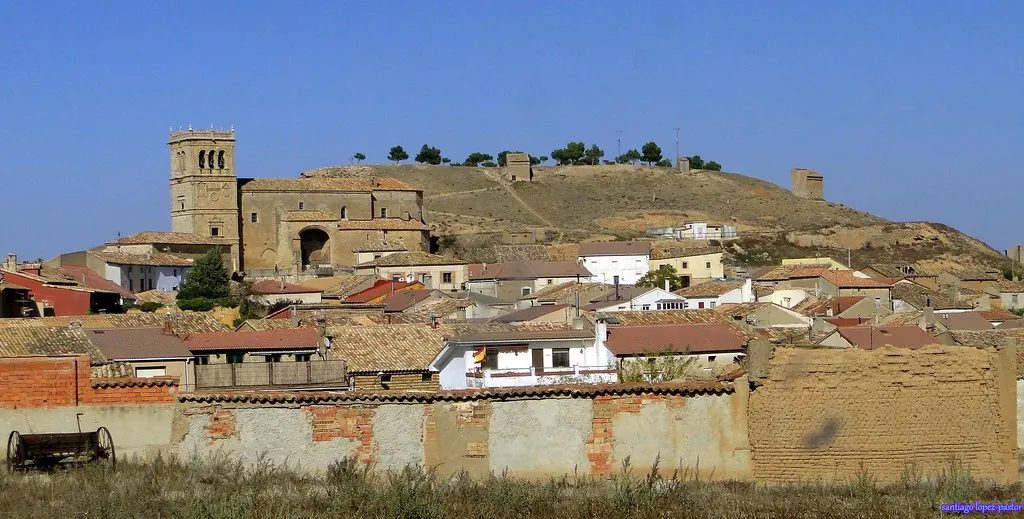
Early in the morning, when the air still holds a chill even on clear days, Alentisque sits almost in silence on the high ground of the Almazán district in the province of Soria. The houses, built of stone and adobe, with the occasional wooden door darkened by time, form a small cluster of streets where the wind moves freely. On an autumn day it can be heard clearly as it brushes against façades, lifts a little dust from the tracks and slips between empty pens. Just over twenty people live here today, and that modest scale is immediately apparent.
The village is small enough to cross in a matter of minutes. Some gateways have been closed for years, a few façades lean with age, while other homes are still carefully kept, with pots on the windowsill or a car parked by the door. From the little square, the view opens out across the páramo, the high, open plateau typical of this part of inland Spain. There are cereal fields, scattered holm oaks and a clean line of horizon that seems to retreat the longer you look at it.
By late afternoon the light turns low and golden. Textures stand out more sharply on the walls, and the straw tones of the stubble fields deepen. There is barely any noise. Now and then a car passes along a nearby road, but most of the time there is only the wind and, in spring, the faint movement of insects along the field margins.
San Pedro Apóstol, Stone and Silence
The parish church of San Pedro Apóstol rises from one of the most visible points in the village. Built in pale stone, it has a solid tower that can be recognised from the tracks leading towards Alentisque. The doorway is simple, with little ornamentation, as is common in many rural churches across this part of Soria.
When the door is open, which depends on whether neighbours are nearby or if there is a specific celebration taking place, the interior feels restrained and quiet. The stone floor shows the wear of many years. A modest altarpiece still retains traces of polychrome paint in some areas. Light filters through small windows and falls in soft patches against the walls.
There is nothing grand about the building, and that is precisely its character. It belongs to the same rhythm as the village itself, shaped by daily life rather than by spectacle.
Walking the Páramo
Several agricultural tracks lead out from Alentisque and disappear into the surrounding fields. They are not signposted as walking routes. In reality, they serve as access to farmland rather than as purpose-built paths. Even so, following them on foot is the most direct way to understand the landscape that defines the village.
The slopes are gentle and the terrain largely open. On clear days the view stretches a long way, something typical of this stretch of the Soriano plateau. In spring, green bands appear between the scattered holm oaks. By mid-summer, everything shifts towards ochres and golds as the cereal dries in the fields.
Preparation matters here. There are no fountains and no reliable shade, and the wind can be strong even when the sun is out. A short walk around the edge of the village is usually enough to get a sense of the terrain and its scale. Distance is measured less in kilometres than in horizon lines.
Light, Mist and Long Views
Those interested in photography will find the most rewarding moments at first light or towards sunset. The low sun emphasises the relief of the land and warms the tones of the stone walls. In autumn, some mornings bring low-lying mist that partially covers the nearby fields, leaving the village seeming to float above a white layer.
There is no need to venture far. A brief walk along a dirt track and a turn back towards the village is often enough to see the whole settlement from the outside: the tight cluster of houses, the church tower and, all around, kilometres of open countryside.
The sense of space is constant. The plateau does not frame the village dramatically; it simply extends in every direction. Weather and season alter the colours and textures, yet the basic outline remains unchanged.
Eating in the Area and the Rhythm of the Year
There are no bars or restaurants in Alentisque itself. The usual option is to drive to a larger village within the Almazán district, where more services are available. Across this area of Soria, dishes based on lamb are common, along with cured sausages. In autumn, mushrooms gathered from nearby woodland also appear on local tables.
For those spending a morning walking around the fields, bringing some food and sitting for a while in the open air makes sense. The landscape here encourages pauses rather than constant movement.
With so few permanent residents, daily life is quiet. Even so, there are moments in the year when Alentisque regains a measure of activity. The feast of San Pedro, held towards the end of June, usually draws back people who maintain family ties to the village even if they no longer live here. During those days some houses reopen and the streets take on a different feel.
For the rest of the year the usual rhythm returns: few lights at night, only occasional cars and a landscape that shifts with the seasons. Alentisque does not revolve around tourism. It is simply one of those places that remains, discreetly, in the countryside of Soria, with the wind moving through its streets much as it has done for decades.