Full Article
about Borjabad
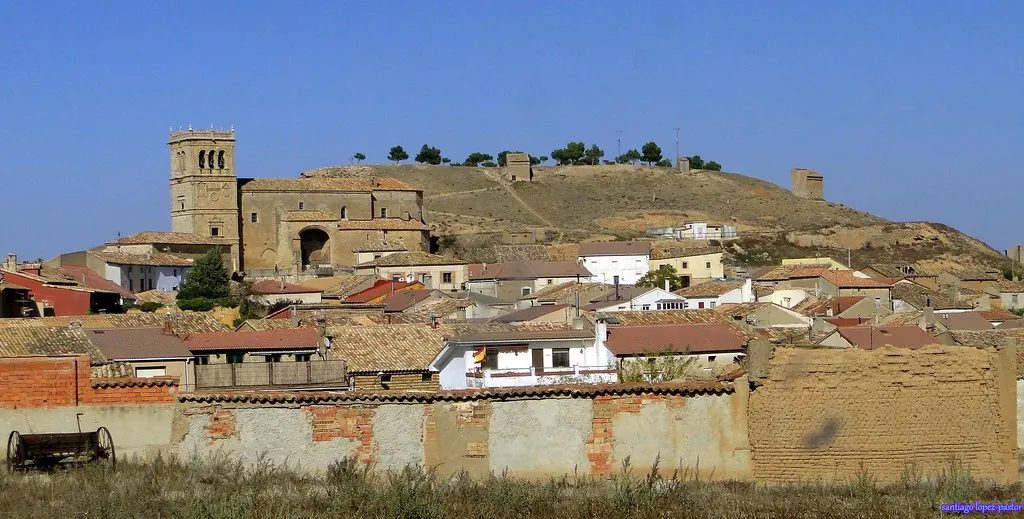
Small settlement among holm oaks and farmland with a prominent church
Hide article Read full article
Borjabad, a hamlet on the Sorian plateau
Borjabad is one of the smallest registered villages in the Almazán region, with a census that has hovered around thirty residents for years. Its existence is tied to the medieval repopulation processes emanating from Almazán, which organised this territory into agricultural hamlets. The village sits at just over a thousand metres on the slopes of the Sierra de Toranzo, its houses spread across open terrain defined by cereal fields, holm oaks, and junipers.
The local architecture speaks directly to that past. The buildings are solid, with thick walls of stone and adobe and wide gateways designed for carts and livestock. There is no ornamentation; these are practical structures built to withstand the long winters and persistent wind of this exposed part of the plateau. They follow the vernacular style common across rural Soria, where form has always followed function.
The church as a point of reference
The church of La Asunción occupies the highest point in the village. While its foundations are medieval, its current appearance is the result of later modifications, a common trait in rural parishes that were adapted over time. Its artistic interest is modest, but its location is not accidental.
From its position, the church tower overlooks the cluster of houses and the surrounding farmland. In settlements of this size, the tower served a clear practical purpose: it marked the hours and could signal to the whole community. The church grounds were, for centuries, the natural meeting point. The village layout still reflects this, with a handful of short, quiet streets converging towards it.
A landscape shaped by dryland farming
The land around Borjabad shows the classic patterns of the Sorian countryside. This is not a decorative landscape but one shaped by generations of dryland cereal farming and livestock grazing. Large, open fields change colour with the seasons, interrupted only by patches of resilient holm oak and juniper.
If you walk the paths leading out from the village, you can still see remnants of an older agricultural order: stone boundary markers and the ruins of isolated enclosures. These are traces of the mixed system of common lands and family plots that structured life here from the Middle Ages onwards. The distribution of fields and tracks reveals a rural organisation that has adapted slowly, its imprint remaining clear on the land even with far fewer people working it.
Walking the working tracks
A network of agricultural tracks extends from the village into the countryside. These are working routes, maintained for farming, but they also provide straightforward walking among the fields and scrubland. The visibility is wide here, and it is common to see birds of prey—common buzzards or kestrels—circling over the open ground.
The altitude and absence of major light sources make for notably clear night skies. A short walk away from the village centre on a cloudless night is enough to see the difference. In autumn, after the first rains, some nearby pine woods in the wider comarca attract foragers, though it is necessary to check the current mushroom-picking regulations for the province.
Context within the Almazán region
Borjabad falls within a region where Romanesque architecture is scattered across many small villages. These settlements were historically part of a network that supported the town of Almazán. The village itself is small; you can walk its streets in a brief visit.
Its value lies in its coherence as a hamlet whose form is still directly tied to its agricultural past. It functions best as a quiet pause on a broader route through the Sorian plateau, a place to observe how traditional architecture sits within a landscape that has been worked for centuries. What remains here is not a monument, but a tangible record of rural life shaped by climate, work, and necessity.