Full Article
about Coscurita
Historic rail junction and farming village on the plain
Hide article Read full article
A village shaped by silence and light
By mid-morning, when the sun is already hitting the façades head-on, Coscurita settles into near silence. Light bounces off stone and adobe walls and slips into the narrow streets laid out at right angles. In the square, the church clock marks the hours with a dry, clear sound that carries further than expected in such a small place. Beyond the last row of houses, open countryside begins almost immediately.
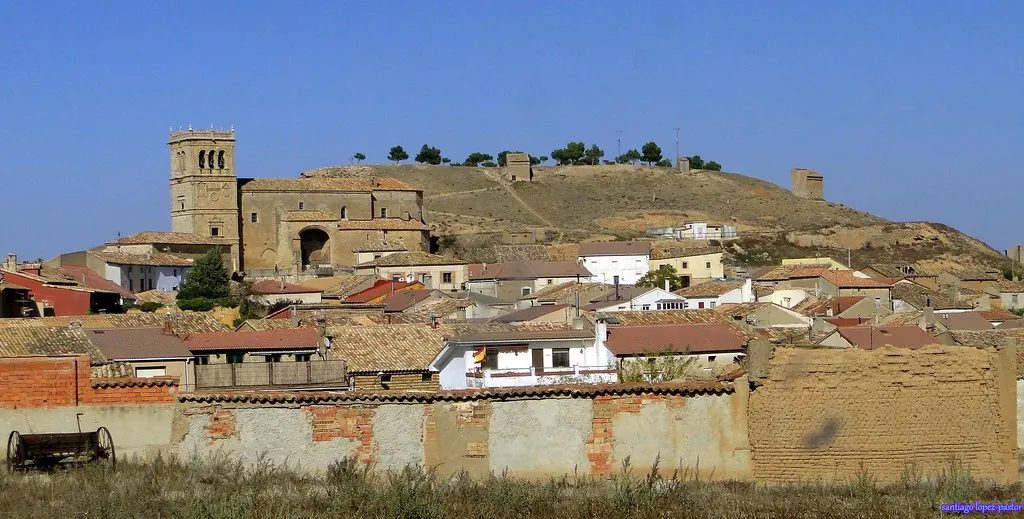
Coscurita sits in the Almazán area, in the south of the province of Soria, within Castilla y León. It is one of those very small settlements where the landscape feels more dominant than the village itself. There are only a handful of streets, some farm buildings and enclosures, and the church at the centre holding the layout together. Life here still follows the rhythm of the agricultural calendar. During harvest time, tractors move in and out throughout the day; in winter, the streets can remain empty for hours at a stretch.
Around the church of San Martín
The layout is simple and easy to grasp within minutes. Several short streets lead into the area around the church of San Martín, whose bell gable rises above the lower rooftops. Pale stone and adobe define most façades, many with large wooden gates that hint at their agricultural use.
Walking slowly through the village brings out small details. A whitewashed wall where the surface has begun to crack, a wooden bench placed in a sunny spot for the colder months, a vine that casts uneven shade over the pavement in summer. These are modest elements, but they give a sense of how the place is used day to day.
There are no grand monuments or carefully restored buildings to seek out. The interest lies instead in continuity. Houses have been repaired little by little, often without altering their original shape. The result is a village that feels consistent with itself, rather than curated or redesigned.
Where the fields begin
The countryside starts almost at the last corner of the village. From there, wide cereal plains open out, crossed by agricultural tracks that cut long, straight lines through the land.
The seasons change the character of these fields quite dramatically. In spring, green stretches almost without interruption, and the wind moves through the crops like a shifting surface. Summer brings toasted tones and fine dust that lifts behind passing tractors. Winter strips things back: darker soil, stubble left after harvest, and a broad sky that seems to expand over the flat terrain.
Anyone who enjoys walking can simply follow one of these farm tracks. There are no signposts or information panels, so it helps to have a clear idea of your route or to carry a map. In return, the quiet is almost complete. Footsteps on dry ground stand out, the occasional distant car barely breaks the stillness, and from time to time large birds cross the open sky overhead.
Taking time to read the landscape
At first glance, this terrain can seem straightforward, but it shifts noticeably depending on the time of day. Early in the morning, low light stretches long shadows from isolated trees and from small rises in the land that are barely noticeable at midday. As the day progresses, those subtle variations flatten out.
Later, when the sun drops towards the west, the fields take on warmer tones. The colours deepen and the lines of the landscape become clearer again. It is a place where change happens slowly, through light rather than movement.
For those with a camera, this is often where Coscurita becomes most engaging. The horizons are clean and uninterrupted, solitary trees stand out against the distance, and the sky occupies a large part of the scene. The simplicity of the setting is exactly what allows these elements to stand out.
Food tied to the land
A village of this size does not have tourist infrastructure as such. Visitors usually arrive having already eaten in nearby towns or while staying somewhere else in the wider Almazán area.
The food associated with homes here follows long-established Castilian traditions. Roast lamb appears on special occasions, while simpler dishes are part of everyday life. Soups made from stale bread with garlic and paprika are common, as are legume stews that are especially welcome during the colder months. These are meals shaped by modest larders and long winters rather than variety or abundance.
When to pass through
Coscurita changes noticeably with the seasons. Summer can bring a little more movement, as families return temporarily to houses they still keep in the village. In contrast, winter deepens the sense of stillness, and some days pass with very little visible activity in the streets.
If you decide to come, it works best as a short stop within a wider route through the Almazán area. Parking is easy on the wider streets at the edge of the village, and within a few minutes you can be walking out towards the open fields.
The point here is not to tick off sights or follow a set route. Coscurita is about pausing for a while and watching how the landscape shifts, how the light moves across the ground, and how a very small place continues at its own pace.