Full Article
about Escobosa de Almazán
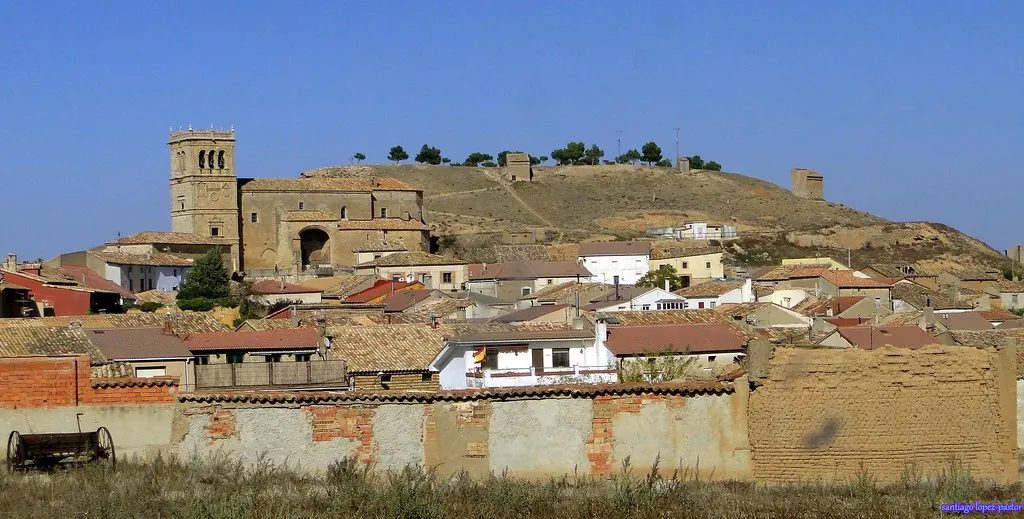
Small village on high ground overlooking the Almazán region.
Ocultar artículo Leer artículo completo
The church bell hasn't worked since 1987, yet at 7 a.m. the village still wakes. A tractor fires up, dogs negotiate territorial boundaries, and somewhere a radio plays folk songs at half-volume. Escobosa de Almazán doesn't need accurate timekeeping—days here are measured by how long the bread takes to rise, by the shadow that creeps across the plaza, by the moment the first star appears over the cereal plains.
Perched at 1,079 m on the southern lip of Soria province, the settlement is home to 19 permanent residents, a number that swells to perhaps 40 when grown-up children return for All Saints or the August fiesta. Stone houses huddle shoulder-to-shoulder against winter winds that can knife down from the Cantabrian cordillera; walls are a metre thick, roofs pitched steeply for the snow load. Adobe patches glow apricot at dusk, the colour revealing where medieval bricks have been replaced with modern mortar. There are no souvenir shops, no guided tours, not even a bar. What you get instead is a living lesson in how Castile survived for a millennium: build high, build tight, share heat, keep goats.
The Arithmetic of Silence
Leave the A-15 at Almazán, drive 19 km south-west on the SO-920, then watch for the stone cross draped in fading plastic flowers—turn left, climb another five kilometres. Mobile reception vanishes before the asphalt does. In the final approach the road narrows to a single track; wheat brushes both wing mirrors. Parking is wherever the verge feels firmest; no metres, no attendants, no charge.
From the last crest the village appears almost suddenly: a tight knot of roofs above a dry stream bed, surrounded by a ocean of blonde stubble. To the north the River Duero glints like a discarded bracelet; to the south the land rolls away into the endless meseta that Madrid's AVE trains cross in 90 minutes but which here still feels frontier-wide. The altitude keeps summer bearable—afternoons peak around 28 °C rather than the 40 °C that fries the capital—yet nights plummet to 12 °C even in July, so pack a fleece. Frost can arrive mid-September; snow usually locks the upper approach road for a week or two each January, turning the hamlet into a brief island.
Silence is advertised by many rural hotels; here it comes free and absolute. Stand on the ridge at 3 a.m. and the loudest component is your own pulse. The Milky Way feels close enough to snag on a roof tile; shooting stars leave after-images that last longer than the village streetlights (all four of them). Light pollution registers 21.7 on the Bortle scale—better than most professional observatories.
What the Stones Remember
Start at the plaza, really just a widening of the main lane where rainwater collects before disappearing into a stone trough. The parish church of San Andrés keeps its key under a flowerpot; inside, the single nave smells of candle wax and damp sandstone. A 16th-century font rests on a Roman altar stone, recycled like much of Spain's heritage. The fresco above the altar was touched up in 1934 by a travelling restorer who accepted payment in eggs; faces of the apostles are slightly oval, as if seen through cheap glass. No audioguenes, just a printed A4 sheet that ends with the honest line: "We know little else; archives burned in 1808."
Opposite stands the oldest dwelling, number 14 Calle Real. The wooden balcony—mirador—leans at an angle that would give a surveyor hiccups, yet the elderly owner, Don Aurelio, insists it has always been "perfectly level with the horizon of its time." He'll demonstrate how the balcony doors fold inward to form a crude camera obscura, projecting upside-down views of approaching strangers onto the lime-washed wall. Entry is by invitation; accept if offered, decline coffee and he'll pour homemade aguardiente instead.
Walk the lanes counter-clockwise and you trip over history without interpretation boards. A low stone wall incorporates two Roman milestones, their inscriptions half-eroded but still legible to anyone who learnt Latin at a British grammar school. Beyond the last house a threshing circle 12 m across lies exactly aligned with sunrise on the feast of St James; farmers used it until 1972, now it hosts the annual verbena dance where someone brings a generator and the entire village sways under fairy lights powered by a tractor engine.
Trails that Forget to End
Maps are optimistic here. The 1:50,000 sheet shows three footpaths; on the ground you find a tangle of farm tracks that peter out among cistus scrub or dive private gates without warning. That said, walking is the point rather than the route. Head south past the abandoned threshing circle and follow the sunken lane between dry-stone walls; after 25 minutes the wheat gives way to holm-oak pasture and the path dissolves into open dehesa. Keep the telecom mast on your left shoulder and you'll reach the ruins of an 11th-century watchtower built by El Cid's lesser-known cousin, according to Don Aurelio. The views stretch 40 km to the Montes Universales, a horizon so straight it looks ironed.
Spring brings colour quickly: first the purple flash of Anemone pavoniana, then whole hillsides of Cistus laurifolius smelling of warm lemons. Birdlife is subtle rather than spectacular—calandra larks tumble overhead, little bustards call like creaking gates from the stubble—but patient watchers can log 40 species before lunch. Autumn reverses the palette: ochre cereals, copper oaks, and the sudden white flash of a booted eagle banking over the ridge. Take water; there are no fountains once you leave the village, and midday shade is as rare as a traffic jam.
The serious hike is the three-day loop linking Escobosa with the deserted villages of Valtajeros and Aldealpozo, both ghost settlements since the 1968 agrarian exodus. You can wild-camp legally under Spanish ley de montes as long as you pitch above 1,600 m (outside private dehesa) and pack everything out. Mid-October delivers 20 °C days and star-scattered nights cold enough to justify a dram from your flask.
Eating Without a Menu
The village itself offers zero food outlets. The last shop closed when the owner retired in 1997; the nearest loaf is 18 km away in Almazán. Bring supplies or time your visit around the monthly community paella held in the threshing circle—first Sunday of each month, €7 donation, arrive at 2 p.m. sharp or the rice will be gone. Donations fund the village's only ambulance service, a second-hand Land Rover kept in a barn between emergencies.
For restaurant dining, drive back to Almazán where Asador Casa Valentín serves roast suckling lamb (€24 half-ración) cooked in a wood-fired clay oven older than the chef's grandmother. Vegetarians get migas—fried breadcrumbs with grapes and peppers—plus the owner's assurance that "no animals were harmed, only bread." Book weekends; half of Soria city empties here on Saturday afternoons.
Buy local cheese directly from the Las Nieves farm, 3 km before the village turn-off. The ewe's-milk wheel is aged eight months in walnut leaves, yielding a nutty paste that pairs indecently well with a Rioja crianza. They accept cash only, preferably in exact change; opening hours are "when we hear the bell," so honk twice at the gate.
Departing Before the Bell rusts Further
Staying overnight inside Escobosa means asking. One house takes paying guests—Casa del Cura, three rooms, shared bathroom, €45 including breakfast of coffee, toast and apricot jam made from the garden tree. Hot water arrives via solar panels; if the day has been cloudy, shower quickly. Electricity cuts out at 1 a.m. when the village generator rests; candles are provided, romance optional.
More comfortable beds lie 25 minutes away in Almazán's Hotel Villa de Almazán (doubles €70, wi-fi that actually works). Treat the village as a day-trip, but leave before dusk if you fear narrow lanes without streetlights. Winter visitors should carry snow chains; a sudden storm once marooned a BBC film crew for three days, forcing them to finish a documentary about rural depopulation using only footage of sheep.
Tourism leaflets call places like Escobosa "undiscovered." They aren't; the 19 inhabitants know exactly where they are, and most could locate London on a map even if they have never been. What the village offers is simpler: a calibration point for urban clocks, a place where an hour lasts as long as it takes a cloud to cross a field. Come for the silence, stay for the bread rising, leave before you start counting stones. The broken bell will still be silent next year; the lanes will still remember your footprints even after the wind has erased them.