Full Article
about Frechilla de Almazán
Tiny farming hamlet on the Almazán plain
Hide article Read full article
A Small Village on the Almazán Plain
Early in the morning, the air in Frechilla de Almazán still holds the dampness of dew. The village is made up of just a handful of streets that cross between stone houses, and at that hour they are silent. A dog barks somewhere in the distance, wind moves through the leftover stubble in the surrounding fields, and little else breaks the quiet.
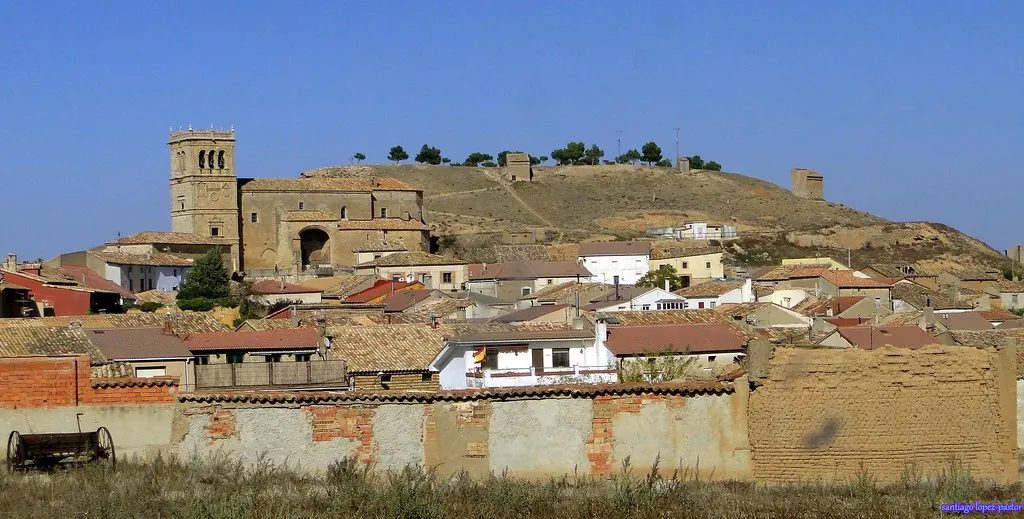
Frechilla de Almazán lies in the comarca of Almazán, in the province of Soria, part of Castilla y León. It is one of those very small villages where only a few people live throughout the year. The plain dominates the landscape here. Step beyond the last houses and the horizon opens in every direction, with fields stretching out under a wide sky.
The houses, with their thick walls and red-tiled roofs, reflect long, cold winters. Many still have large wooden gates designed to store tools or bring in a tractor at night. Animal pens are often attached to the homes, and old haylofts stand close by, though they are used less than they once were. Everything about the place speaks of an agricultural rhythm that continues, even if on a smaller scale than in the past.
San Andrés at the Heart of the Village
At the centre of the settlement stands the church of San Andrés. It is a simple building, constructed from masonry with dressed stone at the corners. A modest tower rises just above the surrounding rooftops. The church is not large, yet it anchors village life.
The square around it is less a formal plaza and more a widening of the street, with a few stone benches and some shade when the sun is strong. This is where neighbours gather when there is something to mark, and where people return in summer if their family home is still here.
The feast of San Andrés, towards the end of November, brings together villagers and those who now live elsewhere but keep ties to Frechilla. The celebrations are small and local in character. In a place of this size, any shared event feels significant simply because it gathers most of the community in one spot.
Walking the Short Streets
Frechilla can be crossed in minutes, yet it rewards a slow walk. Details stand out: slightly crooked black iron window grilles, inscriptions carved into stone lintels, heavy wooden doors with worn hinges. Some façades have been repaired in recent years, while others show fine cracks where old plaster peeks through.
The streets are short and straightforward. There is no maze to navigate, no grand buildings to tick off. Instead, the interest lies in everyday traces of rural life. The smell of firewood sometimes lingers, even outside winter. Piles of stone or stacked timber sit beside a corral. These are practical spaces, shaped by work rather than design.
Life here follows the seasons. In winter, once the sun drops, the cold settles quickly. In summer, there is a little more movement as families return to houses that remain in their name. Even then, the scale remains small. Frechilla does not change its character; it simply feels slightly fuller for a few weeks.
The Parameras of Soria
Leave the last house behind and agricultural tracks begin almost at once. These dirt paths are used by tractors and can be followed on foot. They connect plots of farmland and low rises in the terrain. There are no marked hiking routes or long-distance trails, just simple tracks across open country.
This is the landscape of the parameras sorianas, high plains typical of this part of Soria. Fields spread wide, trees are scarce, and the sky occupies a large share of the view. The sense of space is constant.
In spring, green crops soften the tones of the land. Summer brings the dry yellow of harvested cereals. Autumn introduces more muted colours, with low skies and a cold wind that runs across the plain without obstacle. Each season reshapes the same basic scene rather than replacing it.
Walks here are gentle rather than demanding. They are not about reaching a summit or ticking off a landmark, but about moving through a working landscape. In summer, it makes sense to head out early or wait until evening, as the midday sun can be strong and there is little shade.
Birds, Silence and Dark Skies
These open cereal fields are home to birdlife typical of steppe environments. Carrion crows appear regularly. Birds of prey can be seen circling high overhead. Flocks sometimes cross the sky towards dusk. The lack of trees and buildings makes movement easy to spot against the horizon.
Silence is one of the defining features of a walk around Frechilla. There are no major roads nearby, and little traffic even within the village itself. The soundscape is shaped by wind, distant animals and the occasional passing vehicle on a country road.
At night, darkness is almost complete. Street lighting is limited, and on clear evenings the sky appears clean and bright. In winter, the constellation of Orion is easy to distinguish. During summer nights, the pale band of the Milky Way stretches across the sky from side to side. The absence of artificial light allows these details to stand out clearly.
Everyday Practicalities
Frechilla de Almazán does not have shops or bars open on a regular basis. For groceries or a meal out, residents and visitors usually travel to Almazán, a few kilometres away by road. There, there is more activity, a weekly market and bakeries where large, crusty loaves are still common.
In autumn, when the season is favourable, people in this area also collect wild mushrooms in nearby woodland. Specific spots are kept discreet, as is often the case in rural Spain. It is a seasonal habit rather than an organised activity.
When to Visit
The village changes noticeably with the time of year. Winter can feel almost empty, and the cold intensifies quickly after sunset. Summer brings a modest increase in life as families return.
The most rewarding moments tend to be early in the morning or towards evening. At those times, the light falls lower across the fields and the stone façades take on a warmer tone. Frechilla de Almazán does not require much time to explore. What it asks for instead is the right expectation: this is a very small village, surrounded by open countryside and defined by quiet.