Full Article
about Momblona
Quiet village on the Sorian plateau
Hide article Read full article
A village shaped by silence
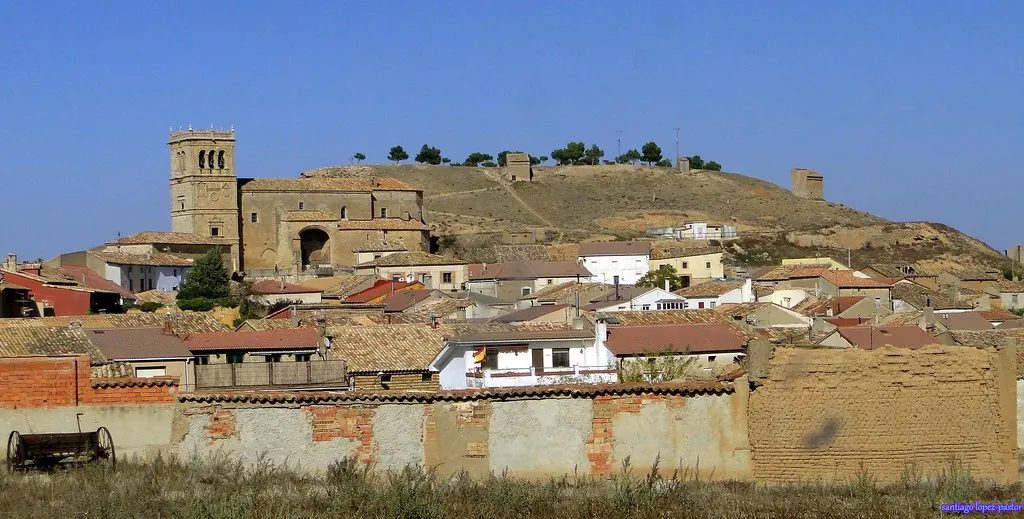
In the Almazán region, at the southern edge of Soria’s province, Momblona sits at 1,062 metres. It is one of many villages here that have seen their population decline over decades. Where more than fifty people once lived, the official count is now nineteen. The landscape is one of cereal fields and grazing land, and the village’s presence is understated.
Its layout preserves the traditional Sorian pattern. Narrow streets pass between houses of stone and adobe, many with the wooden galleries and chimneys typical of this area. There has been no recent expansion. The built environment, in both materials and form, is tied to its agricultural past.
The surrounding area reinforces that. Wide plains and gentle hills are planted with wheat, barley, and oats. You will find no tourist services or shops in the village; for necessities, you must go to Almazán or further. With few vehicles and no modern infrastructure breaking the sightlines, the prevailing sound is silence, broken by birds like hoopoes and larks, or the wind moving through the crops.
The church of San Pedro
The main architectural feature in Momblona is the church of San Pedro. Built in the 16th century and reformed in the 18th, it reflects the typical characteristics of rural Sorian churches rather than any grand ambition. Its structure is simple: a rectangular nave, a modest bell tower, with brick detailing providing contrast to the stone.
From the outside, the church appears functional and restrained, consistent with the agricultural economy that sustained the village. There are no elaborate façades. Its value lies in its continuity, in how it has remained part of local life.
Inside, a few original elements are preserved. A small painted wooden altarpiece and a stone baptismal font stand out in otherwise plain surroundings. The building has not undergone recent restoration, and that absence of intervention contributes to its austere atmosphere. Compared to larger churches in the province, San Pedro feels pared back.
Its position offers one of the village’s widest views. From the atrium, the fields open towards the horizon. At sunrise and sunset, the shifting light across the plains changes the tones of the land, giving a clear sense of the landscape’s scale.
Streets and agricultural memory
Walking through Momblona means moving through a space where agricultural life has left visible traces. The streets follow traditional lines, with houses grouped around small squares or enclosed yards. Most have stone façades and wooden doors, some with carved lintels or old metal fittings that have been in place for decades.
In the courtyards, you can still identify structures like corrales, haylofts, and threshing areas. These spaces show how grain was stored and livestock kept. Even when no longer in active use, they remain part of the village’s visual organisation.
Details emerge gradually: windows with wrought-iron bars, doors with original hinges, walls marked by the wear of tools. These elements have disappeared elsewhere but remain here not as decoration, but as part of a continuing way of life. The impression is one of simplicity shaped by function and long-term use.
The relationship between buildings and land is constant. Houses are not sharply separated from the fields; they form part of a broader system tied to cultivation. That connection has not entirely vanished.
The colour of the fields
The landscape around Momblona is defined by large expanses of cereal crops that change colour through the year. Green in spring, golden by summer, turning to browns and ochres in autumn.
The terrain can seem uniform at first glance, but it supports life adapted to these open conditions. With attention, you might see small birds of prey, hares, or foxes at the edges of fields.
For birdwatching, the open fields and boundaries between plots offer chances to spot steppe or migratory species. There are no marked trails; instead, existing rural tracks provide access. The ground can be sandy or grassy, so suitable footwear is useful. Binoculars help for observing wildlife at a distance.
The sense of openness defines the area. With few obstacles to the horizon, changes in weather or light are immediately visible. This is a landscape less about landmarks and more about gradual variation and seasonal rhythm.
Night skies and quiet
Low population density and minimal artificial lighting make Momblona a place where you can observe the night sky. On clear nights, constellations are distinct, and the Milky Way is visible, particularly in summer. There are no dedicated facilities; the experience depends on darkness and stillness.
The same conditions suit other quiet activities. Photography benefits from the light at dawn and dusk, when stone façades and fields take on warmer tones. The absence of urban noise also creates a setting where writing or drawing outdoors is possible without interruption.
The lack of services remains a key consideration. With no amenities in the village itself, any activity must be planned accordingly.
Calendar and continuity
Traditions in Momblona remain linked to agriculture and to specific dates in the religious calendar. These practices are not staged for visitors; they continue as part of local life, shaped by the seasons and long-standing custom.
This continuity reinforces the village’s character. Momblona does not position itself as a destination with conventional attractions. It offers a setting where landscape, architecture, and daily routines remain closely connected.