Full Article
about Velilla de los Ajos
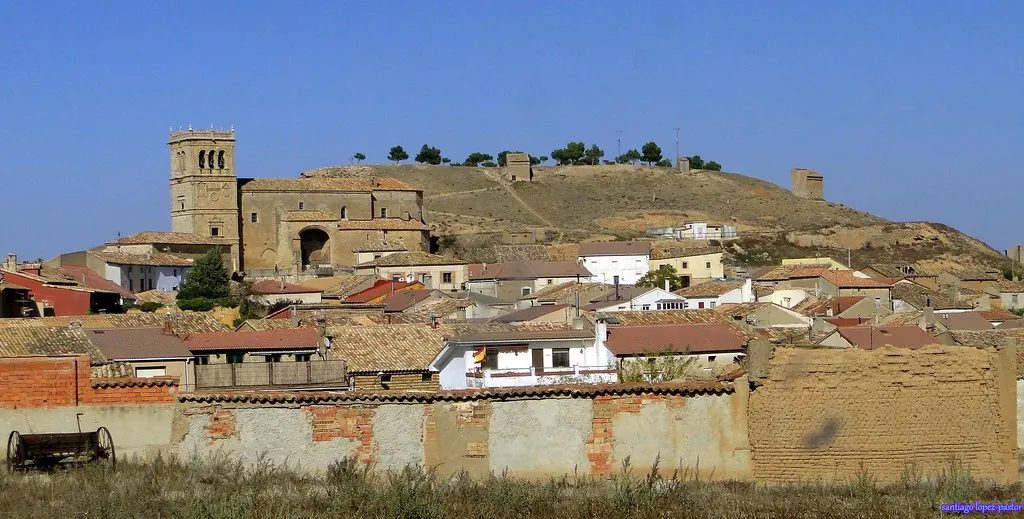
Small village with a prominent church tower
Hide article Read full article
A village where sound carries
On the edge of Velilla de los Ajos, along a stretch of track that slips between cereal fields, the silence is often broken by something very specific: the dry snap of a tool striking the soil or the call of a blackbird cutting across the morning. This small settlement in the comarca of Almazán has only around fifteen residents for much of the year. In summer, children and grandchildren of those who left return, bringing a little more movement. Even then, the overall feeling remains one of long, unhurried calm.
The approach is along a narrow road that crosses gentle rises and cultivated plots. On clear days the horizon feels open, with barely any tall trees, and the light falls directly onto the fields. In July and August everything takes on a golden, dusty tone. Autumn softens the landscape, with ochre shades and darker earth after the first rains.
Garlic and everyday rural life
The name Velilla de los Ajos is not accidental. For generations, garlic growing formed part of everyday work here. Even now, a walk past nearby kitchen gardens or into some of the yards reveals strings of garlic hanging to dry, or small plots still planted for household use.
The houses combine stone and adobe. Many retain thick wooden gates and enclosed courtyards where an old bread oven or a small shed for tools sometimes appears. There are also underground cellars and the occasional isolated dovecote on the outskirts, structures closely tied to rural life in this part of Soria.
With so few residents, the village can be crossed in minutes. The interest lies less in ticking off sights and more in noticing small details: a mud wall patched again and again, an old cart leaning against a boundary wall, the sound of a door opening in the middle of the afternoon.
San Miguel and the heart of the village
At the centre stands the parish church dedicated to San Miguel. It is not a large building. A simple bell gable rises above pale walls, and the interior is quite plain. It is usually closed outside specific times of year, but from the small square it is easy to see how the church marks the point where the few streets meet.
Around it are the oldest houses. Some show recent alterations, others remain much as they were decades ago, with uneven façades where stone shows through layers of whitewash.
Tracks through open land
The surroundings of Velilla de los Ajos are wide and exposed. There are cereal fields, some fallow plots and farm tracks leading out of the village in different directions. There are no signposted routes or information boards, just dirt paths used by local farmers.
Walking here can feel repetitive and, at the same time, oddly absorbing. Long horizons stretch out ahead, wind moves through the grain, and traffic is almost non-existent. After heavy rain, small temporary streams sometimes appear in shallow dips, though the land soon returns to its dry appearance.
In summer, anyone heading out on foot needs to carry water and protection from the sun. There is very little shade and distances can be deceptive.
Light over the plateau
If there is a moment that stands out, it is the end of the day. From any slight rise nearby, the sun can be seen dropping over the fields, lengthening the shadows along the edges of the plots. The pale soil reflects a reddish light that lasts only a few minutes before fading quickly.
At night, the sky is usually very clear, something increasingly rare in more populated areas.
Home cooking and a quiet rhythm
In a place this small, social life does not revolve around restaurants or bars. Meals tend to be at home, based on simple dishes and local produce: lamb, potatoes, homemade cured meats and, of course, the garlic that gave the village its name.
For anything more in terms of services, people usually travel to Almazán, which is relatively close by car.
Summer returns and the rest of the year
Local festivities are generally concentrated in summer, when many former residents come back. It is then that the village changes pace: more people in the streets, shared meals and simple events around the church.
For the rest of the year, Velilla de los Ajos returns to its usual scale. Few lights at night, near-constant quiet, and the sense of being in a place where time moves more slowly than in other parts of the province.