Full Article
about Villasayas
Village with a Romanesque church listed as a Cultural Heritage Site.
Hide article Read full article
A Small Village on the High Plateau
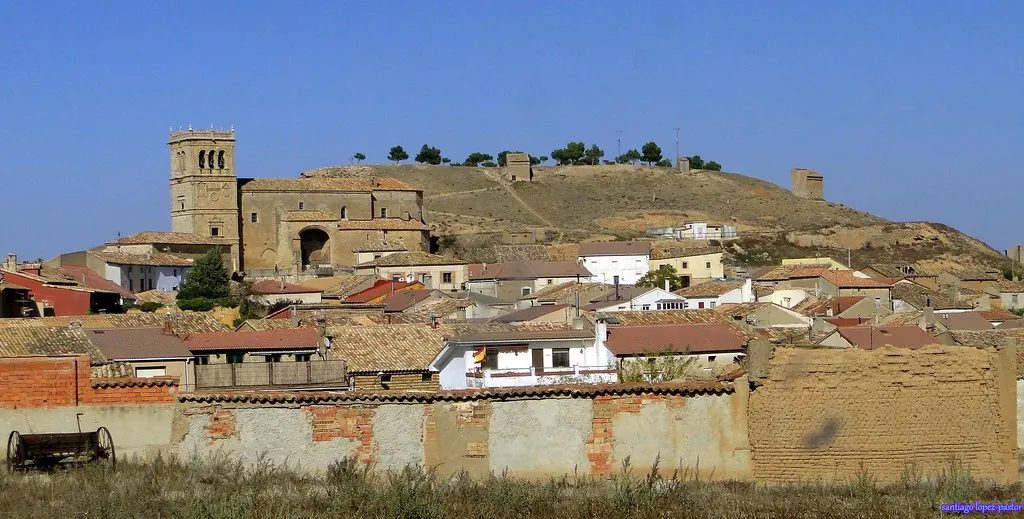
Villasayas lies in the comarca of Almazán, in the province of Soria, within Castilla León. It stands on high plateau country more than a thousand metres above sea level, in a landscape that opens out into broad cereal fields. The municipality has around sixty inhabitants, a scale that shapes both its rhythm and its appearance.
Altitude makes itself felt here. Winters are long, with frequent frost, and wind often sweeps across the nearby páramos, the exposed moorland typical of this part of inland Spain. The village itself gathers around the Iglesia de la Asunción and keeps the proportions of agricultural settlements across this stretch of Castile: short streets, enclosed yards, and buildings constructed from stone and adobe, using whatever materials were available locally.
The surrounding territory explains much of Villasayas’ character. Farming and livestock have long sustained the local economy. That history is still visible in the layout of the houses, in storage spaces and in the tracks that lead directly out towards cultivated land. Even without large monuments or formal attractions, the relationship between village and fields is easy to read.
The Church and the Shape of the Settlement
The Iglesia de la Asunción occupies the most visible point in the village centre. The building appears to date from the early modern period, probably the 16th century, although it has undergone later alterations. Such changes are common in small rural churches, which have been adapted over time to suit the needs of their communities.
Beyond the church itself, interest lies in how the settlement is organised around it. Houses combine masonry with adobe and often retain wide gateways designed for carts and farm equipment. Some courtyards still contain cellars dug into the ground or small agricultural outbuildings. These details speak of a way of life closely tied to the land.
Not everything is in perfect condition. There are cracked façades and buildings no longer in use, an image familiar in villages with a small permanent population. The overall impression, however, remains coherent. Villasayas continues to reflect the scale and practical design of an agricultural community on the Castilian plateau.
Cereal Fields and Juniper
The countryside around Villasayas follows the pattern typical of the Sorian campiña. Cereal plots change colour with the seasons, from green in spring to gold as harvest approaches. Here and there stand clusters of sabina albar, a type of juniper with twisted trunks and very slow growth. These trees are well adapted to cold winters and dry summers, conditions that define the area.
It is an open landscape with long horizons and few visual barriers. Birds of prey are often seen above the fields, especially during the calmer hours of the day. In spring, small birds associated with farmland can be heard across the cultivated ground. The area is not arranged or signposted for tourism. It remains working countryside that has gradually become a refuge for wildlife as well.
After dark, on clear nights, the lack of artificial lighting allows for an unobstructed view of the stars. In more densely populated areas this is increasingly rare, but here the sky forms part of the experience. Silence and darkness are as characteristic as the wind and the fields.
Tracks, Walks and Orientation
Access to the surrounding landscape is via agricultural tracks. These are not marked hiking routes, but paths used for generations to reach fields or connect with neighbouring villages. They form a practical network shaped by daily work rather than leisure.
Walking along them is straightforward provided a sense of direction is maintained. A map or route application is advisable, as the landscape can appear uniform and reference points are not always obvious. The openness that gives the area its distinctive feel can also make navigation less intuitive.
The reward is space and solitude. Long stretches can pass without encountering another person, reinforcing the sense of being in one of the least populated areas of Castile. There are no visitor centres or interpretative panels. What defines the experience is continuity between village and farmland, and the steady presence of sky above the plateau.
Daily Life and Traditional Food
Villasayas has no establishments for eating or shopping, something worth bearing in mind before setting out. For basic services it is necessary to travel to larger nearby towns such as Almazán.
The traditional cooking of this part of Soria revolves around simple, hearty ingredients suited to an agricultural calendar and a cold climate. Legumes play a central role. Dishes linked to the matanza doméstica, the traditional home slaughter and preservation of pork, remain part of local food culture. Roast lamb cooked in the oven is another staple. These are foods shaped by season, work in the fields, and the need for sustaining meals during winter.
Although there are no restaurants in the village itself, the culinary identity of the area is clear. It reflects the same practicality and adaptation to environment that can be seen in the buildings and the landscape.
Summer Gatherings and San Isidro
The most lively moments in Villasayas tend to occur in summer. Families who live elsewhere return for a few days, and the village regains movement and noise. Activities are organised in shared spaces such as the plaza or the frontón, the traditional court used for pelota games. The atmosphere is distinctly local, centred on reunion rather than spectacle.
There is also a celebration linked to San Isidro, the patron saint of farmers. This observance recalls the historical importance of agriculture in the municipality’s life. In a place where the land still shapes daily routines and memory, such a festival carries clear meaning.
When to Visit
Spring and autumn are generally the most comfortable seasons for exploring the area. The fields shift in colour and temperatures are milder than in the extremes of summer or winter. Summer days can be dry and hot, although evenings tend to cool once the sun drops. Winter is serious here, with frequent frosts and persistent wind.
Villasayas is small and quiet. Rather than offering a list of sights or organised activities, it presents landscape, silence, and the visible trace of a way of life closely tied to the land. In its streets and along its agricultural tracks, the connection between people and plateau remains easy to recognise.