Full Article
about Fresno de la Polvorosa
Set on the Órbigo river plain with very fertile land; quiet village with nearby river spots for swimming and fishing
Hide article Read full article
Evening Light on the Meseta
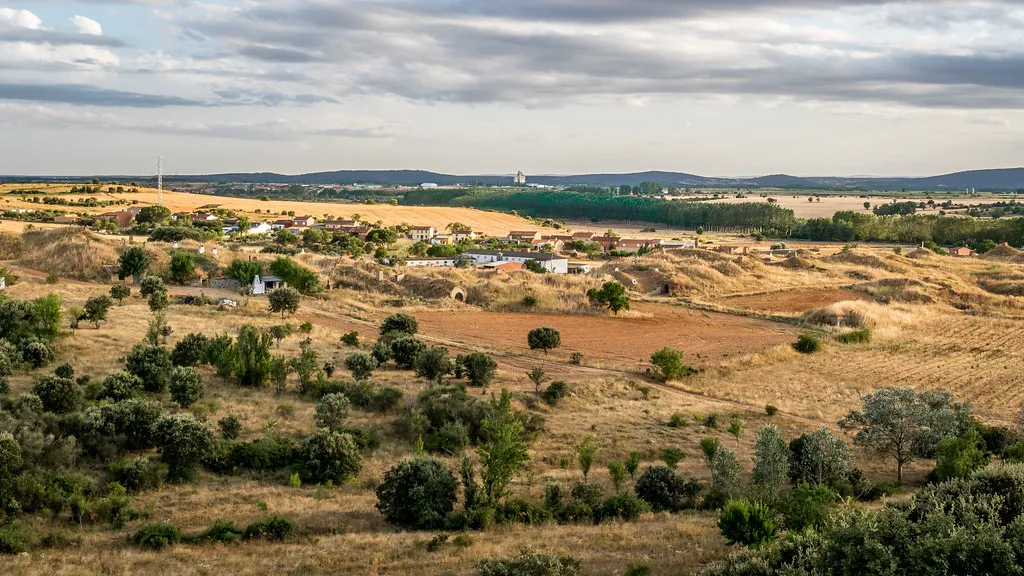
By late afternoon in Fresno de la Polvorosa, the light falls sideways across adobe façades, leaving the streets suspended between pale dust and long shadows. There is almost no traffic, perhaps the occasional car passing slowly through. What carries most clearly is the wind, nudging something loose, a sheet of metal, a door not quite shut, and now and then a dog barking from a yard.
This is a small village, with just over a hundred residents throughout the year, in the comarca of Benavente y Los Valles in the province of Zamora. At around 720 metres above sea level, the setting is typical of the Zamora plain. Open fields stretch out in every direction, the horizon sits far off, and the silence is not absolute but steady and constant.
Fresno does not compete for attention. Its rhythm is that of the surrounding farmland, and daily life moves at a pace that feels largely unchanged over decades.
The Iglesia del Salvador and the Village Heart
The Iglesia del Salvador reveals itself almost unexpectedly as you turn a corner. Built in stone and generally dated to the 16th century, it is a sober structure with a bell tower visible from several points in the village centre. More than its age, what stands out is its continued use. Parts of the walls have been repaired at different times, fresh render sits beside more weathered sections, and the building bears the marks of maintenance rather than restoration.
On the days when the church is open, the bells can be heard across the entire village. With so few streets, any sound travels quickly.
Around it, houses cluster along narrow lanes and small open spaces. Some still have stone benches or a few trees that provide a measure of shade in summer. These modest squares function less as formal plazas and more as places to pause, talk or sit out in the evening once the heat begins to ease.
Adobe Walls, Yards and Old Gateways
Walking through Fresno de la Polvorosa is an exercise in noticing small details. Many houses retain rammed earth or adobe walls, their earthy tones shifting with the time of day. In the softer light of morning or dusk, the colour deepens. At midday, the surfaces reflect the glare.
Some properties have been updated with brickwork and newer windows. Others still display large wooden gates darkened by years of weather. Behind them, rear yards reveal traces of the village’s agricultural past, which in many ways is still its present.
Stone feeding troughs remain in place. Low sheds lean against boundary walls. Former stables have been converted into storage spaces. These features are not arranged for display. They remain because they are useful, or because no one has felt any urgency to remove them. The impression is not of preservation for visitors, but of continuity.
Fields That Begin at the Edge of the Street
Step beyond the last houses and cereal fields begin almost immediately. The view opens without obstruction. Long plots of land run towards the horizon, crossed by dirt tracks and occasionally interrupted by a solitary tree.
In spring, the green is vivid, with wildflowers appearing along the verges. By mid-summer, the landscape shifts to a dry gold that reflects the light intensely. Wind is common in this part of Zamora. When it blows, the ears of grain move together in a single, rippling surface.
Several agricultural tracks can be followed on foot or by bicycle, though they are not signposted as walking routes. These are working paths, used by farmers and machinery. After rain, the ground can become heavy with mud that clings stubbornly to boots, so it is sensible to check locally whether they are passable before setting out.
The fields are not framed as a scenic backdrop. They are the reason the village exists and the measure by which seasons are felt.
Everyday Scenes and Small Clues
Fresno de la Polvorosa has no grand viewpoints or monumental buildings. What gives it character lies in smaller things. A metal water trough set against a wall. Old tools hanging beneath a shed roof. A cart still used to move between nearby plots.
At certain hours, ordinary scenes unfold without ceremony. Someone waters a small vegetable patch. A tractor returns along the track, trailing a cloud of dust. Neighbours stand leaning in a doorway, talking while the afternoon light fades.
For travellers unfamiliar with rural Spain, this is a glimpse of a way of life that remains closely tied to the land. The scale is intimate. People know one another by name. Conversations happen in the street rather than behind closed doors.
Eating and Supplies
The village does not maintain bars or restaurants open consistently throughout the year. If you are passing through, it is usual to bring provisions with you or to stop beforehand in Benavente or another nearby town.
Across this part of Zamora, products linked to the traditional matanza, the annual pig slaughter that supplies cured meats, are common, as are locally made cheeses. These circulate between neighbours and are sometimes sold directly at small points within the wider comarca. It is a local economy in a very literal sense, based on proximity and familiarity rather than formal retail.
When the Village Fills: San Bartolomé
For much of the year, Fresno is exceptionally quiet. In summer, however, the atmosphere shifts. The fiesta in honour of San Bartolomé is usually held in August and marks the moment when many people with family ties to the village return, even if they now live elsewhere.
There are religious events linked to the church, gatherings in the streets and shared meals. Rather than being designed for visitors, the celebration functions as a reunion. Houses that are closed for much of the year open up. The sound of conversation carries later into the evening.
It is one of the few periods when the population noticeably increases and the pace of daily life briefly changes.
Getting There and Choosing the Time
Fresno de la Polvorosa lies about 40 kilometres from the city of Zamora and relatively close to Benavente. Access is via regional roads that cross open farmland. A car is almost essential, as public transport services are infrequent.
In summer, the most comfortable times to walk through the village are early in the morning or as the sun begins to set. At midday, heat settles against the adobe walls and there is very little shade.
This is a place that does not attempt to reinvent itself. It remains one of the villages of the Castilian meseta where landscape and routine move in step: cereal fields, quiet streets, neighbours who greet each other by name. For those willing to slow down, Fresno de la Polvorosa offers a clear view of rural life on the Zamora plain, shaped less by spectacle than by habit and continuity.