Full Article
about Pobladura del Valle
Municipality with a long tradition of visitable underground cellars; set in the fertile Órbigo plain.
Hide article Read full article
Morning Light in Tierra de Campos
At around eight in the morning, when the light still falls low across the square, the sound of a tractor engine cuts through Pobladura del Valle. The noise bounces off the façades, then fades, and the village slips back into silence. A shutter rattles open. Someone sweeps the pavement. The smell of cereal drifts from trailers parked near the farm buildings.
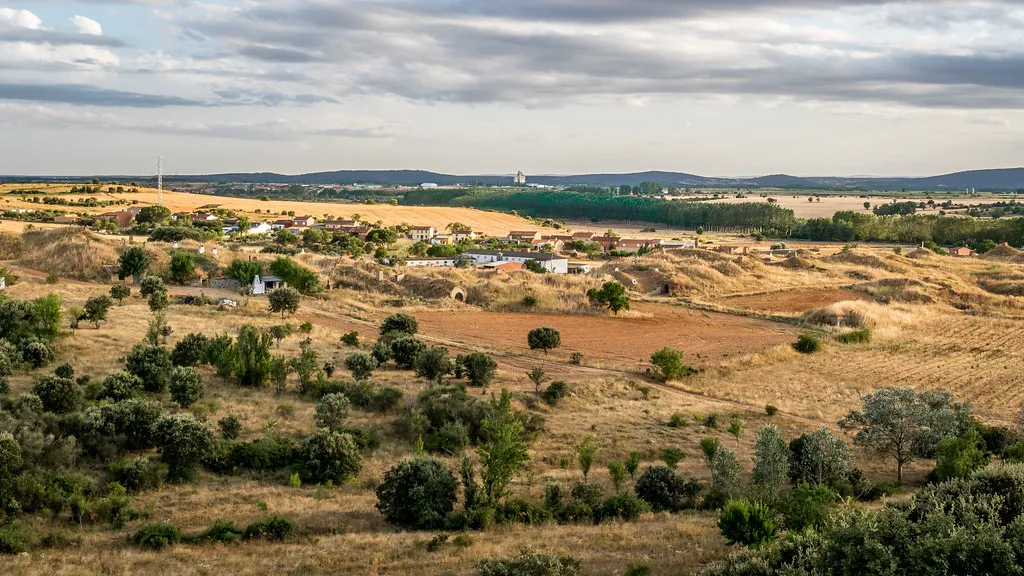
With fewer than three hundred residents, this small municipality in the province of Zamora continues to revolve around agriculture, without embellishment. Pobladura del Valle lies about 20 kilometres from Benavente, within the comarca of Benavente y Los Valles. The terrain is gentle, with no large hills or dramatic drops, just a succession of low rises covered in crops.
In spring the green is brief but intense. By July, the landscape shifts towards a dry yellow that crunches under car tyres on the dirt tracks. The changes are gradual yet decisive, and the horizon remains wide and open throughout.
The layout of the village is straightforward. Straight streets run out from the square, lined with low houses. Many have adobe walls reinforced with stone along the base. Large gateways, once wide enough for carts, are still visible. Some homes have ventilation openings for underground cellars dug beneath the houses. If you pause by one of these, especially at dusk, a cool scent of damp earth rises up, in sharp contrast to the heat lingering in the street.
San Pedro at the Centre
The parish church of San Pedro anchors the village. Its bell tower is visible from the tracks leading in from the surrounding fields and acts as a point of reference when walking back between plots of land. Over the years the building has undergone several renovations, and the stonework clearly varies from one section to another.
During the week the church is usually closed. Anyone hoping to see inside will generally need to ask a neighbour near the square who holds the key. The process is informal, shaped by the rhythms of daily life rather than by fixed visiting arrangements.
The square itself forms a modest social centre. At certain times of day there is a little more movement. It is possible that a small travelling market appears on some days, as happens in many villages in the area, though it is wise not to rely on it being there.
Fields, Tracks and Big Skies
The landscape around Pobladura del Valle is primarily agricultural. Long plots stretch out in straight lines, and the sky often seems to occupy more space than the land. Seasonal change defines the view: green shoots in April, dust in summer, stubble in autumn.
Rural tracks circle the municipal boundary and can be followed on foot or by bicycle without facing steep climbs. After heavy rain, small streams form in the shallow dips of the land. For much of the year only the trace of the channel remains. On electricity poles, stork nests are a common sight. In the open fields, steppe birds may be spotted if you walk quietly and without hurry.
Summer visits require some planning. The sun falls directly overhead at midday, and there is little shade for shelter. Early morning or late afternoon offer gentler conditions for walking the tracks and taking in the sweep of the fields.
The surroundings do not present dramatic landmarks. What they offer instead is space and a particular quality of light. Wind moves across the cereal crops in long ripples, and the sound carries easily across the flat ground.
Old Houses, Quiet Streets
In the oldest part of the village, dark wooden balconies remain, along with narrow gates that lead into interior courtyards. Some houses have been renovated in recent years. Others stay closed for much of the year, waiting for summer or long weekends when families return.
Daily life is unhurried. Outside the busiest moments, the streets are calm. Pobladura del Valle does not revolve around tourism or major monuments. Its scale is domestic and practical. What stands out are small details: dust rising behind a passing car on a track, the sound of bells at midday, a wooden door creaking as it opens.
This is a place where time feels measured differently. The day seems to stretch, with pauses built into it. Sitting for a while in the square before heading on towards Benavente can feel like part of the visit, rather than an interlude.
Food Rooted in the Larder
Cooking in Pobladura del Valle remains closely tied to what is raised locally or stored in the pantry. Lechazo asado, roast milk-fed lamb, appears at family celebrations and is prepared slowly in a wood-fired oven where that tradition continues. Sopa de ajo made with day-old bread is common, as are legume stews and embutidos produced during the annual pig slaughter.
In season, mushrooms gathered from nearby pinewoods circulate among households, along with vegetables from kitchen gardens. This is not a village of restaurants or extensive menus. Food tends to remain within homes and family gatherings.
Winter brings a quieter pace. In some houses, the matanza del cerdo, the traditional pig slaughter, still takes place. For generations this practice has shaped the domestic calendar, providing cured meats and sausages for the months ahead.
Summer Return and San Pedro
When summer arrives, the atmosphere shifts. Many residents who live elsewhere come back for a few days, and the village fills out beyond its usual numbers. The fiestas in honour of San Pedro are typically held around these weeks. There are open-air dances, games and long tables set up on the threshing floors or in the square.
Afterwards, as autumn advances and winter settles in, the tempo slows again. The tractors return to their steady routines. The fields change colour. The square grows quieter.
Pobladura del Valle does not promise spectacle. What it offers is more understated: the movement of wind across cereal, the echo of a bell, the cool air rising from an underground cellar. A short walk along the surrounding tracks, a pause in the square, then the road back towards Benavente. In this corner of Castilla y León, the day seems to hold a little more air inside it, and that is part of the experience.