Full Article
about Villabrázaro
Located at a transport hub near Benavente; it has riverside walks and religious heritage.
Hide article Read full article
Early in the morning, the street is almost empty. A van passes slowly, lifting a little dust as it goes. Villabrázaro wakes like this on many days, with the distant sound of a tractor and the dry smell of the surrounding fields.
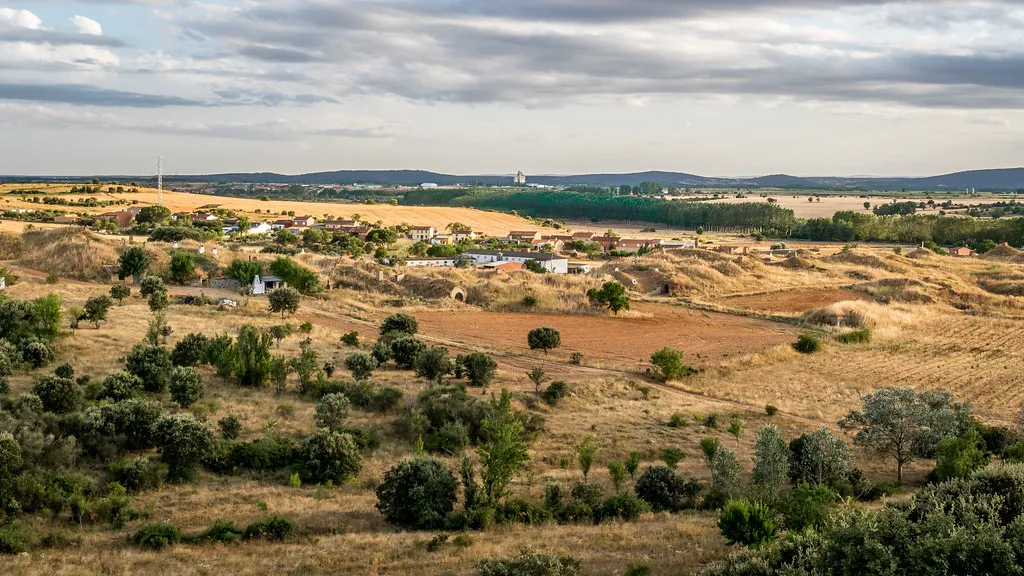
Villabrázaro sits in the comarca of Benavente y Los Valles, and even by the standards of this part of Zamora it is small. Around two hundred and fifty people live here. The houses are arranged along a handful of straight streets, with no great detours or surprises. Many still have walls made of rammed earth reinforced with stone, and wide gates that once opened into yards or storage areas tied to agricultural life.
A slow walk reveals details that point to that past. There are whitewashed courtyards, heavy wooden doors, and the occasional hayloft now used as a garage. Some homes have been updated, but the overall look remains simple and fairly uniform. There are no shop windows and no constant traffic. Daily life follows its own steady rhythm.
The Church of La Magdalena
The tower of the church of la Magdalena rises above the low rooftops. From the surrounding tracks it is easy to spot, and it helps orientate anyone heading back towards the village.
The building appears to date back several centuries. Some sources place its origins around the 16th century, although what stands today reflects later alterations. The exterior stone shows signs of wear from wind and rain, with surfaces softened over time.
The interior is not usually open except during religious celebrations. When the door does happen to be open, the shift in light is immediate. The brightness of the square gives way to a cool, dim space where dark wooden pews creak with movement.
Short Streets and Earthen Houses
The layout of the village is straightforward. Streets cross without complication and within a few minutes it is easy to end up back where you started. In some sections the paving remains uneven, while others have been covered with asphalt.
The façades combine adobe, brick and stone. Many houses have a bench built against the wall, the kind where neighbours sit in the evening once the heat begins to drop. In summer, shade only becomes useful from mid to late afternoon. Before that, the sun falls directly onto the pale walls.
There is little variation in the overall appearance. That uniformity is part of what defines the place. Changes have come slowly, and the built environment still reflects practical needs rather than design trends.
Tracks Through Cereal Fields
Just beyond the edge of the village, agricultural tracks begin almost immediately. These are dirt paths that cut between plots of cereal crops. In spring the green is intense, and the wind moves through the grain in a way that recalls the surface of water. By autumn, the landscape shifts to ochre tones.
Storks are often visible nearby, especially perched on towers or tall posts. Rooks and other birds typical of open farmland also appear across the fields.
It helps to carry an offline map or keep a clear reference point in mind. Many of the tracks look similar. After heavy rain, some sections turn muddy and progress becomes difficult, even on foot.
At night, silence is almost complete. With very little public lighting, the sky appears clear when conditions allow. In winter, the cold sets in quickly once the sun goes down.
Eating and Getting Around the Area
Commercial activity in Villabrázaro is minimal and closely tied to everyday village life. For a wider range of shopping or a more relaxed place to sit down for a meal, people usually head to Benavente, about twenty kilometres away by road.
Benavente acts as the service centre for the wider comarca. There is more movement there, along with shops and historic buildings such as the church of Santa María del Azogue and the main square.
From Villabrázaro it is also possible to explore other nearby municipalities in the Los Valles area. Each has its own mix of traditional architecture, older churches and open countryside.
When to Visit
Spring and early autumn are generally the most pleasant times to walk around Villabrázaro and its surroundings. The fields have colour and the temperatures allow for unhurried walks.
Summer brings intense heat around midday, and there is very little shade along the tracks. Walking is better early in the day or later in the afternoon.
Winter is harsher. Frosts are common, and some paths become uncomfortable after several days of rain. Even so, on cold and clear mornings the landscape takes on a particular clarity: a high sky, still fields, and the distant sound of machinery working the land.