Full Article
about Arenillas
Town known for fighting depopulation and restoring natural areas
Hide article Read full article
Getting There and Moving Around
In Arenillas, the simplest option is to leave the car in the main square beside the church of San Cipriano. From there, everything is within easy reach. The village is very small and can be crossed in just a few minutes on foot.
There is no traffic to speak of and no special signage to guide visitors. It is a place that functions at its own pace, without adjustments for tourism. In summer, it is best to arrive early in the morning or later in the evening. Around midday, the heat settles heavily over this part of Soria, and there is little shade to soften it.
A Village Reduced to the Essentials
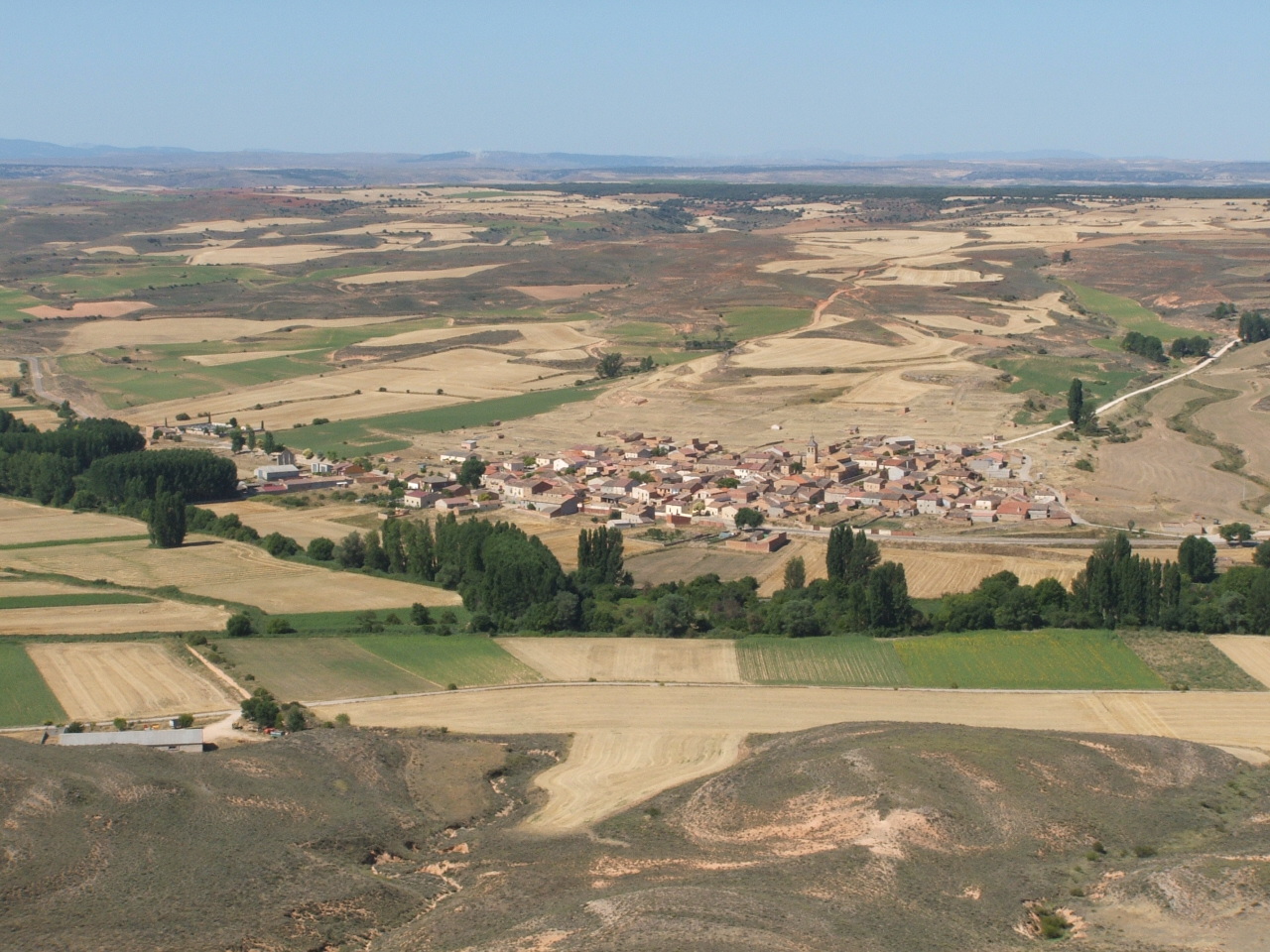
Arenillas has just over twenty residents, and that scale becomes clear almost immediately. One main street runs through it, lined with a handful of houses built from stone and adobe. Beyond that, there is quiet, uninterrupted.
There are no shops and no services aimed at visitors. The village does not attempt to cater to passing travellers, and that absence shapes the experience of being there.
The church of San Cipriano is the only building that stands out slightly. Its structure is straightforward, with thick walls and a simple bell tower rising above them. The design reflects rural architecture without ornament or flourish. It exists to serve its purpose, nothing more.
The houses follow the traditional layout of the area. Large gateways open into spaces once used for machinery or animals. High walls enclose interior courtyards that remain mostly hidden from the street. Some façades still display family coats of arms, traces of older agricultural households with a certain standing in the past.
The Fields That Define It
What truly defines Arenillas lies beyond its buildings. The surrounding countryside stretches out in wide cereal fields that shift dramatically with the seasons.
In spring, the land turns green. As harvest approaches, the colour changes to gold. By winter, the fields are bare, and the landscape takes on a drier, more austere character.
There are no viewpoints or information panels explaining what you see. There is no marked place to stop and take it in. You simply leave the village along one of the agricultural tracks and look around. This is the Sorian plateau in its most direct form.
Wildlife appears without ceremony. Small birds of prey can sometimes be seen gliding over the crops. Storks may perch on nearby roofs or utility poles. It is not a designated birdwatching area, and nothing is organised around these sightings. They are simply part of the everyday scene.
Walking and Cycling Routes
Several working tracks lead out from Arenillas and connect it with other villages in the Berlanga area. These paths are wide and generally flat, making them suitable for walking or cycling without much difficulty.
There are no official routes and no signposts to follow. Anyone heading out should bring water and rely on a map or a mobile phone for orientation. The openness of the terrain means there is very little shelter. On windy days, distances can feel longer than expected.
The experience is straightforward: open land, long horizons and the steady rhythm of rural tracks linking one small settlement to another.
Food, Atmosphere and Local Life
There are no bars or places to sit down and eat in Arenillas itself. For that, it is necessary to travel to nearby towns in the Berlanga area, where there is more activity and a wider range of options.
The cuisine in this part of Castilla follows long-established patterns. Hearty soups are common, designed for colder months. Lamb appears when the season allows. Traditional cured meats, produced during the annual pig slaughter, are also part of the local food culture.
In villages as small as Arenillas, much of this food remains tied to private homes rather than public establishments.
During the summer, patron saint festivities are usually held in honour of San Cipriano. These celebrations are simple and organised by the residents themselves. Their purpose is to bring together those connected to the village rather than to attract outside visitors.
Arenillas is not a place designed for a full day’s visit. It fits more naturally as a short stop along a wider route through the region. Ten minutes can be enough to walk through the street, see the church and take in the surrounding fields before continuing on.
That is how places like this tend to work.