Full Article
about Berlanga de Duero
Historic-artistic ensemble with an imposing castle and Renaissance collegiate church
Hide article Read full article
A Hilltop Town Watched by a Castle
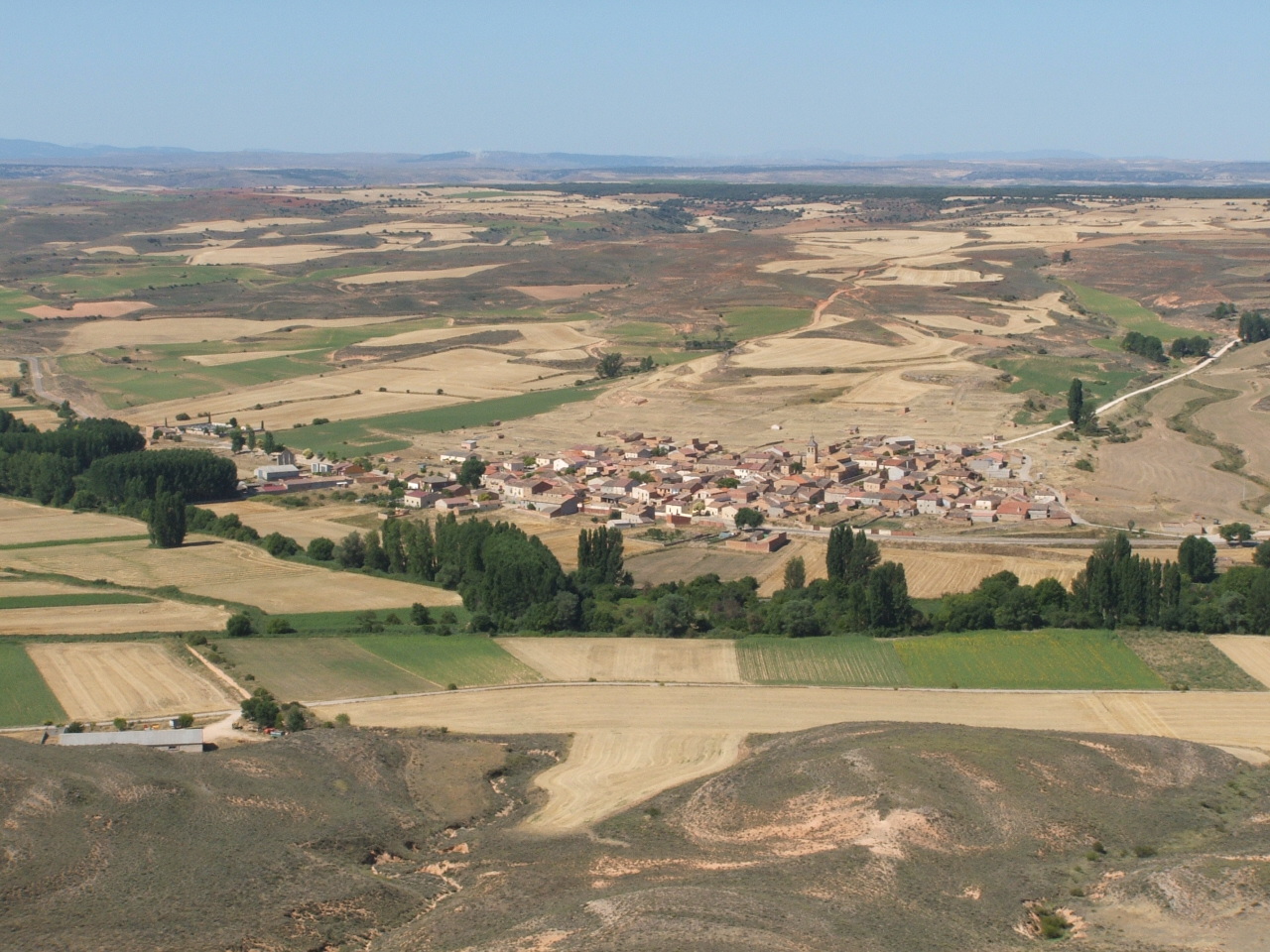
Early in the morning, when the air still carries a chill down from the high plains, the castle of Berlanga de Duero stands dark against the pale sky of Soria. In the old quarter, shutters are only just being raised and footsteps echo on uneven stone. The town sits on a rocky promontory, and even from below it is clear that everything here revolves around the fortress that dominates the skyline.
Houses of stone and brick line the narrow streets, some with coats of arms carved into their façades. They hint at a past more prominent than the town’s present size suggests. Today, just over eight hundred people live here, and the pace remains calm even in summer. Berlanga is best explored on foot and without hurry. A couple of steady slopes, tight streets and several small squares with benches in the sun shape the walk through the centre.
The sense of scale is modest. Nothing feels designed for crowds. Instead, the rhythm of daily life continues in the same spaces that once held greater political and social weight.
The Castle and the Walls Around the Hill
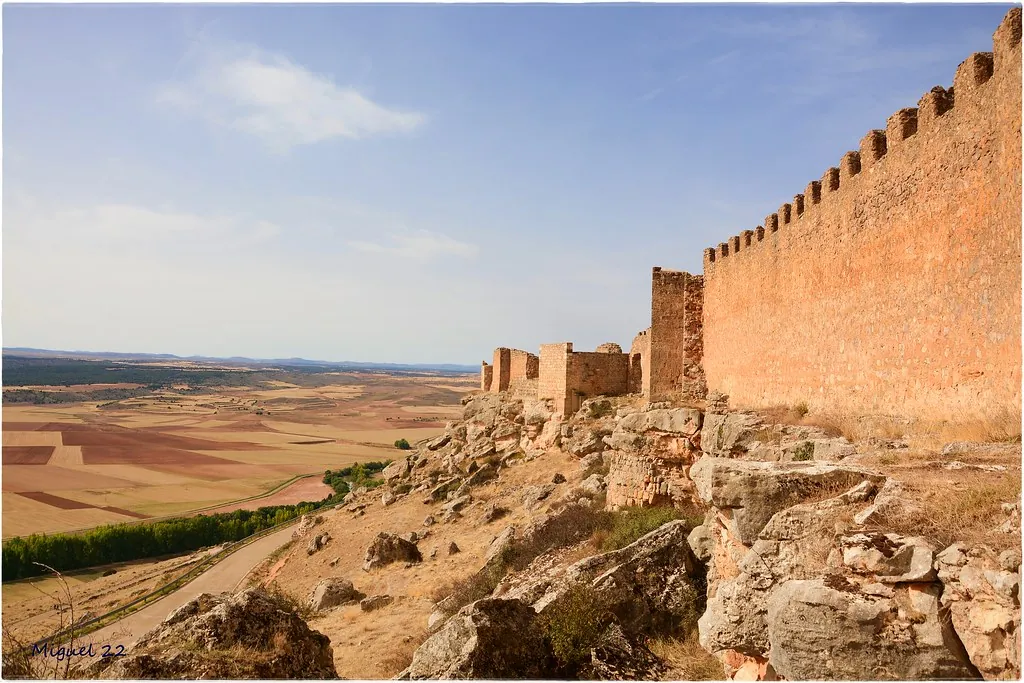
From almost anywhere in town, the castle is visible. Built in the 15th century and later expanded, it still marks the landscape with solid round towers and thick defensive walls. The climb to the top explains why this site was chosen. All around stretches an open plain of cereal fields and high plateau, a broad expanse where any movement would once have been visible from far away.
At the foot of the castle lie sections of the 16th-century Renaissance wall, linked to Fray Tomás de Berlanga. This outer enclosure encircled the hill, reinforcing the settlement below. Parts of the wall remain, and it is possible to walk alongside some preserved stretches. The route is not long, yet it helps to picture how the town once organised itself within these defences.
The ascent to the castle is best taken slowly. In summer there is little shade, and the sun falls directly onto the pale stone. Choosing cooler hours makes a noticeable difference.
From the top, the relationship between town and landscape becomes clear. Berlanga does not hide within forests or valleys. It rises from open ground, exposed to wind and light.
The Colegiata and the Shape of the Town
The Colegiata de Santa María del Mercado appears suddenly among the houses, its tower visible from some distance when approaching by road. A colegiata is a church served by a college of canons, reflecting the town’s former importance. The building combines Gothic and Renaissance forms. Inside, a richly worked main altarpiece draws attention, along with surviving fragments of mural painting.
Around the colegiata the streets widen slightly. At midday there is more movement. Neighbours cross the square, conversations unfold under arcades and the smell of bread drifts from a nearby oven. This is not a grand civic space designed for large gatherings. It is a square where everyday life continues, framed by stone façades and simple proportions.
The church tower shapes the profile of Berlanga almost as much as the castle does. Together they anchor the town between religious and military history, both expressed in limestone and brick.
Palaces, the Main Square and a Seigneurial Past
Berlanga held a significant position during the Renaissance, and that period left its mark on several civil buildings. The Palacio de los Marqueses de Berlanga retains an arcaded courtyard and a restrained façade, its proportions carefully measured rather than ostentatious.
In the Plaza Mayor stands the rollo jurisdiccional, also known as a picota. This stone column symbolised the town’s right to exercise its own judicial authority. Such monuments were erected in places granted a degree of self-governance, and its presence here underlines Berlanga’s former status.
The façades around the square show worn stone coats of arms and irregular arcades that offer shelter from the strong summer sun typical of Soria province. Time has softened the details, but the sense of a seigneurial town, shaped by noble families and ecclesiastical power, remains legible in stone.
Paths into the Open Landscape
Step beyond the edge of the old quarter and the landscape shifts quickly. Cereal fields take over almost the entire horizon. The ground rolls in gentle hills, changing from ochre to green depending on the season.
One of the usual walks in the area leads towards the canyon of the River Escalote. It is not a demanding route, yet it is exposed, with little protection from the sun. In summer it makes sense to set out early or wait until late afternoon, when the light drops lower and the colour of the earth deepens towards red.
Close to the town are the Ermita de Nuestra Señora de la Soledad and the remains of the Convento de San Francisco. Both are quiet spots where the dominant sound is often the wind moving across the fields. They sit slightly apart from the compact urban centre, reinforcing the impression of Berlanga as a settlement between cultivated land and wide, open plateau.
The surrounding countryside is not dramatic in a conventional sense. Its appeal lies in space, horizon and the steady rhythm of agriculture.
Eating in Berlanga
Cooking in this part of Soria is rooted in straightforward, substantial produce. Dishes linked to the matanza, the traditional pig slaughter, are common. Roast lamb prepared in the Soria style also appears frequently, with golden skin and very tender meat.
In damp autumns, mushrooms emerge in the nearby hills and tend to feature on many menus. Bread remains central to the meal. Pan candeal, known for its compact crumb and firm crust, accompanies almost everything served at the table.
The food reflects the climate and landscape. Winters are cold, summers can be hot, and the cuisine answers with depth and simplicity rather than ornament.
When the Light Changes
Berlanga de Duero shifts noticeably with the time of day. Early morning and late afternoon bring out the textures of the limestone, and the town regains a quiet tone. Light skims across walls and towers, picking out details that fade at midday.
Summer weekends may bring more activity to the centre. Even then, walking two streets away or heading up towards the castle is usually enough to hear little more than the wind crossing the hill.
In Berlanga, the experience rests on scale and atmosphere. A castle above, a colegiata within, fields beyond. Stone underfoot, sky overhead, and a settlement that still carries the outline of its Renaissance past without losing the calm of a small town in Soria.