Full Article
about La Riba de Escalote
Tiny village in the Escalote river valley with a Romanesque hermitage
Hide article Read full article
A Village Above the Escalote Valley
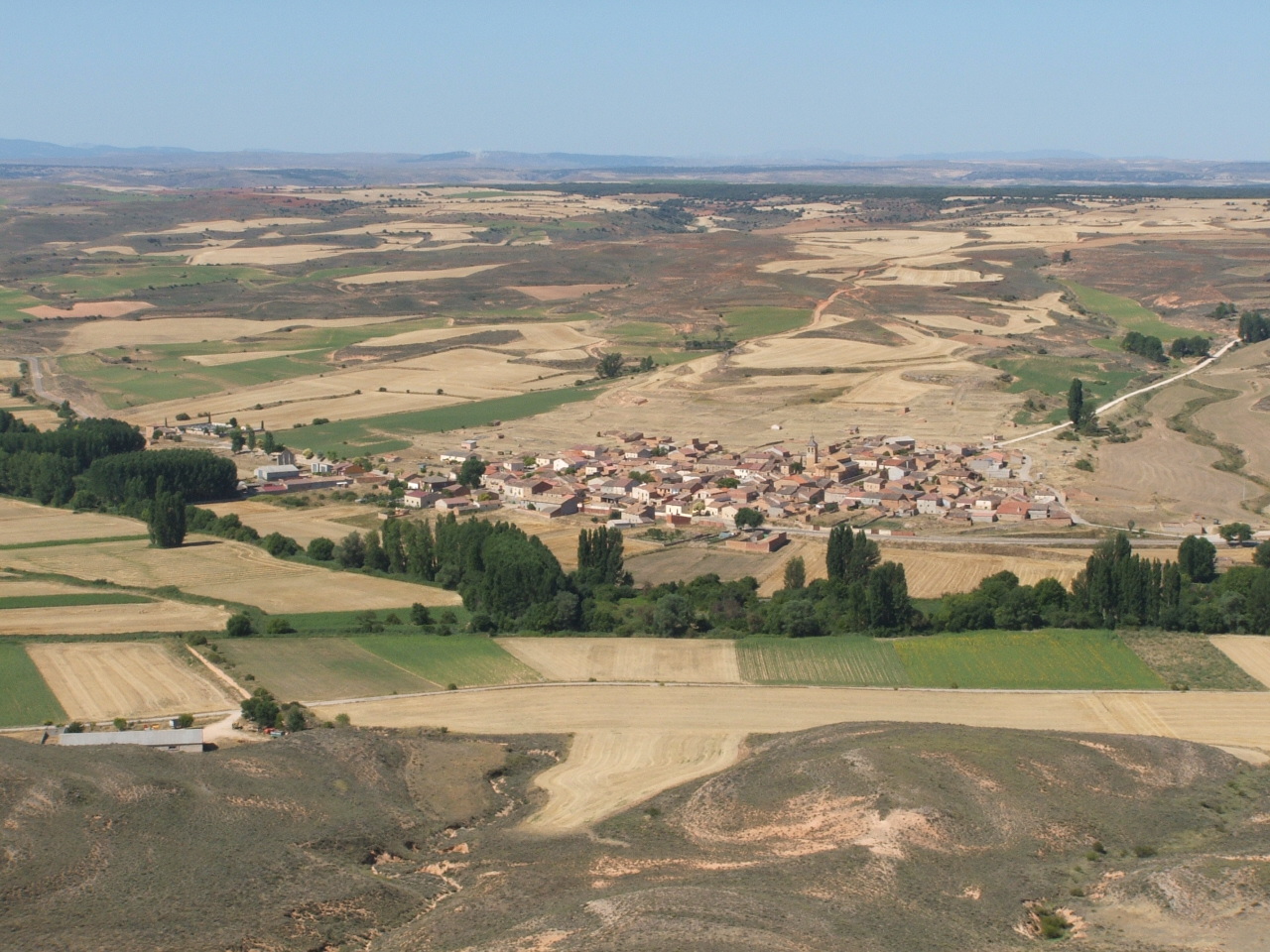
La Riba de Escalote stands in one of the highest parts of the Berlanga district, in the south of the province of Soria. It sits on a gentle rise overlooking the valley of the River Escalote, at around 1,030 metres above sea level. From this height, the landscape stretches wide and open, defined by cereal fields, patches of holm oak and the broad, dry plains known locally as páramo.
The village itself barely exceeds a handful of residents. Its current form reflects the agricultural settlements that took shape here in the late nineteenth and early twentieth centuries. This is not an ancient walled town or a place built around a grand monument. It is a small rural nucleus shaped by farming and livestock, and by the demands of a climate that can be harsh in winter and dry in summer.
The sense of isolation is real. It comes from geography rather than myth. Across this part of inland Soria, villages are tiny and separated by several kilometres of open countryside. Roads run between fields, horizons feel distant and human presence is light. La Riba de Escalote belongs fully to that landscape.
Houses Around the Church
There is no monumental old quarter here, no streets designed for leisurely strolling. La Riba de Escalote is simply a compact cluster of houses. The dwellings are built from masonry and adobe, with more recent alterations layered on top. They gather around the parish church and follow the soft slope of the hill.
Walking through the village reveals practical details that speak of everyday life. Doorways are wide enough to store tools and farm equipment. Chimneys are solid and prominent. Walls have been rebuilt with reused stone, adapted as needed over time. In places like this, architecture is less about style than survival and utility.
The layout is straightforward. A few streets, short distances, everything within easy reach. The church stands at the centre, both physically and historically. In a settlement where homes are only a few steps apart, the idea of a distant suburb does not exist. Community life was concentrated and immediate.
La Riba de Escalote does not attempt to reinvent itself for tourism. What you see is what remains of a working rural environment that has changed little in decades.
The Church of San Miguel
The most visible building is the parish church, dedicated to San Miguel. Built in limestone, it shows additions and repairs from different periods. That layered appearance is common in small villages, where works were carried out when funds or labour were available rather than as part of a single grand project.
The church is usually closed. Even so, its position at the heart of the village helps explain its importance. In places of this size, the church was more than a religious space. It functioned as a meeting point and a shared reference in daily life.
Its solid stone construction contrasts with the more modest houses around it, yet it does not dominate the skyline in a dramatic way. Instead, it anchors the settlement quietly, reflecting the rhythms of a community that revolved around agriculture and seasonal tasks.
The Landscape of the Escalote Valley
Beyond the last houses, the landscape opens immediately. This is a representative stretch of inland Soria. The flattest areas are given over to cereal crops. On poorer soil, holm oaks appear in scattered clusters, breaking up the expanse of fields.
From the edge of the village there are broad views across the Escalote valley and the neighbouring rises. Light plays an important role here. Towards evening, the sun tends to intensify the dry tones of the earth and the deep green of the oaks. The contrast is characteristic of these high plains.
Human activity is limited, and that relative absence favours wildlife. With patience, it is possible to spot birds of prey gliding over the fields or perched on the posts that mark rural tracks. The open terrain makes the sky feel larger, and movement overhead becomes part of the scene.
This is not a landscape of dramatic peaks or dense forests. Its appeal lies in space, scale and continuity. The terrain has not been heavily transformed in recent decades. Fields, low hills and oak patches maintain a pattern that would be recognisable to previous generations.
Tracks Between Villages
Several rural tracks connect La Riba de Escalote with other towns in the district, including Berlanga de Duero and Rello. These are agricultural routes used for decades to reach farmland. Today, they also allow visitors to move through the area without traffic.
The wider region is crossed by itineraries linked to the route of El Cid, the medieval figure whose journey runs through much of the southern part of Soria province. Some travellers pass through villages like La Riba de Escalote as a quiet stage within longer routes.
These connections place the village within a broader historical and geographical framework, even if it remains small. Movement here tends to be slow, whether along farm tracks or between scattered settlements.
Before You Go
A visit to La Riba de Escalote is brief. The entire village can be covered in less than an hour.
It is advisable to arrive with what you need from larger towns in the district, where services are available. La Riba de Escalote itself is not set up with facilities for visitors.
The interest of the place does not lie in ticking off sights. It lies in observing how a small rural settlement continues within a landscape that has barely shifted in decades. Silence here is not staged for visitors. It forms part of daily life.