Full Article
about Recuerda
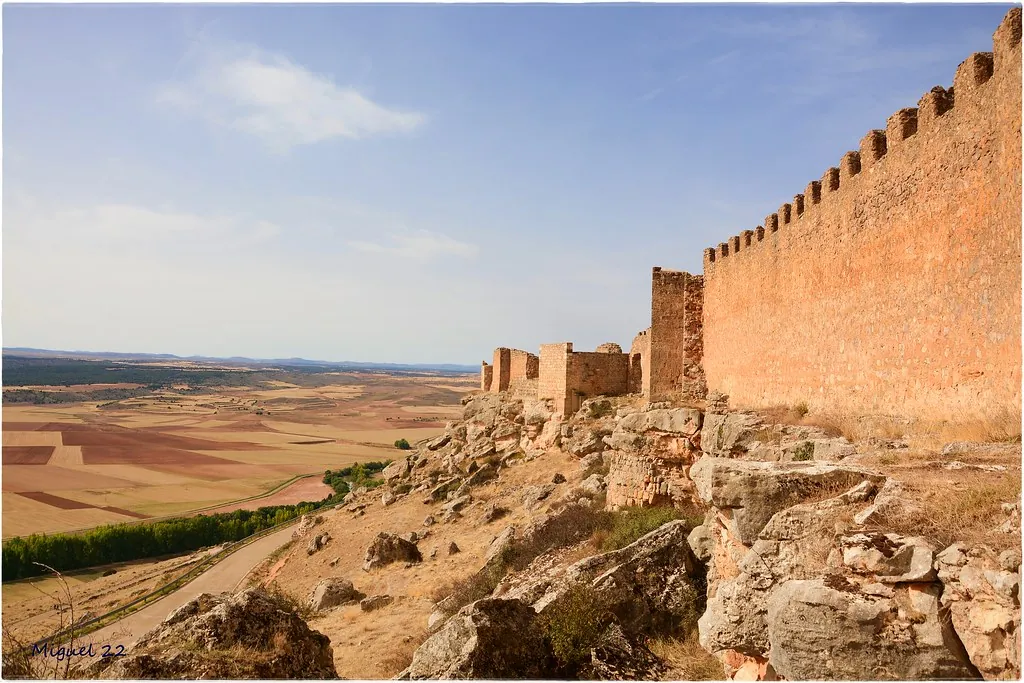
Known as the "City of Joy" (wineries) with Gormaz in the background
Hide article Read full article
Getting there and first impressions
Recuerda sits about 40 km from Soria, along the N‑122 in the direction of Valladolid. The approach is straightforward, with open country stretching out on either side of the road. On arrival, it is best to leave the car in the small parking space at the entrance to the village. The streets inside are narrow, and in places the surface is uneven, so driving further in is not especially practical.
This is a place that reveals itself quickly. There is no long list of sights to work through, and the layout is simple enough to understand at a glance.
A compact village centre
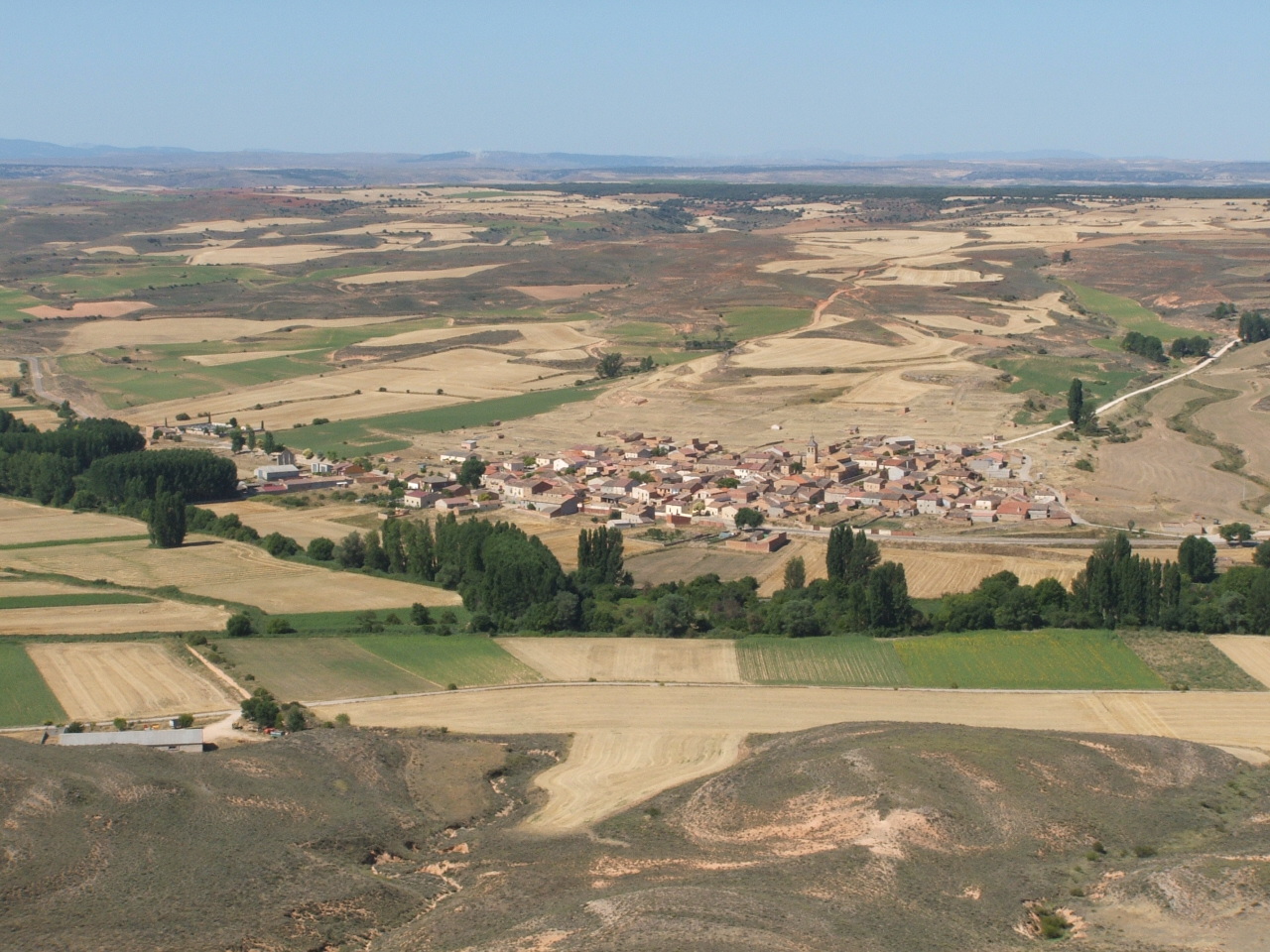
Once parked, everything can be covered on foot in just a few minutes. The houses cluster around a small square and along the street that leads up to the church of San Miguel.
This church is usually the only building that stands out at first glance. It is a simple stone structure, set at the end of the main street, and its construction is attributed to the 16th century. At times the door is open in the morning, though this is not guaranteed.
Beyond that, the village centre offers little in terms of standout landmarks. The streets are lined with stone and adobe houses, some bearing coats of arms on their façades. A number are still lived in, while others have been closed up for years, their doors and windows shut against time.
There is no sense of bustle here. Movement is minimal, and the space feels shaped by routine rather than by visitors.
How long to spend
Ten minutes is enough to walk through the core of Recuerda. From one end to the other, there is little distance to cover and few detours to take.
For most visitors, the reason to stop is not the village itself but what lies beyond it. If time allows, the visit often continues outwards, along the tracks that leave the settlement and cut through the surrounding land.
There are no marked routes or signposted trails. These are agricultural tracks, used by local residents and farm machinery, rather than paths designed for walking. Even so, they are accessible and easy to follow in a general sense, as long as expectations are kept simple.
The landscape around Recuerda
What surrounds Recuerda is open countryside. Fields of cereal crops stretch across gently rolling ground, broken only by the occasional pine tree. The landscape changes noticeably with the seasons, especially between spring and summer, when the cereal covers almost everything in sight.
Fences appear here and there, marking out areas for livestock, and there are a few isolated agricultural buildings scattered across the land. The horizon remains largely uninterrupted, with kilometres of open space and very few obstacles to block the view.
It is a setting defined by its simplicity. There are no viewpoints or built structures designed for taking in the scenery, just the natural lines of the terrain and the shifting colours of the fields.
For those interested in wildlife, the area can offer quiet moments of observation. Birds of prey are often seen circling above the crops. Closer to the ground, partridges or hares may appear near the tracks, particularly towards the end of the day. There is no infrastructure for this, no hides or marked observation points, only the chance encounters that come with being present.
Walking and cycling the tracks
Several tracks leave the village and connect either to nearby settlements or directly to cultivated plots. On a map, everything can appear close together, with distances that seem easy to cover.
In reality, the conditions make a difference. The sun can be strong, and the wind has a noticeable presence across the open land. Both can make even short distances feel longer than expected.
In summer, it is sensible to carry water and some form of sun protection, such as a hat. Shade is almost entirely absent once outside the village, and there are few places to pause out of direct exposure.
The terrain itself is not complicated, but the environment sets the pace. Walking or cycling here is less about reaching a specific point and more about moving through a wide, exposed space.
Eating, shopping and local life
Recuerda does not have bars, restaurants or shops open on a regular basis. Visitors should not expect to find services of that kind during a typical stop.
At certain times of the year, the social hall may open, or local gatherings may be organised. These are usually linked to village celebrations rather than ongoing activity.
The main celebration tends to take place around San Miguel, at the beginning of September. During these dates, many people who have family homes in the village return, and the population briefly increases. Outside of these moments, daily life remains quiet and limited in scale.
Before you go
Recuerda is a very small and very calm village. It does not offer monuments in the usual sense, nor organised activities or structured visits.
If passing through the area, it can serve as a short stop, a place to stretch your legs and look around before continuing on. Ten minutes is enough to understand its layout and character.
For those who enjoy walking in open countryside, it makes sense to stay a little longer and follow one of the tracks out into the surrounding fields. That is where the setting opens up, and where the visit takes on a different rhythm.
Everything here moves slowly. There is little to distract from that pace, and not much beyond it either.