Full Article
about Cillaperlata
Hide article Read full article
Early in the morning, when the sun is still slow to rise above the rock walls of the valley, Cillaperlata is almost completely silent. The River Ebro runs a few metres below the village, and now and then there is the solid thud of a wooden door. Tourism in Cillaperlata begins like this: a car edging along a narrow road, fields of cereal on either side and stony slopes that make it clear the river sets the rules here.
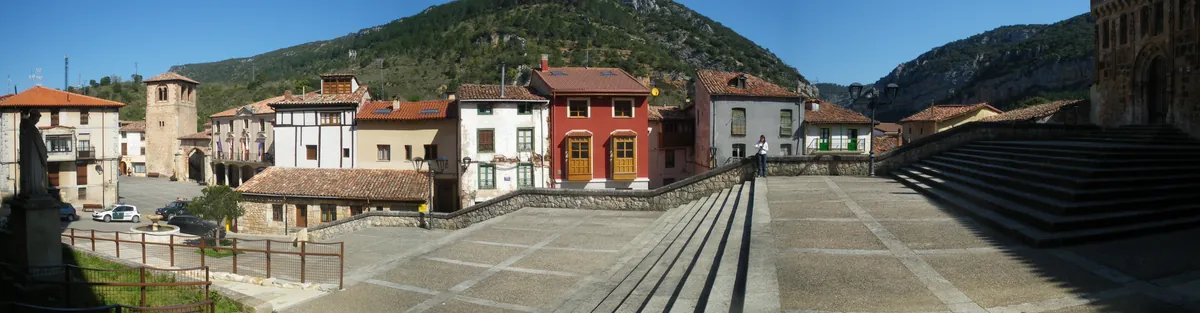
The village is small, with only a few dozen residents, and can be walked from end to end in minutes. Its streets are short and slightly irregular, with stretches of stone paving and others where the tarmac only just covers what came before. Many houses still have wide gateways once built for carts, and stone walls that shift in tone as the day moves on, grey in the morning, almost golden as the light drops.
There is no rush here. The scale of the place encourages you to slow down.
San Pedro and the Heart of the Village
At the centre of the cluster of houses stands the church of San Pedro. It is not monumental, yet its solid stone presence sets the rhythm of the square and the homes that lean in around it. The bell gable is visible from almost anywhere in the village, a simple landmark that ties everything together.
If the door is open, the interior holds that familiar mix found in many rural Spanish churches: cool stone and old wood. Light filters through small windows, so the space remains dim even at midday. It is one of those interiors where time seems to move differently, or at least more slowly.
There is barely any traffic around the church. The village is explored on foot. A short stroll is enough to pass from the square to the edge of open countryside.
Down to the River Ebro
A path leaves the village and slopes towards the Ebro. At first the descent is gentle, then the ground becomes rockier as it approaches the water. In this stretch the Ebro is neither especially wide nor slow. It runs between limestone walls and tight bends, with banks where low shrubs grow alongside small stands of poplars.
Standing still for a few minutes reveals more than first expected. Water strikes against stones, wind moves through scrub, and a bird cuts across the valley. On these slopes it is common to see small birds of prey riding the air currents that rise from the rock faces.
After heavy rain the ground can be slippery, so footwear with a decent sole is advisable. The route is not presented as a formal trail with detailed signposting. It is simply the way locals have reached the river for years.
Down by the water, the sense of enclosure becomes clearer. The valley tightens between pale rock walls, and the river follows its own curves without hurry.
Paths Through the Valley Landscape
The area around Cillaperlata is crossed by agricultural tracks and footpaths that follow the course of the river or climb towards the nearby high plains, known locally as páramos. These are not designed as carefully marked walking routes. They are working paths that have been maintained over time because they are useful.
From some higher points there are views over the Ebro valley, hemmed in by light-coloured rock. On clear days the late afternoon sun arrives from the side and emphasises the folds and ridges of the terrain. The shapes of the land become sharper, shadows longer, and the contrast between cultivated fields and rough slopes more defined.
Those who want a little more movement or a change of pace will find larger villages and more services a few kilometres away, such as Frías, Oña or Trespaderne. Many travellers combine a visit to one of these places with a quieter stop in Cillaperlata by the river. The contrast works well: busier historic centres on one side, a small riverside settlement on the other.
Back in Cillaperlata itself, the scale remains modest. The roads are narrow and the usual approach is to leave the car at the entrance and continue on foot. Within minutes, the built-up area gives way to open views and the sound of water below.
Food in This Part of Burgos
In this part of the province of Burgos, cooking is still closely tied to the countryside. In nearby villages it is common to find substantial dishes based on stewed pulses, roast meats, and cured sausages prepared in winter during the matanza, the traditional pig slaughter that supplies families with preserved meat for months. These are straightforward recipes built around the pot and the oven, designed to sustain long working days.
Cillaperlata itself does not have a defined dining scene. The usual option, if eating out is the aim, is to head to one of the surrounding towns. The focus in the village remains on daily life rather than hospitality infrastructure.
When to Come and What to Bear in Mind
The valley can become hot in summer once the sun climbs high, as the rock walls retain warmth. For those planning to walk along the paths, it is generally more comfortable to set out early or wait until later in the afternoon when the light softens and the heat eases.
Because the village is small and the streets are narrow, moving around on foot is the norm. Traffic is minimal, and the overall pace is unhurried.
On calm days, outside particularly busy weekends in the wider region, Cillaperlata offers something that is increasingly difficult to find: time. The sound of the river, a conversation drifting from an open window, wind stirring the leaves of the poplars. Little else intrudes.
It is a place defined less by sights to tick off and more by atmosphere. The Ebro flows below, the church of San Pedro anchors the centre, and the valley walls hold everything in place. For some travellers, that simplicity is precisely the point.