Full Article
about Aldea Real
A farming village with rural charm; it preserves examples of folk architecture and a church visible from afar.
Ocultar artículo Leer artículo completo
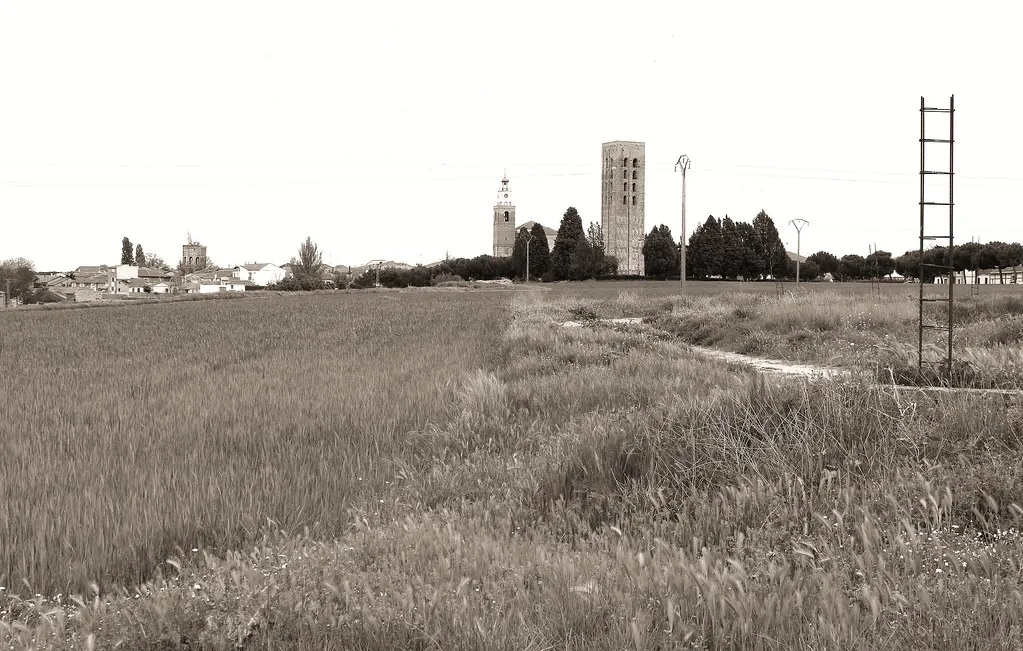
Eight hundred and eighty metres above sea level, the air thins just enough to make the sky feel closer. From the edge of Aldea Real, cereal fields drop away in every direction, their colours shifting from straw-yellow in July to a muted pewter-green in November. The village itself sits on a gentle rise, a single church tower marking the highest point, its bell tolling the hours for 275 residents and whoever happens to be passing through.
This is Castilla’s campiña at its most honest: no honey-coloured stone villages clinging to cliffs, no dramatic gorges, just an ocean of earth and sky. The roads leading in are straight enough to see tomorrow’s weather; when the wind picks up, the wheat bends like a single creature turning its back. Visitors arriving from Segovia—45 minutes south on the A-601 then the CL-601—often remark that the last ten kilometres feel longer than the previous hundred. Mobile signal flickers, hedgerows disappear, and the horizon widens until it feels almost intrusive.
What passes for a centre
Aldea Real has no plaza mayor in the postcard sense. Instead, a triangle of cracked concrete in front of the church acts as car park, playground and meeting point. The bar, Casa Galo, opens at seven for field workers and closes when the last customer leaves; coffee is €1.20, caña 80 cents, and the tortilla is sliced straight from the pan still warm. There are no menus in English, no Wi-Fi password written on a chalkboard, and no one will offer to explain the difference between a pincho and a tapa because no one expects you to ask.
The church itself, dedicated to San Juan Bautista, is fifteenth-century at its core but owes its current sober dress to repairs carried out after lightning struck the tower in 1886. Inside, a single Baroque retable survives, gilded wood dimmed by incense and dust. The side door is usually unlocked for an hour after mass on Sunday; at other times you may have to fetch the key from the house opposite, where Doña Feli will insist on accompanying you to switch on the lights, narrating who paid for which chapel in a Spanish that even intermediate speakers can follow if they nod in the right places.
Radiating from this modest ecclesiastical hub are three streets and a handful of alleys lined with adobe and brick houses. Walls are thick, windows small, roofs of curved terracotta tile weighted down with stones against the wind. Many homes still keep the traditional wooden door-within-a-door: the full height for livestock, the smaller cut-out for people. Paint colours are regulated by the municipality—whites, ochres, the occasional muted green—so the overall effect is uniform without being twee. Satellite dishes sprout like grey mushrooms, the only obvious concession to the twenty-first century.
Walking the sky
The real reason to come is outside the village. At sunrise the fields glow rose-gold and the only sounds are larks and the creak of a distant gate. A network of unmarked caminos vecinal connects Aldea Real to its neighbours: Cantalejo lies 7 km west, Fuentepelayo 5 km south. The tracks are wide enough for a tractor, so navigation is simple: keep the tower behind you and pick any path that heads for the skyline. Stout shoes are advisable; after rain the clay sticks like wet concrete and in July the surface hardens into ankle-turning ridges.
Spring brings calandra larks, little bustards and the occasional stone curlew, while autumn skies fill with cranes heading for Extremadura. There are no hides, no interpretation boards, just the birds and whoever bothers to raise binoculars. Mid-summer is less forgiving: temperatures regularly top 35 °C and shade is theoretical. Setting out before eight is sensible; by eleven the heat shimmers like glass and the only movement is a dust-devil spinning across stubble.
For something more structured, the signed PR-SG variant that loops north-east toward the abandoned hamlet of El Molar adds 12 km and 250 m of ascent through almond groves and pine shelterbelts. It starts opposite the cemetery—look for the yellow-and-white blaze on a telegraph pole. Halfway round, the ruins of a nineteenth-century lime kiln provide a windbreak just wide enough for lunch, though you will share it with lizards and the smell of wild thyme crushed under rucksacks.
Eating (and sleeping) on farm time
Accommodation within the village is limited. Casa Rural El Campillo has three doubles (from €65, including breakfast served at the time you request, which usually means whenever you drag yourself out of bed). The owners, Pepi and Manolo, retired from barley farming five years ago and treat guests like distant relatives: fresh oranges appear on the kitchen table, and Manolo will draw maps in biro on the back of seed-catalogue envelopes. There is no reception desk; ring the bell and wait, someone will emerge wiping hands on an apron.
Evening meals require forward planning. Casa Galo will serve cordero asado if you order before noon—half a suckling lamb feeds four, costs €18 per person and needs three hours in the wood-fired oven. Otherwise, expect migas (fried breadcrumbs with garlic and chorizo) or judiones de La Granja, the local butter bean stew thick enough to stand a spoon in. Vegetarians can usually negotiate an omelette stuffed with seasonal spinach or wild mushrooms, but the concept of vegan cheese has not yet arrived. Kitchens close at ten sharp; after that the only option is the vending machine at the petrol station on the main road, 4 km away.
Winter silence, summer exodus
January and February transform the plateau into a monochrome study. Daytime highs struggle past 5 °C, mist pools in the hollows and the fields turn to iron. The village feels half shut: metal shutters stay down, chimneys exhale a constant ribbon of almond-wood smoke, and the sole bakery reduces its hours to three mornings a week. Yet the light is extraordinary—low, slanted, silver—and the tracks empty enough to hear your own heartbeat. Bring boots with grip; when the ground freezes, ruts solidify into ankle-breakers.
Conversely, August empties Aldea Real of locals. Families head for the coast, leaving mostly retirees and the bar owner who doubles as stand-in mayor. Afternoons are siesta-shut, evenings stretch past midnight, and the fields smell of warm resin and distant pig farms. Water supplies can falter; the village relies on a borehole 300 m deep, and during prolonged droughts the council issues timed cuts. Visitors filling camper-van tanks are politely but firmly redirected to the public fountain in Cantalejo.
Getting there, getting away
No railway comes closer than Segovia’s AVE station, 55 km distant. Car hire is therefore essential; allow €40 a day from the city-centre offices. The final approach involves five kilometres on the CL-601, a road so straight locals use it as a wind gauge; when poplars bend, tractors stay parked. Buses run twice weekly—Tuesday and Friday—from Segovia’s Estación de Autobuses, departing at 14:15 and returning at 06:30 next day. The timetable is optimised for medical appointments, not tourism, but it is possible if you enjoy early rises and have a tolerance for diesel fumes and accordion music from the driver’s radio.
When the time comes to leave, the horizon that once felt liberating can suddenly look monotonous. The advantage of such unobstructed views is that you can watch your departure long before the village disappears: first the church tower shrinks to a pin, then the whole settlement flattens into a dark smudge between earth and sky. By the time you reach the first roundabout, Aldea Real has reverted to the map—a name you will probably have to spell for anyone who asks where you spent the weekend.